Posted in General

To Mark Or Not To Mark (My Contrarian Bible-Marking Philosophy)

By Weylan Deaver

You might think a preacher marks up his Bible more than anyone else with highlights, underlining, references, definitions, etc. I used to be of that mindset. I thought it ideal, for example, if I were teaching a class on Matthew, if I could just open my Bible and have all my study notes in microscopic print in the margin. That way, no additional notes or notebook would be necessary to teach the class; I could carry my Bible and nothing more (how marvelously simple!). Over time, my Bible-marking ways evolved into anti-marking. I didn’t just decide to mark less in my Bible; I ceased it altogether (writing on the blank pages in back of the Bible doesn’t count). You may feel free to differ. But, here is my reasoning.

First, margin notes are not easily transferred. Any continuously used Bible will wear out and, no matter how precious your handwritten margin notes, the day will come when you have to replace your Bible. Transferring notes then becomes a daunting or even impossible task, depending on their copiousness (not to mention legibility).

Second, writing in your Bible is a constant battle against the margin (usually a small margin). Bibles I tend to favor are diminutive in size. I don’t want lengthy book introductions, extensive outlines, commentator’s notes across half the page, archaeological supplements, or a hefty concordance in the back. All of that makes for extra pages I have to carry around. If I need a concordance, I’ve got a better one on my bookshelf and even online than one in the back of a study Bible. All I need in a Bible are a few maps (optional), some handy cross-references (if a study Bible), and footnotes (esp. translator’s textual notes). In other words, I want a Bible that fits my hand—not a backpack—and that usually means one with small margins which are not conducive to handwritten notes.

Third, marking your Bible brings the danger of impairing the readability of the back side of the page. Without just the right kind of pen, handwritten notes tend to bleed through thin Bible paper. There are colored pencil options, but I believe in ink (pencils are for elementary school). So, your eloquent comments regarding Matthew 6:33 (on page 7) end up bleeding through to page 8 and making the “Golden Rule” (Matthew 7:12) unreadable. Not good.

Fourth, margin notes anchor you in yesterday’s level of understanding. I’m not going to teach a Bible book exactly the same next time around. My understanding grows with time and learning. Points I may have highlighted years ago may be superceded by more apropos material now that I know more. But, where am I going to put additional notes from further fruitful study if my margins are already full from what I wrote ten years ago? Maybe my first tour through the book was mediocre and now I’ve got a Bible full of mediocre notes that leave no room for more meaty reminders. Maybe, instead of margin notes, you underline verses, but, over time, discover that you wish you had not underlined a verse (like Genesis 1:1). When I was about twelve, my grandfather gave me an expensive Dickson Analytical Study Bible. It had a moroccan leather cover and more study helps than you could shake a stick at. Were I still using that, you can believe that the underlinings (etc.) I put in it back then are not what I would have put today.

Fifth, Bible-marking creates the risk of missing something important. To me, this is the weightiest reason of all. If you underline a verse (or highlight it in a color, or notate the margin), then your eye is drawn to that verse every time you open the Bible to that page, right? It’s as though we’re saying that verse is super-important, as opposed to the rest of the verses on the page, which are not important enough to merit highlighting. With the subconscious emphasis drawn to the highlighted verse, what becomes of my ability to notice the verses right before, or after, the highlighted verse? What if I unintentionally treat the highlighted verse in the second column as more significant than anything in the first column? When I look at a Bible page, I want it to contain God’s words instead of my own, for my own may serve to detract from my ability to fully appreciate God’s.

Now, as the saying goes, your mileage may vary. You may benefit greatly from marking up your Bible. If so, more power to you. There’s nothing wrong, either way. These are simply my own opinions, and I’ve never seen anyone enumerate the view I’ve grown to adopt.
Posted in Doctrine

Find the Right One

By Weylan Deaver


An encyclopedia of religions lists over 2,600 faith groups in America and Canada. That staggering figure is in stark contrast to Jesus’ promise that “on this rock I will build my church” (Matthew 16:18). Most who call themselves “Christian” see no problem with thousands of different churches with differing doctrines, as though God were pleased with this arrangement. In fact, many see such diversity as a boon because they think it gives everyone opportunity to look for a church that “fits” them. The number of denominations keeps growing. The world keeps turning. The clock keeps ticking. God’s patience keeps lasting—for now.

All the while, the right church is the one found in the Bible, and not simply one found in a phone book, or with an internet search. Jesus is “the head of the body, the church” (Colossians 1:18). So the church is described, metaphorically, as Jesus’ body. Just how many bodies (churches) are there supposed to be? The apostle Paul wrote “there is one body” and that Jesus is the savior of that body (cf. Ephesians 4:4; 5:23). All who want to be saved eternally must be in the spiritual body of Jesus, which is the church of Christ.

Think about it. If there is only one church that Jesus promised (Matthew 16:18) and then purchased with his own blood (Acts 20:28), then every church which is not that church is a wrong church. But, how can anyone tell which church is right? Again, God’s plan is so simple. He wrote a guide for us called the New Testament. When a person obeys what that gospel teaches, he is a Christian. When a group of people in the same location all obey that book, you have a congregation of the church. Which church? God’s church. To find the genuine article, study your New Testament for the earmarks of the church when it first began, then find who is practicing the same now. The New Testament has not changed.

But beware. Satan is a subtle deceiver, making the multitudes content with churches that depart in countless ways from the original blueprint. Yet, Jesus says, “Every plant which my heavenly Father planted not, shall be rooted up” (Matthew 15:13). We in the church of Christ lovingly invite you to investigate us. Put our beliefs under a microscope. Shine a spotlight on our teaching. Check our practice against the words of the apostles. Ask hard questions. Think deeply. Dig until the truth is uncovered. It could very well mean you have to leave the church you are in. If so, pay that price. Eternity hangs in the balance. And one church—the Lord’s true church—outweighs every other. Find it.


Posted in Announcements

Site Improvements and a Great New Feature

Dear Readers,

If you’ve not been to the site in a while, please come see what is happening. Annoying ads (over which we had no control) are now gone. Recent articles can be found by simply scrolling down the page instead of having to dig through the archives. We are very pleased to announce a brand new feature. There is now a page tab labeled “Audio.” Clicking on that takes you to our new page where audio sermons will be posted. Particularly, we plan to publish Mac Deaver’s sermons, as preached at the church of Christ in Sheffield, Texas. His two lessons from March 30 are already up on “Why Naaman Got So Mad.” Give them a listen, and check back weekly for new sermons being posted. Help us spread the word and, if you like a page or an article, please go ahead and “like” it on Facebook, Pinterest, Twitter, etc. Encourage your friends to subscribe to the site, and they will receive an email every time a new article is posted. Thanks much!

Posted in Apologetics, Books, Reviews

God’s Undertaker (Book Review)

By Weylan Deaver

Richard Dawkins, irascible critic of the Creator, says “I am utterly fed up with the respect we have been brainwashed into bestowing upon religion” (p. 8). He would like nothing better than to banish theism and religion to the ash heap of historically bad ideas. But, has science buried God? That question is the subtitle of God’s Undertaker, a Lion Hudson book penned by John C. Lennox. With three doctorates, Lennox is a mathematics professor at Oxford and a philosopher of science at Green Templeton College. His twelve chapters are a volley of withering fire against pseudo-science masquerading as the real thing.

Is a Dawkins an atheist because of the evidence, or because of a worldview, not founded on science, which he carries with him to the microscope? Lennox’s thesis is that real science actually points toward an intelligent Designer. That some scientists are so vehemently opposed to God speaks more to their unscientific prejudice and presuppositions than it says about God. The degree of atheistic animosity toward theism is itself a curiosity to Lennox, begging investigation why, if God were fiction, anyone should hate Him so. Lennox gives the much needed reminders that “Statements by scientists are not necessarily statements of science” (p. 19) and “you cannot deduce a worldview from a science” (p. 121). Worldviews are not mixed in a test tube; they originate outside science, but end up influencing the conclusions of scientists.

Lennox claims the biblical worldview, grounded in the ancient Hebrews’ concept of a single, omnipotent Creator has done more to advance science than any contribution from the ancient Greeks. Far from stopping scientific investigation, it was belief in an orderly universe created by God which initially propelled the discipline. Theism gave science its beginning; atheism gives science a black eye.

Lennox takes evolutionary theory to task, pointing out there is an “edge to evolution,” beyond which it cannot go. This is why small changes within species are observed (i.e. microevolution), but evolution across species (macroevolution) has never been observed, much less duplicated by science. Gaps in the fossil record tell an embarrassing tale too often buried as science’s dirty secret.

Further, as science is able to see increasingly on a microscopic level, it is becoming more difficult to argue against design in the universe. Lennox discusses the marvel of DNA from a scientific and mathematic perspective, adding up facts that make it impossible for life to have arisen on the basis of mindless chance. And, as information theory begins to blossom, he draws a striking point on the biblical teaching that, prior to the incarnation, Jesus existed as the “Word” of God. Information is real, but not physical. And there is nothing anti-science in recognizing divinely-put information in a cell, which gives design to an organism (especially when evidence points to the impossibility of its being undesigned).

Rejecting the popular concept that faith is not evidence-based, Lennox gives a cutting edge, refresher course on why we need not bow to brash scientists who overreach into metaphysics and stake claims far too weighty for science to bear. The last chapter is a devastating critique of David Hume, the 18th century Scottish philosopher who did much to destroy belief in biblical miracles.

Lennox is an engaging writer, pulling the rug from under atheism with true British courtesy. But his kindness does not disguise the tatters in which he leaves materialism. His final two sentences are worth the book’s price: “Either human intelligence ultimately owes its origin to mindless matter; or there is a Creator. It is strange that some people claim that it is their intelligence that leads them to prefer the first to the second” (p. 210).

[This review was originally published in the April 2011 issue of Sufficient Evidence (pp. 56-58), the journal of the Warren Christian Apologetics Center.]

Posted in Baptism, Doctrine, Marriage

What About Divorce and Remarriage Before Baptism?

By Weylan Deaver

It goes without saying our society has put a chasm between itself and Bible teaching on marriage and the family. Divorce is pandemic, and often followed by second or third marriages entered without any regard for what Jesus taught on the subject (e.g. Matt. 19:3-10, etc.). The pressure exerted by Satan on the church can be tremendous. The devil would like nothing better than to get Christians to compromise the gospel without realizing that is what’s happening. While the devil tempts us to fold up, God tests us to hold out and lift high the banner of divine truth—even if most turn a deaf ear (2 Tim. 4:1-4). While the world runs rampant in sin, the church is trying to reach out to save some souls. This leads to inevitable contact with couples in a second, third, or fourth marriage who may want to become Christians. There are two basic approaches to such a scenario.

The first approach says that Jesus’ teaching on divorce and remarriage (cf. Matt. 19:9; Mark 10:11-12; Luke 16:18; 1 Cor. 7:10-11) applies to everybody—Christian and unbeliever alike. Jesus’ gospel is for those in the church, as well as those outside of it, and the same commands, truths, and principles apply to all. Therefore, if a couple finds themselves in a marriage out of harmony with what Jesus taught, repentance demands they cease their unscriptural marital relationship. Put simply, they must get out of the marriage. Dissolving a sinful marriage is easier said than done, and may incur a plethora of difficulties, but the question needs asking, “How badly do I want to go to heaven?” Remember Jesus remarked, “there are eunuchs who have made themselves eunuchs for the sake of the kingdom of heaven” (Matt. 19:12, ESV). Tragically, most are not willing to do whatever it takes to be saved.

The second approach says that God has separate requirements for Christians, which the world is not expected to obey, and that Jesus’ teaching on divorce fits in this category. In other words, when Jesus said, “whoever divorces his wife, except for sexual immorality, and marries another, commits adultery” (Matt. 19:9), he was teaching something unbelievers were never obligated to listen to. Therefore, unbelievers are free to marry, divorce, remarry, divorce, and remarry again (ad infinitum) and, if they ever decide to become Christians, they can be baptized and keep whatever spouse they have at that time. Only after baptism do they become accountable to Jesus’ teaching, and they are expected to obey it from then on.

We believe this second view is fraught with error (not least of which is that Jesus’ original comments in Matthew 19 were directed to unbelieving Pharisees, not Christians). Consider but two brief arguments showing the second view to be wrong.

Argument #1

The combination of two simple verses should conclusively settle the matter. “And I say to you: whoever divorces his wife, except for sexual immorality, and marries another, commits adultery” (Matt. 19:9). Those words were initially spoken to unbelieving Jews (should they have replied, “Jesus, we’re sure glad you’re not talking to us!”?). Whatever else the New Testament says about divorce does not contradict what Jesus here plainly taught. All Scripture harmonizes with itself. Here is the second passage: “The one who rejects me and does not receive my words has a judge; the word that I have spoken will judge him on the last day” (John 12:48). Notice Jesus’ words are specifically said to be what judges those who refuse to receive them. What will judge the unbeliever? Jesus’ words will. And, Jesus’ words include what he taught about divorce! Put in logical form, the argument reads:

  • All unbelievers alive today are people who will be judged by Jesus’ words (John 12:48).
  • The words of Matthew 19:9 are Jesus’ words.
  • Therefore, all unbelievers alive today are people who will be judged by the words of Matthew 19:9.

Any Christian or church that believes pre-baptism marriages can be washed away, or that a pre-baptism unscriptural marriage can be turned into holy matrimony by baptism, has got to ignore this argument, or else try to falsify it. Yet, we see no way it can be successfully disproven.

Argument #2

Any position which implies an untruth is itself a false position. God is the God of all truth, and truth is consistent with itself. No Bible teaching implies error. No error can be proven by the Bible. And, any position implying an unbiblical conclusion cannot be true and should be abandoned.

The view that unbelievers are not accountable to Matthew 19:9 (etc.) implies error. How? Suppose Mike (a Christian) marries Jane (also a Christian). All sides agree Mike and Jane are bound to abide by Matthew 19:9 (since both are Christians). Suppose that Jane divorces Mike because he is too much into sports. All would agree that this divorce is not authorized by Matthew 19:9, and is contrary to what Jesus there taught. Now suppose that Jane marries Bill (an unbeliever). What would Jane and Bill’s relationship be? On Jane’s side, she is a Christian who had no right to divorce her first husband, and thus, had no right to marry Bill. Per Jesus’ teaching, she is now in adultery. But what about Bill? Those who insist that Matthew 19:9 does not apply to Bill (an unbeliever) must say one of two things. Either (1) Bill is in a God-sanctioned marriage to Jane, or (2) Bill is not in a God-sanctioned marriage to Jane.

If (1) Bill is in a God-sanctioned marriage to Jane, then that would imply that Matthew 19:9 does not even apply to the believer (Jane), in which case Jesus’ teaching on divorce applies to no one today. Any position which implies Jesus’ teaching on divorce is not applicable to anybody is a false position.

If (2) Bill is not in a God-sanctioned marriage to Jane, then what is it that would make Bill’s marriage wrong, since Bill’s marital status is allegedly not dependent on being in harmony with Matthew 19:9? If it is true that unbelievers are not under Jesus’ teaching, then no one can appeal to Jesus’ teaching to either justify or condemn an unbeliever’s marriage. If Bill and Jane’s marriage is adulterous, then Bill (an unbeliever) must be amenable to Matthew 19:9. But, if Bill and Jane’s marriage is not adulterous, then Jane (a believer) must not be amenable to Matthew 19:9. Either way, the belief under review runs aground, smashed on the rocks of inconsistency. That which implies error is itself error.

“What therefore God has joined together, let not man separate” (Matt. 19:6). A marriage is real only if God does the joining, and a divorce is actual only if God does the separating, and God joins and disjoins only according to his will, which is revealed as the New Testament! Does God join Bill to Jane (since he is an unbeliever), but not join Jane to Bill (since she is a believer out of harmony with Jesus’ teaching)? Are we to believe that Bill and Jane’s relationship is half adultery (i.e. on Jane’s part) and half holy matrimony (i.e. on Bill’s part)? Scripture knows nothing of such a hybrid marriage monstrosity. Every marriage is either adulterous or non-adulterous; there is no half-and-half. We can state a formal argument thus:

  • Any doctrine implying that a marriage can be simultaneously adulterous and non-adulterous is a false doctrine.
  • The view that unbelievers are not under Matthew 19:9 (etc.) is a doctrine implying that a marriage can be simultaneously adulterous and non-adulterous (see above).
  • Therefore, the view that unbelievers are not under Matthew 19:9 (etc.) is a false doctrine.

Far more can be said on the issue, but if the view under consideration can be falsified by one or both of the above arguments, then that is sufficient. A doctrine need not be disproven from multiple angles before we give it up. All it takes is one sound argument. And, if there is a single sound argument proving that a position is wrong, then the position is wrong, no matter what else may be marshaled in its defense. There seem to be far too many congregations who think Jesus’ teaching (at least on divorce) does not apply to people until after conversion. Yet, we have shown that to be error. If society had not drifted so far away from biblical teaching, the church might not be divided on this issue. But society has drifted. And the devil wants to take the church along with it. If we believe John 12:48, then we must believe that Matthew 19:9 will judge the unbeliever. It is that simple. If we do not believe Matthew 19:9 will judge the unbeliever, then we trample John 12:48. What will it be? “Let marriage be held in honor among all, and let the marriage bed be undefiled, for God will judge the sexually immoral and adulterous” (Heb. 13:4).

Posted in Apologetics, Old Testament

Which Way the Shadow?

By Weylan Deaver

Hezekiah, king of Judah 700 years before the birth of Christ, received one day a most distressing message from Isaiah the prophet (2 Kings 20:1-11). The king had become deathly ill and the Lord sent his prophet to inform Hezekiah that he needed to make ready because death was imminent. Hearing that, the king wept bitterly and prayed to the Lord for mercy, speaking to God of the faithful life he had lived. God heard the prayer and saw the tears and sent Isaiah back to Hezekiah with news that the king would be healed, another fifteen years being added to his life.

The king then asked Isaiah what sign God would give to prove he would, indeed, be healed. God, through Isaiah, gave Hezekiah a choice, letting him pick his own sign from Heaven. Hezekiah could choose either that the shadow went forward ten steps, or that the shadow went backward ten steps on the sundial of Ahaz. In an age before clocks, this was a means of keeping time. The normal event was for the shadow to move forward as the day progressed. An obvious miracle would be required to move the shadow backward ten steps, and Hezekiah chose this for his sign (noting that this would be the more difficult of the two choices). In other words, God’s causing the shadow to move backward would give the appearance of time moving in reverse. Isaiah then prayed to God and the requested sign was given.

In reading this account, we usually focus on the miraculous nature of the second option—the sign that Hezekiah chose. But, have you ever considered that the first option would have been just as much an act of God as the second? As a day wears thin and shadows lengthen, it is, after all, God who controls the process. True, time moving in reverse would be a miracle. But, when time moves methodically forward, day in and day out, how many of us chalk it up to “Mother Nature”? In fact, there is no such thing as “Mother Nature.” Nor is nature itself either controlling events or propelling itself forward. Those ideas rob the true force—God—of glory he is due. Rather, the biblical concept is that God is running things, and very much so. Specifically, every element in the universe is currently being held together by none other than Christ himself (Colossians 1:17).

We may fail to recognize the Lord’s power in a raindrop on the cheek, blooming flowers in spring, the hoot of an owl, the tick of a clock, the cool of a breeze, or an evening shadow. But that is only because we are not looking at things through biblical lenses. Which way the shadow? In point of fact, either way a shadow moves is proof enough that God moves it. The shadow moving backward was a clear sign to Hezekiah’s eyes. But let us not forget that the shadow moving forward should be no less the working of God in our eyes today. What we perceive as “nature” is really the continuous product of divine supernatural activity, sustaining the world till the time God has chosen to bring all things to an end. In the meantime, perhaps we should sing with greater reflection the lyrics of Maltbie Babcock—

This is my Father’s world, the birds their carols raise,
The morning light, the lily white, declare their Maker’s praise.
This is my Father’s world: He shines in all that’s fair;
In the rustling grass I hear Him pass;
He speaks to me everywhere.

Posted in Restoration History

An Incredible Tale of Influence

By Weylan Deaver

One man can have lasting effect on multitudes, even after death. Nicholas Brodie Hardeman was a premier preacher, debater and educator in the first half of the twentieth century. In Nashville’s Ryman Auditorium, he preached the gospel to multiplied thousands, the sermons from which can still be read. He debated truth’s cause, to great effect, with prominent digressives and denominational preachers. He trained preachers in a college named for him. My grandfather, Roy C. Deaver, studied at Freed-Hardeman College in the 1940’s and, after graduating, stayed an extra year to study Hardeman. A half-century later, I would graduate from Freed-Hardeman University. What becomes monumental with time can begin with a modest tale of Christian influence, and Earl West relates just such a remarkable story (Search for the Ancient Order, vol. 4, pp. 155-156).

In 1890 an Alabama preacher named J. A. Minton goes to Milledgeville, Tennessee. His preaching career is young at the time (West describes him as “one of those relatively obscure preachers who just floated around burdened with the desire to preach the gospel, save souls, and establish congregations”). Minton begins preaching in an empty store. He meets the town’s wealthy physician, who subscribes to no religion, and is certainly not a Christian. With Minton’s effort, the doctor learns the gospel. Minton baptizes him into Christ, along with several of his family. The doctor’s name is J. B. Hardeman, who has a sixteen-year old son, Nicholas Brodie, who, thanks to Minton’s converting his family, will, himself, obey the gospel that fall when he enrolls at West Tennessee Christian College (being baptized by a professor, R. P. Meeks). N. B. Hardeman grows into a great Bible student, holding rapt attention with a gentleman’s presence, a scholar’s demeanor, and a polished orator’s style in presenting heaven’s simple message that had saved his father, Dr. Hardeman, back in Milledgeville.

But all contact between Hardeman and Minton is lost. Minton, whose work had brought the Hardemans to Christ, moves west, where he acquires land and meets financial success. He buys a hotel in Sayre, Oklahoma, the town where he preaches. Sadly, as division within the Lord’s body wreaks havoc, Minton sides with the Christian Church (which embraced unauthorized practice, such as instrumental music in worship).

In June 1948 Hardeman travels to Sayre to preach a meeting. He stays in the hotel owned by Minton and the two get reacquainted. It has been fifty-eight years since Minton visited a small Tennessee town and taught the gospel to Hardeman’s father. The now-aged preachers reminisce on times long past. In 1890 Hardeman was sixteen and not even a Christian. Minton was already preaching. In 1948 Hardeman is a college president training future preachers, and has a storied career in the kingdom. His influence has eclipsed Minton, who has cast his lot with the digressives Hardeman so strongly opposes. Then again, would any of Hardeman’s success have happened had Minton, as a young roving preacher, not stopped in Milledgeville and begun teaching in an empty store over half a century earlier?

Minton listens to Hardeman’s preaching in Sayre and concludes, “I have heard many of our best preachers from time to time, but I am compelled to say I have never heard a preacher superior in ability to N. B. Hardeman.” After his short stay in Sayre in Minton’s hotel, Hardeman leaves. However, within months he receives a letter from Minton with good news the latter has “left the Christian Church and now belonged to the church of Christ.” J. A. Minton had helped save N. B. Hardeman’s soul. And Hardeman had now returned the favor.

Posted in Books, Reviews

Book Review: The Bible Only Makes Christians Only and the Only Christians

By Weylan Deaver

[Editor’s note: This review originally appeared in the October 2012 issue of Sufficient Evidence, the journal of the Warren Christian Apologetics Center].

The Bible Only Makes Christians Only and the Only Christians. By Thomas B. Warren. Glasgow, KY: National Christian Press, 1986. 217 pp.

Thomas B. Warren was a premier Christian philosopher of the twentieth century, and his influence in apologetics is still felt. More than a theologian and philosopher, he was a gospel preacher. And what happened when he turned his logician’s mind to the subject of the church was a book titled The Bible Only Makes Christians Only and the Only Christians.

In this case, the title really does say it all, and serves as the book’s central thesis. Its focus is neither the existence of God, nor the deity of Christ, but, rather, an all-out defense of the uniqueness of the Lord’s church. It is an honor to review, in part because my grandfather, Roy C. Deaver, is one of the preachers to whom the book is dedicated.

As an accomplished debater, Warren knew the power of precision. His terms and propositions are sharply defined. His arguments are cogent and unambiguous. With a rare combination of facts, force and feeling, Warren demonstrates concern for souls while marshaling the muscle of Scripture to wield his thesis with the subtlety of a sledge-hammer. Those used to hearing anemic religious claims may be shocked at his vigorous writing, ignited by his understanding of just how high the stakes are: Every reader will spend eternity in heaven or hell, based on his relationship to the church of the New Testament. Warren wrote to win souls, not to entertain.

The book is composed of eleven parts which are divided into thirty-seven brief chapters. It ranges over epistemology, ecclesiology and soteriology. Firing both barrels at the denominational concept of the church, Warren leaves it unable to give more than a dying gasp. With an arsenal of logic and hermeneutics, he operates as a biblical surgeon, severing denominational from divine doctrine, cutting away the cancer of religious creeds, exposing the healthy tissue of a body nourished by Jesus’ blood because it is governed by naught but the simple New Testament.

Warren did not intend his thesis be refuted, and this affects the style with which he wrote. His arguments and analysis benefit from verbal precision, repetition, and the inclusion of numerous Scripture citations. Those same qualities can also be tedious (chapter 35 repeats much of chapter 26), but, in this case, with Warren treating a topic so vital to us all, we affirm unhesitatingly that the tedium is worth the trouble. This is not light reading before bedtime. Nor is it for the spiritually spineless who cannot abide the staunch claims of Scripture. But, for the reader truly interested in discovering or defending the church about which the apostles preached, then this book is a veritable tour de force on the composition and uncompromising stance of the church of Christ. Those who agree with Warren will applaud his contribution. Those who disagree will find precious little with which to defend themselves against the relentless case he builds. None will have difficulty seeing exactly where he stands.

Posted in Announcements, Books

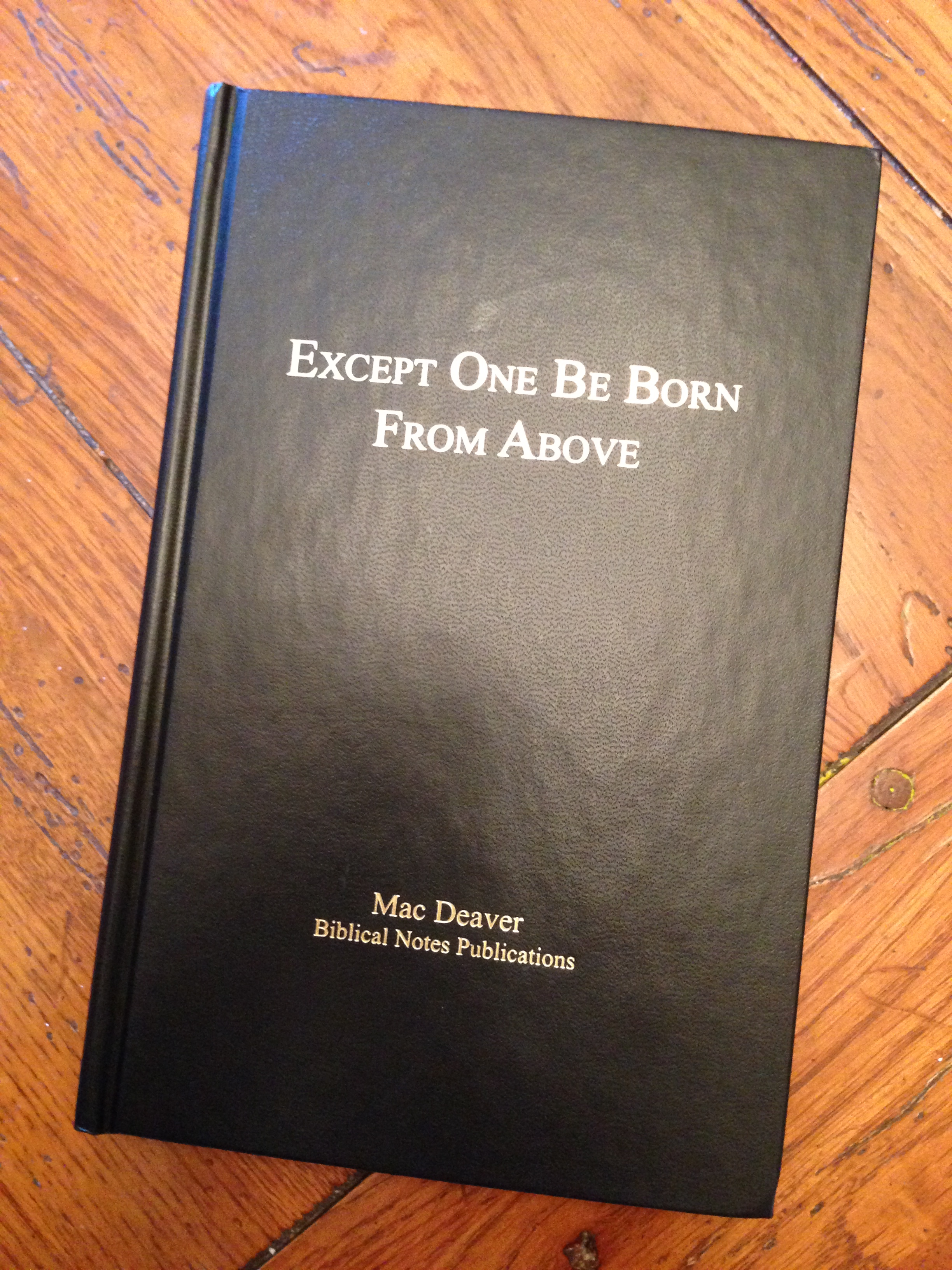
Mac Deaver’s New Book Now Available from Biblical Notes Publications

photoPublished July 2013 in hardcover by Biblical Notes Publications, Except One Be Born From Above has 317 pages, including sixteen chapters and three appendices. Copies can be purchased for $14.00 plus $3.75 S&H ($17.75 total). Please send your order, with payment (personal checks accepted, made out to Mac Deaver) to:

Mac Deaver

P.O. Box 327

Sheffield, TX 79781

Perhaps the best way to introduce the book is to include excerpts from the preface (below). If some of the questions it raises pique your interest (and they should), then you might well enjoy this fascinating study. Having read several times through the manuscript prior to publication, I’ve found it simultaneously simple, challenging, faith-building, and significantly helpful in understanding and appreciating the crucial concept of “new birth” as taught by Jesus. In point of fact, the word “groundbreaking” comes to mind — not in the sense of its being new, but, rather, by way of its clearing aside a few baseless assumptions, making it possible to see better what the New Testament has been saying all along.

Back in 1864, J. W. McGarvey wrote, “I have for some years been convinced that the immersion in the Holy Spirit is not fully understood, and that it needs investigation and discussion de novo. The same may be said of the entire subject of the Holy Spirit and his work in human salvation.” The church has grappled with the topic a long time. Many of prominence have helped us down unhelpful paths that darkened understanding we might otherwise have had, if some unbiblical assumptions had not been drummed into our thinking. Please get the book, read it, understand what it is saying, and, if you are inclined, pass it on to others.   –Weylan Deaver

Excerpts from the Preface of Except One Be Born From Above

by Mac Deaver

Have you ever wondered why it is that some of us have claimed for years that there are certain “measures” of the Holy Spirit when, in fact, the Bible says that there are none? Have you ever heard anyone ever really conclusively prove that Holy Spirit baptism was an exclusively first century phenomenon? Why is it that the cases of kingdom entry in the book of Acts are usually all called cases of conversion, when in some of the cases, conversion does not take place on the same day that kingdom entry does? Why wasn’t Cornelius told to repent of his sins? How is it that he could be baptized in the Holy Spirit before he was baptized in water? And if his baptism in Spirit was to prove that it was time for the Gentiles to enter the kingdom, then why didn’t we conclude that when it was time for the Samaritans to enter the kingdom that their reception of the Holy Spirit was a baptism in the Spirit as well? And what do human hands have to do, if anything, with the reception of the Holy Spirit?

When did the apostles actually enter the kingdom? And when did they repent of their sins? Did they repent of their sins on the same day that they entered the kingdom? Why was Jesus baptized in water? …And why is it that most members of the church have assumed that in Matthew 28:18-20 (when Jesus was giving what we call the “great commission”) even though he was speaking to the apostles only, we somehow reached the conclusion that we are included, but in Acts 1:5 (in the same context) when he was promising Holy Spirit baptism as he was speaking to the apostles only, that we are somehow excluded? What is wrong with such analysis?

And just what was lacking anyway to prevent the kingdom from being established prior to Pentecost of Acts 2? How could Apollos be a member of the church and yet not know that the Holy Spirit had come? When did the apostle Paul receive Holy Spirit baptism? And why is it that for years and years many of us have simply assumed that Holy Spirit baptism is miraculous in its nature without ever seeing any conclusive proof (logical argument) that such is so? How is it that members of the churches of Christ, generally speaking, reached the conclusion that Holy Spirit baptism is not applicable today? …Is it possible that we have failed to recognize a key distinction between baptism in Spirit and power from Spirit while at the same time we elevated the use of apostolic “hands” in Scripture to a position or status that they never had?

And how does every case of kingdom entry in the book of Acts “square” with the words of Jesus in John 3:5? Have you carefully considered the historical transition that was taking place in the book of Acts which transition lasted for about thirty years and which was an exclusively first century phenomenon? And have you ever thought about the precision of the words of Jesus to Nicodemus and what he left out that we, on occasion, have assumed that he meant? Is there any justification in the same context for taking water to mean real water, and flesh to mean real flesh only to conclude that Spirit in the very same passage has to be something other than Spirit and cannot possibly be the Holy Spirit himself?

If you have ever been puzzled by some of the questions here posed, you may want to explore the contents of this book. In this volume, Except One Be Born From Above, such questions will be answered and greater clarity thrown on the book of Acts because of the angle from which it is and should be viewed. It is amazing how many passages we in the past have unintentionally distorted in order to make them harmonize with our incorrect view on Holy Spirit baptism. But once the correction is made, it is absolutely astonishing as to how many more passages can be left alone to simply convey the meaning originally intended.

This is not a book that calls in question the absolute necessity of water baptism, for water baptism has actually been conclusively proven by sound argument in public discussion to be essential to the forgiveness of a sinner’s past sins. I have debated this issue myself, and I am thoroughly convinced of the essentiality of water baptism in order for a sinner to become a saint. The revisiting of the water baptism topic can only reconfirm the truth that we have for years rightly upheld. Churches of Christ have historically advocated and defended the essentiality of water baptism (immersion) throughout our history in preaching, teaching, writing, and debating. However, we have failed to see the nature of Holy Spirit baptism and the full meaning of the one birth of water and Spirit.

It has taken us a while to see the conceptual connection between the various aspects of Holy Spirit doctrine. But from the study in which we have been for a long time engaged on the Holy Spirit, we see now more clearly than ever how passages on the Holy Spirit fit together so harmoniously. And we see the connection between the various cases of “conversion” that we read about in the book of Acts. We have in the past had to unintentionally “torture” certain texts to make them teach what they never said. We did not do this on purpose nor with malice. But because we had the wrong idea as to the nature and purpose of Holy Spirit baptism, we wound up “rewriting” Scripture.

When we get the doctrine of Holy Spirit baptism correct, we can then see clearly (1) the fact of the personal indwelling, (2) the fact of internal Spirit help, and (3) the complete rather than partial nature of the new birth, and even (4) a connection between the nature of the Christian and his prospects in the coming resurrection! So many wondrous truths come together when we reinvestigate the meaning of the Lord’s precious words to Nicodemus: “…Except one be born from above, he cannot see the kingdom of God…Except one be born of water and Spirit, he cannot enter into the kingdom of God” (John 3:3, 5).

If the reader can make a valiant effort to put aside preconceived notions and personal prejudices that may have been entrenched in his heart for years and years regarding the topic of Holy Spirit baptism, and if he will demand of me that the conclusions I present are supported by conclusive proof, he has my sincere appreciation. It took a while for others to get me to revisit the topic. I did not want to have to give serious attention to a topic that I was convinced had been long ago understood by most of our brethren. But I was so wrong in thinking that most of us had understood it and that I, therefore, did not need to give more attention to it. I can appreciate the reluctance that some now have in not giving the topic the attention that I am convinced that it certainly deserves.

We will never see the coherence between all the passages on the Holy Spirit that discuss his relationship to Christians unless and until we get our minds correctly settled on the topic of Holy Spirit baptism. It is that fundamental and crucial. Once we understand what Jesus really said in John 3 to Nicodemus, we can then understand the progression of the history in Acts and finally see how all of the cases of kingdom entry as recorded by Luke fit together without a single exception. There are no cases of exception to the requirements of kingdom entry in the book of Acts!

It is my hope that you have a most enjoyable “trip” through this book, and I desire that your intellectual and spiritual journey be most profitable. May God bless your efforts as you restudy this topic and think seriously about what Jesus meant when he said, “Except one be born anew (ASV footnote: from above), he cannot enter the kingdom of God.”

Mac Deaver

Sheffield, Texas

Posted in Christianity and Culture

If You Give a Fool a Favor

By Weylan Deaver

How often does it make headlines that an atheist group is upset that prayers are being said somewhere, or that some religious symbol is in the public, or that something is said or written that makes unbelief feel the least bit unwelcome? It does seem that adamant atheists think that Bible-believers’ main duty in America is to make sure atheists are not made uncomfortable in any way by their presence. The best expression of Christianity is one that is neither seen nor heard by any potentially offended unbeliever. A recent grievance from the godless is chronicled by Fox News contributor Todd Starnes in a July 24, 2013 online article, “Chaplain Ordered to Remove Religious Essay From Military Website.” Evidently, it is no longer a given that chaplains can do the very things that make them chaplains, lest some atheist see and feel discrimination (which has become one of the longest four-letter words in English). The Air Force chaplain’s column dealt with the origin of the phrase, “no atheists in foxholes.” Naturally, an atheist group complained. The Air Force capitulated and, within hours, the essay was removed. In the ongoing offensive to eliminate what offends, we rarely step back to analyze the scenario’s illogic. If the atheist is right about God’s non-existence, then nothing in the universe has intrinsic value, including his own feelings and mental comfort. Therefore, if the atheist is right, why should anyone care what he approves, since his views are just as meaningless as anyone else’s? In other words, if the atheist is right about atheism, then he is implying the rest of us have no obligation to listen to him about anything. Atheism implies its own worthlessness. Let that sink in. It has always been that “The fool hath said in his heart, There is no God” (Psalm 14:1). What does it say of our military, or society that we craft any custom or policy based on the complaints of fools?