Posted in Apologetics, Baptism, Doctrine, Expository, Heaven, Holy Spirit, Inspiration, Nature of Man, Resurrection

The Man Within

My friend, Glenn Jobe, and I study together a lot over the telephone. We have wrestled together for years over various concepts and passages. We have studied together regarding death and what happens immediately following death. It has been very helpful to me in the light of my late wife’s passing on July 30 of 2021. We continue to study. Much of the thought contained in this article is due to Glenn’s wonderful thinking. Recently, in a telephone conversation with my good friend, Charles Pugh, we were discussing the resurrection. And, he and I (just as Glenn and I) were wrestling with some complicated matters involved in the resurrection and the resurrection body. Following that conversation, I was stirred to study with more focus in trying to solve some of the hard questions that arise regarding what the Bible says about what happens to us at death and what is entailed in the concept of resurrection.

It is good to note that in 2 Cor. 4:16 Paul refers to our “outward man” and our “inward man.” In Eph. 3:16 he again refers to the “inward man.” This article is putting extreme focus on the time at which Christians first are blessed with the “inward man.”

In working on the matter, the thought came to me several weeks ago that we already have the body that is to be raised on the day of the resurrection, and that body is within us now. I called Glenn to ask him if he knew of any passage that would “crush” this idea. We had a good and very profitable conversation. While a question still in our minds was not resolved regarding one passage, it seemed that the idea of our already having the resurrection body is possible. And in further contemplation and with another phone call to Glenn, it does seem to me that the Bible teaches that the Christian’s body that will be raised from the dead is a body that the Christian has presently within his physical body in this life. Furthermore, that body within is the very body that enters Paradise at physical death. That body is certainly not physical (1 Cor. 15:50). What does this mean then? Let us think about this very carefully. And I think that if what I contend for in this article is true, it unravels the complications of the resurrection that have baffled us for years. That is, the explanation provided here does at least two things. First, it preserves the distinction between the physical body and the spiritual body. Second, it shows how that there is continuity of personal identity that continues in a non-physical (spiritual) body following physical death that makes it possible for an actual resurrection to occur according to New Testament teaching.

According to Paul, two bodies are involved in discussion of the resurrection. There is the physical (or, “flesh and blood”) body (1 Cor. 15:50), and there is the “spiritual” (or, non-flesh and blood) body (1 Cor. 15:42-49). He gives a comparison of them.

He calls the physical body the “natural” body (v. 46). This body is “of the earth” (v. 47), and it is the first body that man receives. The second body is the “spiritual” body and is “of heaven.” The first body bears the image of the “earthy.” The second body bears the image of “the heavenly” (v. 47-48). The two bodies stand in stark contrast to one another. Not only do they differ in nature as to realm of formation (earth or heaven), but they differ, consequently, in their natures. The natural body is given to “corruption,” it is “sown in dishonor,” it is “sown in weakness,” it is “sown a natural body.” The second body, however and in great contrast to the first, is “raised in incorruption,” it is “raised in glory,” it is “raised in power,” and “raised a spiritual body” (v. 42-44). Remember, the first body (“first man”) is “of the earth,” and the second body (“second man”) is “of heaven” (v. 47). Thus, the two bodies have natures that fit the two environments: earth and heaven. This entails the conflict of flesh and spirit (Gal. 5:17). And as long as we are alive in this world, we are composed of physical body, soul, and spirit that comes from God (1 Thess. 5:23; Gen. 1:27; 2:7; Heb. 12:9; Mal. 2:14-15). The “soul” seems to be the animation or vitality initiated at the point of contact between flesh and spirit. When the spirit leaves the physical body, the physical body is dead or lifeless (Jas. 2:26). When physical death occurs, Solomon said the body as composed of dust goes back to the earth, and the spirit returns to God (Eccl. 12:7).

Now, the concept of resurrection entails the nature of man as composed of both body and spirit. Since man is made in God’s image and his spirit comes from God, then the separation of the physical body from human spirit necessarily implies two different consequences. Even the unsaved man who dies is immortal in that his human spirit is not quenched or snuffed out. He, too, enters eternity and faces judgment (John 5:28-29; Matthew 10:28; Jas. 1:27). There is no Bible description of the spiritual body of the wicked that enters eternity and goes to judgment.

But we do have in 1 Cor. 15 and 2 Cor. 5 elaborate discussion of the situation engulfing the righteous dead as to their spiritual or eternal bodies. Of course, language used is definite but accommodative to help us understand what takes place when we die even though it is difficult for us to get a clear picture of how it all is. But the new body is viewed as new clothing (cf. Rev. 3:4), just as the old (physical) body is (Jude 23). The spiritual body is a dwelling place “not made with hands, eternal, in the heavens” (2 Cor. 5:1). It is new clothing “from heaven” (v. 2). If it were not for this new set of clothes, after death we would be “naked” (v. 2-3) [Compare this point to the “bare” (or naked) grain in 1 Cor. 15:37]. In this first body, we presently “groan,” and therefore long for a new and better one (v. 2; cf. Rom. 8:23, 26). When a person becomes a Christian, he is a new creation or creature living in the earthly body (2 Cor. 5:17).

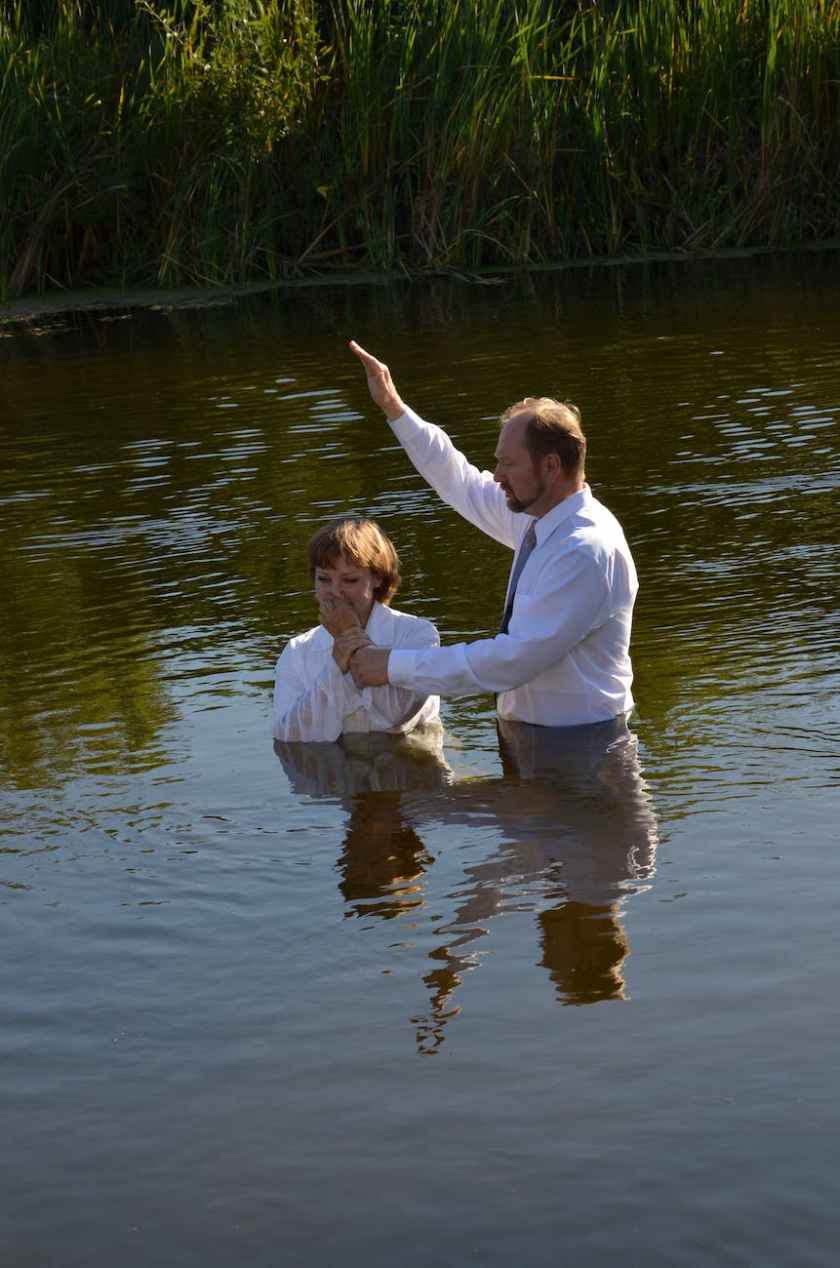
A person becomes a Christian by faith, repentance, confession of faith and immersion in water and in Holy Spirit (John 8:24; Luke 13:3; Rom. 10:9-10; Acts 2:38; 1 Cor. 12:13). And while a believing, having confessed, penitent believer is still in the water of baptism, he is regenerated by the Holy Spirit (Tit. 3:5-6). This occurs as the Holy Spirit engulfs or surrounds the human spirit. That is why it is referred to as a baptism (1 Cor. 12:13). The Greek preposition ἐν in that passage should be translated “in” in English. No one was ever baptized “by” the Holy Spirit. Only Jesus is said to do that (Matt. 3:11; Luke 3:16; cf. Acts 2:33). Furthermore, it is the same preposition used of John’s baptizing people “in” water per Matt. 3:11 as the element in which they were baptized. If John baptized in the element of water, Jesus then baptizes us in the element of the Holy Spirit. Now, following this baptism in Spirit, the Spirit now enters inside the human spirit (Gal. 4:6). When the immersed person rises from baptismal waters, he is “in Christ” because he is now “in Spirit” (Rom. 8:9). This is why he can be said to be a part of the non-personal spiritual body of Christ on earth, which is the Lord’s church (Col. 1:18). From water baptism (which he leaves) and in Holy Spirit (in which he remains), he rises to walk in a new life (Rom. 6:3-4). Thus, this person is now a spiritually alive person and a new creature. And in addition to the physical life that he had before baptism, he now possesses spiritual life while he remains in his mortal or earthly body (Rom. 8:11).

He is now a new creature, spiritually connected to (being “one” with) the Holy Spirit (1 Cor. 6:17). So, he can be renewed each day by this spiritual fellowship or “communion” with the Holy Spirit (2 Cor. 4:16; 13:14). This is how the Spirit leads him (Rom. 8:14), enabling him to produce Holy Spirit fruit (Gal. 5:22-24; cf. Eph. 5:3-14). Being “led by the Spirit” enables him to rightly claim to be a child of God, to hold sin down, and to have continual cleansing of his sins (Rom. 8:14; 1 John 1:7). When a man forfeits the Spirit, he reenters “flesh” or, in other words, his physical body no longer has spiritual life in it (Rom. 8:11). The physical body is once again the sin-dominated body that the person had before he became a Christian (“the body of this death,” Rom. 7:24).

Just as we, in the past, could not yet see that the gift of the Holy Spirit is, in fact, the baptism of the Holy Spirit, we could not yet see that the regeneration and indwelling of the Spirit is the initiation or production of the new spiritual body. We have viewed the conversion as the human spirit being regenerated (and rightly so). But we failed to comprehend that this new creation was not of a spirit without a spiritual body. We took it to be the production of a new creature but simply with his old, earthy body awaiting the future time when he would receive his new spiritual body in the resurrection.

Sometime back, I wrote an article claiming that the new spiritual body is provided immediately following death. That article, “A Tale of Two Bodies,” was published here in 2021. What I affirmed in it was progress, doctrinally speaking, in that it showed that the resurrection body is not given at the time of the resurrection but before it. And while this was an advance in the way to think about resurrection, now, looking back, I see that there is more to be said, and that, actually, the resurrection body is given a Christian earlier than the point for which I argued in that previous article. The more complete understanding of what Paul is saying in 2 Cor. 5 entails the idea—it now seems to me—that the new spiritual body that we receive is not received following death at all. Rather, it is received when we are converted to Christ! The regeneration and indwelling of the Holy Spirit actually constitutes the new spiritual body, the body that enters Hades if and when we die, and the body that will be either raised from Hades or changed at the last day (1 Cor. 15:51; 1 Thess. 4:13-18; 2 Cor. 5:1-2).

Now notice, Paul is not saying in 2 Cor. 5 that Christians on earth will be given in the future a body from God or a “habitation” from heaven. He is saying that when we die (our earthly body being “dissolved”), we already have in place this other spiritual body in which we leave this earth at death! In other words, he is saying that one does not need to worry about being “unclothed” at death (in putting off this physical body) because his human spirit is already housed in his new body. He already has his new set of clothes. When we die, we are already dressed for our entry into glory and into the presence of God (cf. Rev. 22:4).

And when Paul says that we long for the day when we will be “clothed upon with our habitation which is from heaven,” he is saying that we long for the day when we will no longer be burdened as we are now in this physical body. Having put it off, we will experience the revealing or manifestation of our spiritual body that we have had since our conversion. We will see Christ in glory as he is when we die (cf. Phil. 1:23). When Christ at his coming is manifested to faithful Christians living on earth, they will be like him for their spiritual body manifestation at that time will be observable by him and to them as well (1 John 3:2). This is the “revealing of the sons of God” of which Paul spoke in Rom. 8:19. It is “the redemption of our body” (Rom. 8:23). The redemption of the body occurs at death; the resurrection of the body occurs at the last day. The redemption of the body concerns the saved; the resurrection of the body concerns all men.

Notice that in 2 Cor. 5 Paul affirms that God made it possible for Christians to have their new spiritual bodies by means of the Holy Spirit. God is the One who made it possible for us to have the new clothes or the new spiritual body by giving us the Holy Spirit, who is the earnest of our inheritance (v. 5; cf. Eph. 1:13-14). This is the Spirit that made it possible for us to have spiritual life in our “mortal bodies” (Rom. 8:11). So, when our mortal body (“earthly house”) is “dissolved,” our new house is revealed. It is not then given to us. Rather, having been given us at our conversion, we continue to have it so that the spiritual life that we had in the mortal body continues to exist without the mortal body. How? The spiritual life is in our new heavenly body. This new body is “from heaven” (2 Cor. 5:2).

As stated earlier, Paul distinguishes between the “outward man” and the “inward man” (2 Cor. 4:16-18). The “outward man” (physical man) is presently “decaying.” The “inward man” (spiritual man) is being “renewed day by day.” In this life, we can see the “outward man,” but we cannot with physical eyes see “the inward man.” However, Paul shows in this passage that we must see the “inward man.” It is one of those invisible things (v. 18) that we must by faith see (cf. 2 Cor. 5:7). Notice, Paul says that when this decaying outward man “be dissolved, we have a building from God, a house not made with hands, eternal in the heavens” (2 Cor. 5:1). “Be dissolved” is an aorist tense verb, but “we have” is present tense. Paul is telling us that at the point when we Christians put off the “outward man,” we keep on having this “building from God” or this “inward man.” We already have it! It is “in the heavens” in the sense that this is the domain of all of our spiritual blessings. Paul said that all of our spiritual blessings are “in the heavenlies” (Eph. 1:3).

Now, think about this. Jesus had told Nicodemus, “Except one be born from above, he cannot see the kingdom of God” (John 3:3-5). Water is of the earth, just as our first body is (1 Cor. 15:42-46). The birth from above is spiritual and concerns our human spirit (Rom. 6:17). Question: Can a man be born without a body? Answer: No. And Jesus called our transition from the world of sin to spiritual life a “birth.” Paul contrasted our outward man with our inward man. It has been very easy for us to miss the point that the inward man is actually a “complete” man. That is, we never concluded that the inward man had a body since we know that we are still in this first body. However, we have simply missed what we were being told. It is not the case that our human spirit (if we are Christians) is inside one body only (the earthly). He is within two bodies—the physical and, since conversion, the spiritual. Our inward man is a man. It is the same man that is in this earthly body which we can see. But our spirit is now also inside a new body which we as yet cannot see. It is one of those invisible things of which Paul speaks (2 Cor. 4:16-18). Paul encourages us to keep on looking at those things that keep on not being seen. But eventually, when the old, first body is laid aside, the new body will be seen. It is the new man that is being renewed day by day now (2 Cor. 4:16; Rom. 12:1-2). The spiritual body within is getting stronger day by day as our physical body gets weaker and weaker. And consider this point: The church is the non-personal and yet spiritual body of Christ. Christ’s personal glorified body is in heaven at the right hand of God (1 John 3:2; Acts 7:56). This is why I refer to our being the “non-personal” spiritual body of Christ. But also, note that if the church is actually now the spiritual body of Christ (Col. 1:18), then that is so by virtue of the fact that as Christians our spiritual bodies compose it! Our physical bodies cannot possibly be the spiritual body of Christ. Would anyone contend that the Lord’s spiritual body on earth is composed of earthly bodies? Would anyone on earth like to contend that the Lord’s spiritual body on earth is composed of human spirits who have as yet no spiritual body? How can they have no spiritual body and yet be the spiritual body of Christ?

At our new birth, we were given a new body from heaven (from above). This is our “building from God, a house” that God produced, an “eternal” body, “in the heavens” (2 Cor. 5:1). But how is it “in the heavens,” if we have it now? It is like saying that we are not in the world because we are not of the world. We are certainly in the world in one sense (1 Cor. 5:9-10). But we are not of the world in another sense (John 17:16). Our new body is not of this world. John had written, “But as many as received him, to them gave he the right to become children of God, even to them that believe on his name: who were born, not of blood, nor of will of flesh, nor will of man, but of God” (John 1:12-13). Christians have been born of God. They have been born from above. They are new creatures whose spiritual bodies are from heaven where their citizenship is.

Consider Phil. 3:20-21 carefully. (1) Our “citizenship is in heavens” (plural). (2) We are now currently waiting for the return of the Lord. (3) The Lord will “fashion anew the body of our humiliation,” (4) “that it may be conformed to the body of his glory,” and (5) this is accomplished according to the same power and authority by which he is able “to subject all things unto himself.” Paul is, of course, alive on earth in his earthly body at the time of this writing (before physical death has occurred; cf. 1 Thess. 4:13-18). In context, Paul had already referred to some of the Lord’s enemies who “mind earthly things” (Phil. 3:19). If what we said about 1 John 3:2 is correct, and if our contention is that our spiritual body was created at our conversion, how do we square those points with Phil. 3:21, where we are told that Jesus shall “fashion anew the body of our humiliation”?

In Greek, the word “shall fashion” (or change) means to remodel or transfigure (Harper, p. 267). Now, since “flesh and blood cannot inherit the kingdom of God” (1 Cor. 15:50), and since we already have and are “our inward man” (2 Cor. 4:16), and since the first body is to be “dissolved,” how can the Lord “fashion anew the body of our humiliation”? In 2 Cor. 5:1 the word for “dissolved” means “to dissolve, to destroy, demolish, overthrow, throw down…” (Harper, p. 218). If there is to be both a remodeling or changing of the body and at the same time a dissolving (destroying, overthrowing) of the body, how can these things be?

I suggest that changing (or remodeling or fashioning anew) our body is simply a reference to the releasing of the new spiritual body from its attachment to the physical one. Flesh and blood are not remodeled. They are dissolved or destroyed. The Lord’s fashioning anew the body of our humiliation means that he he will release the spiritual body from the physical body when he returns. Its new form will be by virtue of its disconnection from the physical body in which it now resides. Remember, Paul is writing from the viewpoint of the those living on earth. He is not writing from the viewpoint of faithful Christians whose spiritual bodies have already been released from their earthly bodies. So, he is discussing the release of a spiritual body from a physical body and not the creation of a spiritual body at the Lord’s coming. This refashioning would be the equivalent of “the revealing of the sons of God” in Rom. 8:19.

Furthermore, let us remember that what Paul says regarding the Lord’s fashioning again the body of our humiliation (Phil. 3:21) has the background of his comments earlier made with regard to the Lord’s incarnation. Speaking of Christ Jesus, Paul wrote that he “emptied himself, taking the form of a servant, being made in the likeness of men; and being found in fashion as a man, he humbled himself, becoming obedient even unto death, yea, the death of the cross” (Phil. 2:7-8). He said that Jesus gave up “the form of God” (v. 6-7). So, he gave up the divine form (not the divine essence or substance) and took on human form. Jesus retained his eternal identity (John 1:1-2, 14) when he became the son of Mary (Luke 1:35).

Our new body that is conformed to the glorified body of Christ is the new form of the body of humiliation (the physical body). Jesus “humbled himself” in leaving divine form for human form (Phil. 2:8). He humbled himself in being formed as a man. The Lord’s physical body was the body of his humiliation as ours is to us. And notice that the transformation that obtains in our body of humiliation being conformed to the body of his glory is “according to the working whereby he is able even to subject all things unto himself” (Phil. 3:21).

Compare this to what Paul says in Col. 2:11-12. When we were baptized into Christ, Paul says that such constituted “the putting off of the body of the flesh.” Now, that is not the physical body that was put off; it was the body of sin or sin-dominated body. Paul said he was still in the physical body (Gal. 2:20). He is referring to the sin-dominated body or “the body of this death” (Rom. 7:24). And putting off the body of flesh, “having been buried with him [i.e. Christ] in baptism” (Col. 2:12), Paul says that we “were also raised with him through the faith [i.e. the gospel] in the working of God, who raised him from the dead” (v. 12). So, there is a “working” or divine operation that raises us up in our spiritual resurrection from spiritual death at the time of our conversion. That is our “first resurrection” (cf. Rev. 20:6). Regarding our second resurrection, God’s “working” changes us or conforms us to the Lord’s glorified body (Phil. 3:21). This is the fashioning anew of the body of our humiliation. Now, how is it if “flesh and blood cannot inherit the kingdom of God” that God can “fashion anew the body of our humiliation”? If the physical body goes back to dust, and the spirit goes back to God who gave it, then the fashioning anew refers to the release of the spiritual body within from the physical body without. The new form or fashion of the spiritual body is without its attachment to the physical one. Our glorified body is disconnected from the body of our humiliation. Presently our glorified or spiritual body remains within the body of our humiliation.

Consider some points Paul makes on death, burial, and resurrection in 1 Cor. 15:

1. Our physical bodies are not going to be raised from the dead because “flesh and blood cannot inherit the kingdom of God (v. 50; cf. Gen. 3:19). The body goes back to the earth (Eccl.12:7), and the earth will finally be burned up (2 Pet. 3:10-12).

2. At the resurrection the righteous dead (those who will inherit the kingdom of God) will be “raised incorruptible,” and the righteous then-living ones will “be changed” (v. 51-52).

3. “Death is swallowed up in victory” (v. 54) as our spirit is released from its first set of clothes (the flesh and blood body characterized by its corruption and mortality; cf. Jas. 2:26).

4. Victory is obtained before resurrection and at the point of one’s death (v. 54).

5. Eternal clothing (or the new body) is already in place at the time of one’s death (v. 52-54).

6. The buried body is likened to the seed that a farmer plants (v. 36).

7. The seed has to die in order that and before its body comes forth (v. 36).

8. The seed is not the same as the body that it becomes (v. 37).

9. God prepares each body that each kind of seed becomes (v. 37-38).

10. There are various kinds of flesh (v. 39), two basic kinds of bodies (v. 40), and various kinds of glory (v. 41).

11. Paul then declares that the resurrection involves what he has just declared (v. 42). (1) A man must die in order that a body might come forth from the grave; (2) the man’s physical body (as seed) that is planted is not to be confused with the body that comes forth; (3) the body that comes forth, like all bodies, is designed by God (v. 37-38); (4) the identification of “fleshes” and “bodies” and “glories” (v. 39-41) indicates that the resurrection entails the full nature of man (both the physical body and the spiritual).

Remember, Paul is discussing the resurrection of the saved (v. 20-23). It is not a discussion of the resurrection of the lost, although certainly some points made would apply to all men. But the concepts of “incorruption,” “glory,” “power,” “spiritual body” refer to saved people only (v. 42-44). While all men who die will be raised (John 5:28-29), only the righteous are raised in incorruption, glory, power, and in a spiritual (or heavenly) body. The spiritual body is the “heavenly” body (v. 46-49). Remember, when we were baptized into Christ, we were born from above (John 3:3-5). We received that spiritual or heavenly body that is the one and only one of our two bodies (physical and spiritual) that will come forth from the grave.

Before listing several formal arguments, let me comment on 1 Cor. 6:13-20. In our second book on the Holy Spirit, Except One Be Born From Above, I explained the passage (p. 229-237), showing how Paul’s discussion of the Christian’s body actually entailed an identification of three different bodies: (1) the Holy Spirit-filled body, (2) one’s own body, and (3) the body of sin (p. 233). When a Christian, walking in the light (1 John 1:7), still commits a momentary act of sin, he sins without “the body of sin” or the sin-dominated body. But Paul says that when a Christian commits fornication, he sins against his own body (“the Holy Spirit-filled body”). And I wrote, “The Christian in the commission of fornication has created a situation such that the Holy Spirit has been driven out of his body…The Holy Spirit cannot indwell an unholy heart or remain in an unholy body (cf. 2 Cor. 7:1)” (p. 234).

In the past when I have been asked what happens to the personal presence of the Holy Spirit when a Christian apostatizes from the faith, I would answer that he leaves the body. Why is this? Because the Holy Spirit’s presence in the physical body of the saint is proof of the saint’s future inheritance in glory (Eph. 1:13-14; 2 Cor. 5:5). This personal presence makes the saint’s physical body a “temple” of God (1 Cor. 3:16-17; 6:19-20). So, if the Christian apostatizes from the faith, he forfeits the personal presence of the Holy Spirit in his body, whose presence constitutes the Christian’s “earnest” of his inheritance.

In Gal. 4:19, we find a most informative truth in Paul’s description of the apostates in the churches of Galatia. Some brethren had been led away from the purity of the gospel (Gal. 1:6-10). Some Jews had falsely instructed them that they had to submit to circumcision in order to be faithful to Christ. In other words, they were being told that Gentiles had to become Jewish proselytes before they could obey the gospel. Some of them fell for the falsehood, and Paul said of these, “Ye are severed from Christ, ye who would be justified by the law; ye are fallen from grace.” These were apostate brethren. They had stopped obeying the truth (5:7). He reminded them that if they were “led by the Spirit,” they were not under the law of Moses (5:18). This reminds us of Rom. 8:14, where Paul wrote, “For as many as are led by Spirit of God, these are sons of God.” Now, in Gal. 4:19 Paul says, “I am again in travail until Christ be formed in you.” Marshall’s The Interlinear Greek-English New Testament translates the Greek word ὠδίνω to mean “I travail in birth.” Harper’s Analytical Greek Lexicon gives this definition of ὠδίνω: “to be in travail (Gal. 4:27; Rev. 12:2); met. To travail with, to make effort to bring forth (Gal. 4:19)” (p. 282). For the Greek word μορφωθῇ translated “is formed,” Harper gives the meaning as “to give shape to, mould, fashion, (Gal. 4:19)” (p. 273). Thus, Paul is figuratively expressing the idea that he is in spiritual labor until Christ is formed or moulded or shaped in them once again!

Now remember, the formation of a Christian’s spiritual body happens originally when that having confessed, penitent believer is baptized into Christ (John 8:24; Luke 13:3; Rom. 10:9-10; Gal. 3:26-27; 1 Cor. 12:13). The formation of a convert’s spiritual body takes place when he becomes a Christian. That first formation entails (1) the surrounding of the human spirit by the Holy Spirit himself when the Holy Spirit enters his physical body. This is the immersion of a human spirit in the Holy Spirit, at which point the human spirit is regenerated (that is, given spiritual life—1 Cor. 12:13; Titus 3:5-6; Rom. 6:3-4). This the precise point when one is added to the church (i.e. becomes a part of the spiritual body of Christ). The formation of a person’s spiritual body also entails (2) the movement of the Holy Spirit to within the heart of the forgiven and now regenerated person who is, in fact, a Christian (Gal. 4:6). The process of baptism in Spirit plus indwelling (1 Cor. 12:13; Rom. 8:9-11; 2 Tim. 1:14) constitutes the “formation” of the Christian’s spiritual body! Don’t confuse the human spirit with Holy Spirit. All humans have a human spirit (Gal. 1:26-27; 1 Thess. 5:23). Only Christians have been regenerated by and are indwelled with the Holy Spirit (Acts 5:32; 2 Tim. 1:14).

So, when Paul says that he is in spiritual travail until Christ be formed in the Galatian saints, since Christ is personally at the right hand of the Father (Acts. 2:33; 7:55), he can only be “formed” in them again by his Spirit whose form had been forfeited when they fell from grace. That spiritual form (or body) can be reinstated if they heed Paul’s instructions. Amazing!

Let’s conclude with a few arguments:

Argument One

1. If (1) our new birth entails being born of water and Spirit, and if (2) our new birth entails being born from above, and if (3) water is from below and Spirit is from above, and if (4) our human spirit was regenerated by the Holy Spirit, and if (5) we became a new man or a new creature by means of this birth of water and Spirit, and if (6) the concept of being born entails having a body, then we received a new spiritual body when we were born again and became a new man.

2. (1) Our new birth entails being born of water and Spirit (John 3:3-5), and (2) our new birth entails being born from above (John 3:3-5; 1 Cor. 12:13), and (3) water is from below and Spirit is from above (observation; Col. 3:1-4), and (4) our human spirit was regenerated by the Holy Spirit (Titus 3:5-6), and (5) we became a new man or a new creature by means of this birth of water and Spirit (Titus 3:5-6; Rom. 6:1-4), and (6) the concept of being born entails having a body (Gen. 2:7, 23; John 1:13; 1 Cor. 15:47-49).

3. Then, we received a new spiritual body when we were born again and became a new man.

Argument Two

1. If the new birth is comparable to and superior to the old birth, and if the old birth essentially entailed the fundamental concept of a body, then the new birth essentially entails the concept of a body.

2. The new birth is comparable to and superior to the old birth (John 1:13; 3:3-5), and the old birth essentially entailed the fundamental concept of a body (1 Cor. 15:42-49).

3. Then, the new birth essentially entails the concept of a body.

Argument Three

1. If those who are born again or born from above already have a spiritual body within, and if the physical body will go back to dust at death, then it is the spiritual body that enters Hades at death to be raised on the day of the resurrection.

2. Those who are born again or born from above already have a spiritual body within (see Argument Two), and the physical body will go back to dust at death (Gen. 3:19; Eccl. 12:7).

3. Then, it is the spiritual body that enters Hades at death to be raised on the day of the resurrection.

Argument Four

1. If (1) the church’s condition as the spiritual body of Christ on earth is analogous to the condition of a Christian’s spiritual body following physical death, and if (2) that analogy is based on the church’s relationship to (being in) the Spirit now, and if (3) that relationship between the Christian and the Holy Spirit entails the fact that the Christian is a part of a new creation, then the church’s spiritual body following physical death is a body created by the Holy Spirit.

2. (1) The church’s condition as the spiritual body of Christ on earth is analogous to the condition of a Christian’s spiritual body following physical death (Col. 1:18; 1 Cor. 15:44-49), and (2) that analogy is based on the church’s relationship to (being in) the Spirit now (Rom. 8:9-11; 2 Cor. 5:4-5), and (3) that relationship between the Christian and the Holy Spirit entails the fact that the Christian is a part of a new creation (2 Cor. 5:17).

3. Then, the church’s spiritual body following physical death is a body created by the Holy Spirit.

Argument Five

1. If (1) a Christian’s spiritual body is a body created by the Holy Spirit, and if (2) it remains our body following our physical death, then we have our spiritual body before we die a physical death.

2. (1) A Christian’s spiritual body is a body created by the Holy Spirit (see Argument Four; and John 3:3-5), and (2) it remains our body following our physical death (1 Cor. 15:42-49).

3. Then, we have our spiritual body before we die a physical death.

Argument Six

1. If (1) what is sown is what is raised in 1 Cor. 15, and if (2) what is sown is sown a natural body and raised a spiritual body, then the body remains an individual’s body though it changed from natural to spiritual.

2. (1) What is sown is what is raised in 1 Cor. 15 (15:42-49), and (2) what is sown is sown a natural body and raised a spiritual body (1 Cor. 15:42-44).

3. Then, the body remains an individual’s body though it changed from natural to spiritual.

Argument Seven

1. If (1) an individual Christian’s body remains his own body but is changed from a natural body to a spiritual body, and if (2) his spiritual body is not a flesh and blood body, and if (3) his natural body puts on a spiritual body, then his spiritual body was within his natural body before he died a physical death.

2. (1) An individual Christian’s body remains his own body but is changed from a natural body to a spiritual body (1 Cor. 15:42-49), and (2) his spiritual body is not a flesh and blood body (1 Cor. 15:50-58), and (3) his natural body puts on a spiritual body (1 Cor. 15:53-56).

3. Then, his spiritual body was within his natural body before he died a physical death.

Argument Eight

1. If (1) the natural body (physical body) has spiritual life in it on earth by means of the Holy Spirit’s presence in it, and if (2) the natural body is the mortal body, and if (3) the spiritual body is the immortal body, and if (4) the natural body will not be raised but the spiritual body will be raised, then the natural body has spiritual life within it by means of a spiritual body within it.

2. (1) The natural body (physical body) has spiritual life in it on earth by means of the Holy Spirit’s presence in it (Rom. 8:9-11; 6:1-11), and (2) the natural body is the mortal body (1 Cor. 15:44; 2 Cor. 5:1-5), and (3) the spiritual body is the immortal body (1 Cor. 15:42-49; 2 Cor. 5:1-8), and (4) the natural body will not be raised but the spiritual body will be raised (1 Cor. 15:50, 42-49).

3. Then, the natural body has spiritual life within it by means of a spiritual body within it.

A Concluding Thought

Not only does the previous argumentation show that the Christian’s resurrection body is provided to him when he becomes a Christian, but it also provides a unique form of new apologetic argumentation for the inspiration of Scripture and, thus, for the existence of God. The myriad of details involved in the history of man, as told in Scripture, is such that from man’s first appearance on earth to his final destiny, his history reveals the necessity of the divine inspiration of the Book that records that history!

No one but God himself could have told the story of human experience (with all the essential features of it), revealing the necessity of divine redemption in such a complete and coherent way as to provide such a profound account of the nature, the condition, the purpose, and the need of man from time to eternity.

Argument on Inspiration

1. If the Bible provides an account of the totality of human experience (from time to eternity) which is impossible to be the written production of mere man or of any combination of men, then the Bible is the word of God.

2. The Bible provides an account of the totality of human experience (from time to eternity) which is impossible to be the written production of mere man or of any combination of men. [Note: The proof of this second premise is the story of Scripture beginning with man’s first appearance on earth and concluding with his resurrection and/or transformation into his final phase.]

3. Then, the Bible is the word of God.

Posted in Baptism, Doctrine, Holy Spirit, Salvation

Some Fresh Truth Applied to a Stale False Assumption

I want to revisit the controversial case of Cornelius. Much has already been written about him (e.g. here, here, and chapter 8 in Except One Be Born From Above, and chapters 10-11 in I Will Pour Forth of My Spirit, etc.). Without wishing to repeat all of it, still, a little repetition will be essential before getting into some newer material.

Throughout my preaching life, the brotherhood has, when attempting to analyze the kingdom entry of Cornelius as recorded by Luke in Acts 10, viewed Cornelius as an alien sinner before Peter came to his house, on the basis that he had not been baptized in water for the remission of his sins. This is a great and consequential mistake. Consider the following True/False questions:

True/False: Cornelius was obviously an unforgiven sinner when Peter came to see him (in Acts 10) as shown by the fact that he had not yet been immersed in water for the remission of his sins.

True/False: Cornelius was obviously a non-sinner when Peter came to see him (in Acts 10) as shown by the fact that he was immersed in the Holy Spirit just as Peter began his sermon.

Now, one of those two statements is true and one is false. Which is it? I have proven in other writings that the first is false and the second is true. But what I want to do here is add fresh insight to further bolster that conclusion.

As already pointed out, when our brethren treat Cornelius as an example of an alien sinner (with good character, no doubt), they do so because they view him as amenable to the gospel before he actually was. They view him as a man in the world today in the 21st century who has yet to hear the gospel. But Cornelius is not like any man today in that condition. Cornelius is a God-fearing, faithful Gentile serving God as any faithful Gentile had for thousands of years, including Abraham (cf. Romans 4). Cornelius is privileged to live during the unique period when God is “transitioning” Jews and Gentiles from Judaism and Moral law-ism (i.e. Patriarchy) into amenability to the gospel. Remember that no Jew in the book of Acts nor any Gentile became amenable unto the gospel until the gospel became accessible to him.

Furthermore, the descriptions concerning Cornelius’ standing before God cannot be taken as descriptions of a lost man. There are seven descriptions provided in Acts 10 and one more in Acts 11 (10:2, 4, 15, 22, 28, 31, 35; 11:9). According to these verses, Cornelius is a righteous man. Ask yourself how is it that God would describe a saved man if Cornelius is not one of them? The descriptions of Cornelius cannot be successfully gainsaid. He is in good standing with God before he meets Simon Peter.

But now to a different point, and I will take it from Acts 10:15. As one devout soldier and two house-hold servants of Cornelius journey to Joppa to find Simon Peter, a trance comes upon Peter and he sees a vision. We will not here discuss the difference between trance and vision, but it is clear from the text that Peter experiences both. Well, what was revealed to Peter? Verse 11 says, “and he beholdeth the heaven opened, and a certain vessel descending, as it were a great sheet, let down by four corners upon the earth.” Verse 12 informs us that Peter sees all kinds of fourfooted beasts and creeping things of the earth and birds of the heaven. And in verse 13 we learn that Peter hears a voice that says to him, “Rise, Peter; kill and eat.” But then we learn of Peter’s reluctance to obey the order. He respectively responds that he has never eaten anything that is common and unclean. And then Peter hears the voice again, but now it does not simply present a command, but rather states a fact, and then a new command is given. The fact is that God has cleansed something or someone. The text says exactly, “What God hath cleansed, make not thou common” (v. 15). So we have one fact: God has cleansed something or someone. Second, Peter is now under obligation to recognize that fact. Furthermore, and evidently for emphasis this strange scene is presented to Peter three times (v. 16; 11:10).

Now, remember that the Jewish background for this scene has to do with the law forbidding certain animals to be eaten. The Jews were to maintain a difference conceptually between unclean and clean, and the application of that distinction applied to persons and things and included what they could and could not eat (Lev.10:10; ch. 11). It is interesting that in the scene provided to Peter, the Lord uses animals to refer to people. This is clear from Peter’s own explanation of the scene to the apostles and the other brethren in Judea later (Acts 11:1-18). It is certainly the case that the creatures in the vision represent people.

So, we know that the statement in 10:15 refers to people. Secondly, we know that it applied to certain Gentile people. Cornelius, his household, kinsmen, and friends who lived nearby (10:2, 24, 45) were the ones who were immersed in the Holy Spirit during Peter’s visit (10:44, 45).

But now consider this crucial point. God had said to Peter, “What God hath cleansed, make not thou common” (10:15). The extremely interesting point just here is that the verb “hath cleansed” is in the Greek text an aorist tense verb. According to Ray Summers in Essentials To New Testament Greek, “The function of the aorist tense is a matter of tremendous importance. The time of action is past. The kind of action is punctiliar” (point action rather than linear or a continuation of action, MD). According to Summers, “the aorist indicates finished action in past time” (p. 66). So, what God is saying to Peter is that at the moment that Peter is experiencing the trance and the vision, that is a moment before which God had already cleansed some Gentiles! At a particular point of time in the past, the cleansing had already taken place. The Gentiles to which the visionary scene applies had already been cleansed by God. That is why Peter is not only allowed to go into the house of Cornelius, but is rather by God commanded to go into it (cf. 10:28). Did God command Peter to break the law of Moses? The answer is obvious. Should Peter have gone into the house of Cornelius? The answer is again obvious. But just what had occurred that so changed the relationship between Jew and Gentile that now for the first time made it possible for such a visit to rightly occur?

So, we face two questions: first, who were the ones whom God had already cleansed, and second, when did that cleansing take place? The answer to the first question is “all the righteous Gentiles.” Particularly, the vision applies to Peter’s contemporaries, but it also applies to all the righteous Gentiles who had ever lived and died. They were all now clean before Jehovah God! Of course, Peter is present when the divine demonstration is provided to declare what had recently occurred. Some Gentiles now stand before God as “clean.” What Gentiles? All of those who righteously had lived in their system (Gentile-ism, moral law-ism, Patriarchy; see Rom. 2:14-15). Cornelius stands on equal footing with Abraham, an Old Testament Gentile, who is now actually clean. But Abraham is long dead; Cornelius is alive on the earth. And though Peter can’t do anything with regard to Abraham personally, he does have an obligation to the righteous Gentiles then living. He was not to consider them as common or as unclean. The second question has to do with when the righteous Gentiles were cleansed. Remember that at the time Peter sees the vision, the cleansing had already occurred at a specific moment in the past. To Peter, it was finished action in past time. And of course, the cleansing occurred when Jesus died on the cross, and was raised from the grave (cf. Rev. 1:5; 1 Cor. 15:1-3; Heb. 2:9; Rom. 4:25). It had been at least ten years, and maybe more, since Jesus had gone back to glory. So, it is certainly conceivable that the righteous Gentiles whom Peter sees in Caesarea (or at least some of them) had been living as actually “clean” people before God for quite some time as they had continued to serve God under their law from God (Rom. 2:24-25). This indicates to some degree why there was no hurry to get the gospel to the Gentiles following Pentecost of Acts 2. The Gentiles had their own religion in which they were to serve. Peter by inspiration had affirmed in his Pentecost sermon, however, that the gospel was intended by God to go to the Gentiles (Acts 2:39), but he had never understood the truth of that announcement until Cornelius explained matters to him in Caesarea following Peter’s experience with the vision (Acts 10:9-17, 28-35). Cornelius heretofore was doing just fine, but he was not in the church. Jesus had died to purchase the church (Acts 20:28). God wanted the Gentiles to become one with the Jews in the church (Col. 2:17; Eph. 2:11-22). Now, for the first time Cornelius became obligated to leave his former religion in order to enter the church (or, kingdom). In this respect he was just like the Ethiopian eunuch who was doing just fine, as well, as a righteous Jewish proselyte before Philip met him (Acts 8:26-40). Philip taught him what he needed to know in order to enter the kingdom. His amenability, like that of Cornelius, was being changed.

Notice also that when Peter begins his lesson, he affirms that he now comprehends what had been evading him. In 10:34-35 we read, “And Peter opened his mouth, and said, Of a truth I perceive that God is no respecter of persons: but in every nation he that feareth him, and worketh righteousness is acceptable to him.” Those who were at that very time doing those very things (fearing God and working righteousness) were already acceptable to God.

Go back to Acts 10:2 and reread that Cornelius feared God already. Go back to 10:22 and reread that Cornelius was a righteous man already. So, what Peter rightly concluded was not simply about what would be the case in the future; it was about the past and the then present. It is the right conclusion to which God in the vision exposed Peter. All of those who feared God and worked righteousness were already acceptable to God! They always had been. That is how it was possible for those at the house of Cornelius to be immersed in the Holy Spirit before they were baptized in water (10:48). Their subsequent baptism in water was essential to their kingdom enter, but it was not for the remission of past sins. Those sins were already covered by the precious blood of Jesus Christ (Rev. 1:5; Eph. 1:7; Col. 1:14; Heb. 2:9). They were already clean!

The blood of Christ had been applied to the hearts of every faithful Jew who had passed from this earth (Heb. 9:15). Too, we are told that Jesus tasted death for every man, which included Gentiles (Heb. 2:9). The death, burial, and resurrection of Jesus were all historically in place and spiritually applicable to the cleansing of all faithful people in history before Peter arrives in Caesarea. We simply cannot understand the various cases of kingdom entry in Acts if we fail to grasp this vital truth. The Jews for the first time began to be amenable to the gospel of Christ in Acts 2. The Gentiles for the first time began to be amenable to the gospel of Christ in Acts 10. Again, I repeat that no man in the first century became amenable to the gospel until the gospel became accessible to him. God was the One responsible for arranging the segregation between Jews and Gentiles which had for centuries been in place. And God was equally responsible for changing (for all time) amenability status of Jews and Gentiles to the gospel beginning in Acts 2.

Furthermore, this means that Peter’s conclusion in Jerusalem, when speaking to the brethren there, that “Then to the Gentiles also hath God granted repentance unto life” (11:18), does not apply to the righteous Gentiles! That conclusion is applied to the unrighteous Gentiles who were as yet unclean and who, therefore, needed to repent! Remember that Cornelius is never told to repent any more than the Ethiopian officer was told to repent. But, it is the case that in the book of Acts, most of the Gentiles that we read about are the unrighteous ones, just as most of the Jews who come into the kingdom are called out of their sins. They were the ones who needed to repent in order to enter the kingdom (cf. Acts 2:38; 3:19; 14:8-19; 17:16-34; cf. Eph. 2:11-22), but such was not the case with the first Gentiles to enter the kingdom in Acts 10 nor with the first Jews to enter the kingdom (Acts 2:1-4). But the audience to whom the apostles and prophets preached throughout the book of Acts, whether (1) righteous Jews, (2) unrighteous Jews, (3) righteous Gentiles, or (4) unrighteous Gentiles all had to be immersed in both water and Spirit (or Spirit and water) in order to enter the kingdom (John 3:3-5).

Now, what has here been said agrees with what we have concluded with regard to the nature of the “salvation” offered by Peter as referenced in Acts 11:14. The “words, whereby thou shalt be saved, thou and all thy house,” do not denote a salvation from sin since Cornelius and his house had already been cleansed by God. The “salvation” rather referred to deliverance from the divinely arranged religious system for the Gentiles which (though having been in place for hundreds of years) would now no longer be operative to any Gentile as the privilege of entering the kingdom and the obligation to enter the kingdom became accessible to and obligatory upon him. Cornelius no longer would be acceptable to God simply on the basis of his being a faithful Gentile. Now, he must become a Christian in order to maintain right standing before God. If the reader doubts the accuracy of using the word “saved” in Acts 11:14 to refer to anything other than forgiveness of sin, he must recall that “save” in l Peter 3:21 refers not to a forgiveness of sins that takes place but to a physical deliverance. Also, he needs to remember that in 1 Corinthians 7:14, the unbeliever’s “sanctification” by means of the believer, and the children’s “holiness” or “cleanliness” because of the believer has nothing to do with the unbeliever’s salvation from sin or holiness or sanctification through conversion.

Let’s conclude with the following arguments based on what has been said:

Argument One

1. If Cornelius was a righteous man at the time that Peter “began to speak” to him, then the salvation referred to in Acts 11:14 could not be a salvation from alien sins.

2. Cornelius was a righteous man at the time that Peter “began to speak” (Acts 10:22; 11:15).

3. Then, the salvation referred to in Acts 11:14 could not be a salvation from alien sins.

Argument Two

1. If Cornelius had been “cleansed” by God before Peter met him in Caesarea, then the salvation referred to in Acts 11:14 could not be a salvation from alien sins.

2. Cornelius had been “cleansed” by God before Peter met him in Caesarea (Acts 10:15, 34-35).

3. Then, the salvation referred to in Acts 11:14 could not be a salvation from alien sins.

Argument Three

1. If the “salvation” referred to in Acts 11:14 could not be a salvation from sin, then it was a salvation or deliverance from the divinely arranged religious system for the Gentiles that was being terminated in order for Gentiles to become amenable to the gospel.

2. The “salvation” referred to in Acts 11:14 could not be a salvation from sin (per preceding arguments).

3. Then, it was a salvation or deliverance from the divinely arranged religious system for the Gentiles that was being terminated in order for the Gentiles to become amenable to the gospel (cf. Acts 2:39 with Eph. 2:13-22).

Posted in Baptism, Doctrine, Holy Spirit, Salvation

Cornelius Was No Lost Sinner

[The following article is a response to an earlier article written by my friend, Dave Miller. Dave’s article is written on the assumption that the world of the first century was basically like the world of the twenty-first century. That is, as far as amenability to the gospel is concerned, Dave views the world to whom the apostles preached as composed of lost sinners only. This assumption cannot be correct, but as long as Christians study the book of Acts with this assumption, they can never understand kingdom entry that occurs in the first century as recorded by Luke].

In a recent article entitled, “Gentiles Received the Spirit Before Baptism?” in the August, 2022 issue of Reason & Revelation, the director of Apologetics Press and our good friend, Dave Miller, takes a very unique approach to the Gentiles’ reception of the Holy Spirit as recorded in Acts 10 prior to their baptism in water. Brother Miller, like so many other Christians, still thinks Cornelius was a lost sinner before Peter arrived in Caesarea. I have shown in our book, Except One Be Born From Above, why this position is false. However, some brethren still cling to it. And since brother Miller is one of them, he feels the need to explain how it is that Cornelius and his household and near friends as sinners could receive the baptism of the Holy Spirit before they were baptized in water. His approach is unique in that in John 14:17 where the Saviour said that the world cannot “receive” the Holy Spirit, Miller takes the position that the word “receive” means rather that the world would not be able to “seize” or to “take away” the Holy Spirit as the world could and did seize Jesus. He thinks that the word translated “receive” should be taken to be something else. It is a desperate effort in the handling of alleged sinners and their reception of the baptism of the Holy Spirit, to be sure, but it is not correct.

In the first place, the baptism of the Holy Spirit is never promised to any alien sinner as he continues to remain an alien sinner. Never! My good friend knows and admits that Cornelius, his household, and his near friends received the baptism of the Holy Spirit. And he knows that they were baptized (immersed) in Holy Spirit prior to their baptism in water.

Second, the word translated “receive” is, as translated, in complete harmony with the rest of the doctrine of the Holy Spirit in both Old and New Testaments. The world (alien sinners) cannot receive the regeneration of the personal Spirit and the subsequent indwelling until following forgiveness (Acts 2:38; Titus 3:5-6; Eph. 1:13-14; Acts 5:32). Only the forgiven are given spiritual life by the Holy Spirit, and only the forgiven are added to the church (Acts 2:47), and only the forgiven are indwelled by the Holy Spirit (Rom. 8:9-11; Eph. 1:13-14).

Third, Apologetics Press’ own Defending The Faith Study Bible (copyright 2019), which uses the New King James Version, has in the text, of course, “receive.” Is there any reputable English translation of standing that does not translate the Greek word in John 14:17 by the word “receive” or an equivalent? My friend’s effort is a desperate one. But in replacing the word “receive” with another word such as “take” or “seize,” what would my friend hope to gain? He is taking the position that the Bible DOES NOT teach that an alien sinner CANNOT RECEIVE the Holy Spirit! This is not unique, however. In Curtis Cates’ 1998 book, Does The Holy Spirit Operate Directly Upon The Heart Of A Saint?, brother Cates unfortunately took the position that not only can an alien sinner produce Holy Spirit fruit, but that it is absolutely essential that he do so before he can be baptized in water (see pages 146-148). Cates did this in spite of the Lord’s declaration in John 15:1ff. that a person not connected to the vine (Jesus) could not bear fruit! I told brother Cates to his face in Memphis, Tennessee that he had taken the same position that Ben Bogard had taken in his debate with N. B. Hardeman on the fruit of the Spirit. Brother Cates didn’t at the time seem to be aware of this truth. Bogard took the position that one must produce Holy Spirit fruit prior to water baptism, and thus he claimed that water baptism had nothing to do with salvation from sin. Both Cates (Christian) and Bogard (Baptist) failed to understand Holy Spirit baptism and the fruit of the Spirit. Unfortunately, it is still not very clear to brother Miller either.

Fourth, the principle identified in Haggai 2:10-14 shows us that if something clean touches something unclean, the unclean contaminates what had been clean. The clean cannot cleanse the unclean by coming into contact with it. But given the desperate effort of our friend on Cornelius, Dave is implying that a man who is a spiritually unclean person (a practicing sinner) can come into spiritual contact with the Holy Spirit (being immersed in Him), and somehow, the Holy Spirit is not contaminated by an individual who remains contaminated! This peculiar arrangement imagined by our friend does not square with Bible doctrine. Imagine: a sinner’s heart (completely saturated with sin) comes in contact with HOLY Spirit, and the sinner remains a sinner and the Spirit becomes unclean! The Bible position is that when a person is forgiven and is no longer contaminated, the Spirit is joined to his spirit so that the two are ONE SPIRIT (1 Cor. 6:17). Cornelius was forgiven of his sins by the death and resurrection of Jesus (Rev. 1:5; Rom. 4:25). Jesus died for Cornelius and Abraham, and they were cleansed by his blood and justified by his resurrection before they ever had access to the gospel of Christ (Heb. 2:9; Rev. 1:5; Rom. 4:25).

Fifth, clearly brother Miller is trying to help save water baptism for the remission of sins and as the entry point into the church. He knows that Cornelius is not in the church prior to baptism in water. But what he does not yet comprehend is that no one ever entered the church without being immersed in the Holy Spirit as well as water. Water-only never placed one person into the kingdom. But Cornelius received the Holy Spirit before he received the water. And since Dave sees Cornelius as an alien sinner, he writes his article in an attempt to prove that the Bible does not teach that alien sinners cannot receive the Holy Spirit! Well, let me just say this: it is the Bible position that alien sinners cannot be immersed in the Holy Spirit! Miller says they can. The Bible says they cannot. Dave’s confusion is apparent.

Sixth, why do brother Miller and many brethren assume that Cornelius is an alien sinner? Because he has not been immersed in water. Why do they think that Cornelius needs to be immersed in water? Because he is an alien sinner. But, dear reader, this whole perspective regarding Cornelius is totally misguided, and it is based on the failure to remember the historical context in which Cornelius lived. When we are reading the book of Acts, we are not seeing the same kind of world that we have today. The world in which Cornelius lived was composed of Jews and Gentiles who had divinely provided religions by which they could attain unto glory before the gospel was first preached on Pentecost of Acts 2. The world today is composed of alien sinners and Christians. The world of the first century was composed of people who became amenable to the gospel as the gospel became for the first time accessible to them! Cornelius was not amenable to the gospel before Peter reached him. He was a righteous Gentile on his way to glory before Peter came to see him.

All righteous Jews and all righteous Gentiles were judged by the law under which they lived (Rom. 2:14-15). And all of them that died prior to any hearing of the gospel went to glory. Abraham went to glory as well as Isaac, and Jacob (Matt. 8:11) without baptism in water for remission of sins. How could this be? The Jews (descended through Jacob) were judged by the law of Moses, and the Gentiles (Abraham and Isaac) were judged by the moral law (what we have called “Patriarchy,” [Rom. 2:14-15]). So, in the book of Acts, we have seven classes of people who will hear the gospel preached throughout the history recorded by Luke in Acts. We have (1) faithful Jews who are added to the church, including the apostles (Acts 2:1-4; 13:43); (2) unfaithful Jews who needed to repent (Acts 2:5-47); (3) unfaithful proselytes who needed to repent (Acts 2:5-47); (4) faithful Gentiles (Acts 10); (5) unfaithful Gentiles (cf. Acts 14:8ff.; 17:22-34); (6) faithful proselytes (Acts 8:26-40) [Note: the Ethiopian eunuch was a faithful proselyte (Acts 8:26-40); Lydia was either a faithful Gentile or a faithful proselyte (Acts 16:11-15)]; and (7) Samaritans (Acts 1:8; Acts 8). The book of Acts is NOT simply a history of conversions. It is a history of kingdom (or church) entry, and those who entered came from one of the seven classifications just mentioned. Not everyone who entered was a lost sinner! The world was not like that. Some were lost. In fact, most were. But some were righteous Jews and Gentiles and proselytes who entered when the gospel reached them. Read Acts 13:43 very, very carefully. Some people was already in the grace of God when the gospel first reached them. Cornelius is one of these righteous people. How do we know?

Seventh, notice how Luke in Acts 10 describes Cornelius: (1) a devout man, (2) one that feared God with all his house, (3) who gave much alms to the people, (4) and prayed to God always (v. 2). Then again, Luke says of Cornelius that (5) his prayers and his alms had gone up as a memorial before God (v. 4). Again, Cornelius is described as (6) a righteous man and one that feareth God, and well reported of by all the nation of the Jews (v. 22). (7) He is NOT unclean (v. 28). Again, (8) his prayer was heard and his alms had in remembrance in the sight of God (v. 31). Furthermore, Peter finally affirmed that (9) Cornelius and those like him were acceptable to God because they were God-fearers and righteous-workers (vs. 34-35). How can anyone in the light of all this evidence claim that Cornelius was a lost sinner? There is simply no need to try to justify a sinner’s reception of the baptism of the Holy Spirit. Acts 10 provides no such case. Peter’s description in Acts 10:34-35 in context applies to Cornelius. If Cornelius’ prayers were acceptable and a memorial (vs. 4, 31), then Cornelius was acceptable, too!

Think of it this way. If the disciples of John (including the apostles and the Lord’s own mother) that numbered about one hundred and twenty people had died the day before Pentecost, they would have gone to heaven because they were righteous Jews (Acts 1:12-15). If Cornelius had died the day before Peter arrived in Caesarea, he would have gone to glory because he was a righteous Gentile. And that brings us to the final obstacle to some people’s seeing Cornelius for what he was.

Eighth, Cornelius was (1) to hear words from Peter (Acts 10:22); (2) to hear all things that have been commanded thee of the Lord (Acts 10:33); and he was to hear (3) words whereby thou shalt be saved, thou and all thy house (Acts 11:14). First, remember that Cornelius already knew about John the baptizer and Jesus (Acts 10:37-38). Peter did not bring new information to Cornelius respecting them. The fact that he was baptized in the Holy Spirit at the very beginning of Peter’s sermon shows that the reception of Holy Spirit baptism preceded instruction that could have provided necessary faith to salvation from sin. His heart was already right before God before Peter began his sermon. But, as a Gentile, he had no responsibility to John’s baptism which was, to the Jews in the area of the Jordan River, for remission of sin (Mark 1:4). He was a pure Gentile practicing his God-given religion knowing of things happening in the Jewish community to which he was not amenable. However, that situation was now to change at Peter’s arrival to his house. The Gentiles were for the first time becoming amenable to the obligation of entering the kingdom by means of the gospel, which requirement entailed baptism in both water and Holy Spirit (John 3:3-5). Cornelius would no longer have right standing before God if he refused to enter the kingdom. God was now for the first time bringing Jews and Gentiles together in the kingdom (Eph. 2:11-22; Acts 11:18). The first Gentiles to enter were righteous as was the case with the first Jews to enter (Acts 2:1-4). Peter preached words to Cornelius whereby he could be saved—not saved from sin, but saved from his divinely provided situation which would no longer be operative in his life. From now on, he must be not simply a good Gentile, but a faithful Christian. His salvation was deliverance from a divinely provided religion that was no longer to be satisfactory. It was good enough for Abraham, and it was up until Acts 10, good enough for Cornelius. But he lived during the “transition era” in which all Jews and all Gentiles were delivered out of their amenability to previous divine arrangements. That is what the “great commission” was about: it changed the amenability of all men from Judaism and Patriarchy to the gospel of Christ!

If someone objects by saying that the word “saved” in Acts 11:14 must mean “saved from sin,” he is simply not thinking the matter through completely. The word “saved,” though usually in context refers to a spiritual deliverance, cannot always mean that. In 1 Pet. 3:20 Peter tells us that eight souls were “saved” through water. Noah and his family were saved. This was not a spiritual deliverance. It was a physical deliverance from the flood. Again, consider the word “sanctify” (to set apart from common condition or use). It usually refers to spiritual sanctification, but not always. In 1 Cor. 7:14 it cannot refer to spiritual sanctification. We are told that the unbelieving husband or wife is sanctified in the Christian husband or wife. This cannot mean that a non-Christian can be saved simply by marrying a Christian. It means that a non-Christian married to a Christian will be set apart for divine consideration because of his/her relationship to the Christian who is a child of God. So, the reader should be able to see that words like “saved” and “sanctified” have to be understood in their historical context. The same is true of Cornelius. His “salvation” has to be understood in his historical context. Brother A. G. Freed years ago affirmed that Cornelius was “told words by which he is saved from the sinking ship of patriarchy” (Sermons, Chapel Talks and Debates, p. 152). I couldn’t say it any better.

Remember, what the Lord said to Nicodemus in John 3:3-5 is exactly what he meant, and it applies to every case of kingdom entry in the book of Acts without exception. Don’t insert what Jesus never said to Nicodemus. And, as I pointed out in our book, Except One Be Born From Above (p. 274)—

Jesus never said:

(1) Water must come first and then the Spirit;

(2) Spirit must come first and then the water;

(3) Water and Spirit must come at the same time;

(4) One’s forgiveness had to occur at the moment of kingdom entry;

(5) Forgiveness would occur in every case of water baptism;

(6) One born of water-only could enter the kingdom;

(7) One born of Spirit-only could enter the kingdom.

Brother Dave did say in his article that “The Gentiles’ reception of the baptism of the Holy Spirit had nothing to do with their salvation.” He is correct in that it had nothing to do with their salvation from sin! But it was, along with immersion in water, essential to their kingdom entry.

What Jesus said in John 3:3-5 fits every case of kingdom entry recorded by Luke, including that of Cornelius and every other Gentile. “…Except one be born anew (from above), he cannot see the kingdom of God…Except one be born of water and Spirit, he cannot enter into the kingdom of God.”

Posted in Announcements, Baptism, Debates, Salvation

Livestream link for Deaver-Rodriguez Debate 2021

The four night debate will happen April 26-29 beginning at 7:00 p.m. each evening. It is to be streamed live on Facebook at this link:

https://www.facebook.com/Deaver-Rodriguez-Debate-II-A-Debate-on-the-Baptism-of-the-Holy-Spirit-107237591501314/

We hope all of you will be able to watch it in person or online and thus participate in the study of this vital topic.

Posted in Baptism, Doctrine, Expository, New Testament, Salvation

Baptism In One Spirit Per 1 Corinthians 12:13

Last Sunday, I listened to a faithful gospel preacher as he misinterpreted this passage. Sadly, I misinterpreted this passage most of my preaching life. It was all because I failed to understand that Holy Spirit baptism entailed no miracle whatever! As you, I was taught that there are three measures of the Spirit among men (while there actually are none—John 3:34), and that baptism in Spirit was a miracle. But this was all wrong, so sadly wrong, and these mistakes affected all of our biblical interpretation of passages that mentioned the Spirit and his relationship to us.

Think about the words in 1 Corinthians 12:12-13: “For as the body is one, and hath many members, and all the members of the body, being many, are one body; so also is Christ. For in one Spirit were we all baptized into one body, whether Jews or Greeks, whether bond or free; and were made to drink of one Spirit.” Please go immediately to Galatians 3:26-29 for the language of Paul there. And please return to John 7:37-39 immediately for the language there. Do you see concept and language connection?

But, because (1) we all knew there was only one baptism, and because (2) we all knew that water was for the remission of sins, we concluded that we must “interpret” 1 Corinthians 12:13 to mean that we were baptized “by” the Holy Spirit (usually taken to mean by the teaching of the Holy Spirit). How many times have you heard this “interpretation”? We were told that we were baptized in water in harmony with the teaching of the Holy Spirit. My, my! This was an honest but ignorant and unintentional interpretive mistake that we made. But most of us made it. Think! Is there any other passage in the New Testament that supports the claim that the Spirit is an AGENT who baptizes anyone? No! However, we do have passages that claim that JESUS HIMSELF would be the agent who baptized in the Holy Spirit (Matthew 3:11; Luke 3:16).

Interestingly, Luke in describing the difference between John’s baptism and the Lord’s baptism, says that John baptized “with” water, using the dative case of the word “water.” However, he used the preposition “in” (Gr. en) when he said that Jesus would baptize “in” Holy Spirit. Now, we do not reject water as the element in the first baptism on the basis that the proper translation is “with water” rather than “in water.” Do we? No, we do not. Secondly, John said that Jesus would baptize not “with” the Holy Spirit but “in” the Holy Spirit! So, we allow “with” to mean “in” but in 1 Corinthians 12:13 we force “in” to mean “by,” and the only reason we did this was because we took baptism “in” Spirit to mean a miraculous baptism! We were trying, in our ignorance, to be logically consistent.

Too, in Matthew’s rendering of the account, in both references to water baptism and Holy Spirit baptism, he uses the same preposition, “in” (Gr. en). Whatever John was doing with water, Jesus would do with Spirit. If John immersed people “in” water, then Jesus would immerse people “in” Spirit. There is no getting around this. John in his preaching used both water and Spirit as elements. John and Jesus were both agents! We must be fair with the text. Ephesians 5:26 is no help in trying to get around what Matthew says that John did. Paul in Ephesians 5:26 says that Jesus cleansed us by “the washing of the water with the word.” But “the word” is applied to cleansing, and not to regeneration. And they are not the same. So, the passage does not support the interpretation of 1 Corinthians 12:13 that the Holy Spirit “baptizes” us through his teaching in his word!

Also, if Jesus in John 3:3-5 said that a person must be born of both water and Spirit, and if to be born of water means to be baptized in water, then just so does to be born of Spirit mean to be baptized in Spirit.

My good friend, Glenn Jobe taught me several years ago that Acts 1:8 proves that there is no miracle in Holy Spirit baptism. The verb “is come” is an aorist participle which indicates action antecedent to that of the main verb, “shall receive.” That is, the power which would enable the apostles to be the Lord’s “witnesses in Jerusalem, and in all Judaea and Samaria, and unto the uttermost part of the earth” came after their reception of their baptism in the Holy Spirit. The power did not come before nor at the same time as but AFTER the baptism! The KJV is helpful in its translation: “But ye shall receive power, after that the Holy Ghost is come upon you.” We have correctly taught that salvation follows baptism in water as Mark 16:16 teaches. The passage says that the one believing and being baptized shall be saved. Both “believing” and “being baptized” are aorist participles which indicate action prior to that of the main verb, “shall be saved.” It is an aorist participle in Acts 1:8!

Furthermore, while water baptism in the book of Acts is always connected to remission of sins, baptism in Holy Spirit is not. It follows forgiveness rather than to provide it. It is the regeneration of which Paul speaks in Titus 3:5-6. Only a forgiven man can then be given spiritual life! But, think about it: when we were baptized in water, we had to come up out of and leave the water. Water is not the church! When we came up from the water, we were already in the Holy Spirit, and remained in him! Jesus had immersed us in Spirit while we were being immersed in water. This is how and why it can correctly be said that we arise to walk in newness of life (Romans 6:3-4) because life was given us while we were under the water following forgiveness! But we remained in Spirit after we left the water. Following our immersion in water, we came up from it while remaining in Spirit! We are, Paul says, “in Spirit” (Romans 8:9). Being in Spirit is being in the non-personal but spiritual body of Christ (Romans 8:1; Colossians1:18). And just as with regard to any physical human birth, our spiritual birth entails two elements (John 3:3-5). And remember, before Paul mentioned our baptism in Spirit in 1 Corinthians 12:13, he had already reminded the brethren at Corinth that the Jews had been baptized unto Moses by being baptized in two elements (1 Corinthians 10:1-2).

Posted in Baptism, Doctrine, New Testament

Abusing Cornelius

Members of the Lord’s church have in Bible class abused Cornelius time and time again. And, too, he undergoes false accusation as well in sermons. How many times have you listened to someone trying to explain (1) how Cornelius received the Holy Spirit while (2) being a sinner? Imagine, the Holy Spirit entering the heart of someone presently practicing sin and thus bound for hell!

It is absurd. Cornelius was no sinner. How many times does Luke have to describe Cornelius for us until we finally admit his righteousness? See Acts 10: 2, 4, 15, 22, 28, 31, 35. Luke made seven attempts to describe Cornelius for us so that we would see that he was a righteous Gentile when the gospel reached him. How could he be? He was answerable to God through “Gentile-ism” or “Patriarchy” or “moral law-ism” (Romans 2:14-15). Remember the then Bible (law of Moses) had been given to Jews only (Psalm 147:19-20). The Gentiles up into the first century were answerable to God through moral law only. Had Cornelius died the day before Peter came to his house, he would have been bound for glory. Cornelius was a righteous Gentile just as much as Abraham in his own day had been.

Yes, but an objector replies that I am forgetting that Peter preached to him words whereby he would be saved (Acts 11:14). Indeed, but the salvation he received is not what most of us have taken it to be. He was saved in that he was delivered from “Patriarchy” which no longer for him would be operative as the divinely arranged system of religion for his people. Brother A. J. Freed, like most of us in the past, did not understand Holy Spirit baptism, but he did understand Cornelius’ condition. He correctly denied that Cornelius was an alien sinner, and he wrote, “He is told words by which he is saved from the sinking ship of patriarchy” (Sermons, Chapel Talks, and Debates). Amen! When the apostles, following Peter’s explanation of what happened at the house of Cornelius, concluded, “Then to the Gentiles also hath God granted repentance unto life” (Acts 11:18), that was a summation statement regarding the general condition of the Gentile camp which was usually one of sin (cf. Acts 17:30-31). It was not a description of Cornelius, his household, nor his friends. This is proved by Luke’s description of Cornelius and by the fact that Cornelius and the other Gentiles with him were baptized in the Holy Spirit (Acts 10:44-48; 11:15; 15:8). The first Gentiles to enter the kingdom were already living up to their spiritual obligations before the gospel reached them. Therefore, they were in a clean spiritual condition which allowed the Holy Spirit to enter them. After that they submitted to water baptism (Acts 10:47-48), but it was not for remission of sins in their case. It was, however, as per the words of Jesus in John 3:3-5, an absolute requirement (as was Holy Spirit baptism) to kingdom entry!

If, dear reader, you think I am abusing the word “saved” as applied to Cornelius (Acts 11:14), remember that we have to consider biblical words in their contextual use. Noah’s family was also “saved,” and it was even a salvation through water, but it was not salvation from sin (1 Peter 3:20). According to Paul, the unbelieving mate is “sanctified” in the believing mate, but the sanctification has nothing to do with the unbeliever’s salvation (1 Corinthians 7:15). We cannot impose a presupposed definition gleaned from other contexts onto a word in its own context that forbids the application of the presupposed definition. We have sadly done this in Acts 11:14, and abused Cornelius unmercifully!

Posted in Baptism, Doctrine, New Testament, Salvation

How could we miss it so badly?

What we in the churches of Christ have done to Acts 1:5-8 is almost unbelievable. Of course, we simply accepted what was handed down from a generation of brethren who had been taught wrongly on the passage as well. And we thought the way we handled the passage was true to Bible teaching on the Holy Spirit in other passages, and our inherited view kept us from endorsing modern day miracles. It is hard to imagine now in the year 2020 that we could miss the correct interpretation of that passage so terribly.

How did we miss it so horrendously? (1) We took the baptism of the Holy Spirit to be miraculous and temporary, and (2) we took the “great commission” to be permanent and obligatory! And each interpretation is wrong.

Since the words of Jesus to Nicodemus were spoken in John 3:3-5, there has been only one way into the kingdom. I have had debate opponents admit this. Well, how did the first entrants enter the kingdom? If you look at Acts 1 and 2, you will find that the first disciples including the apostles entered the kingdom having already been baptized with John’s water only baptism for the remission of sins (Mark 1:4; Luke 7:29-30) when they were baptized in the Holy Spirit (Acts 2:1-4). How did the apostles enter the kingdom in Acts 2? They had already been baptized in water for the remission of their sins which is baptism into the name of Jesus Christ (Acts 8:12, 16; Acts 19:15). But they did not enter the kingdom until they were baptized in the Spirit (Acts 1:5; 2:1-4), which is baptism into the name of the Father and of the Holy Spirit (Matthew 28:18-20). Their kingdom entry entailed baptism in both water and Holy Spirit which is the one baptism of John 3:3-5 and Ephesians 4:5. If you and I entered the kingdom, we came in just as the apostles did. There has never been any other way into it. Their water only baptism was not enough to propel them into the church. When we concluded that Holy Spirit immersion was a miracle, we made a horrible mistake! The Greek grammar of Acts 1:8 shows that the power came “after” the coming of the Spirit, so that it did not come (1) before the Spirit came, and neither did it come (2) at the same time that the Spirit came.

Too, in our wrong handling of Acts 1:5-8, we concluded that the so-called “great commission” (to distinguish it from the “limited commission” of Matthew 10) was permanent and obligatory. Our false conception of the passage has over many years created (1) imbalanced preaching, (2) a great sense of spiritual insecurity, and (3) guilt-evangelism! Elsewhere on this site is an article, “The Great Commission Has Been Fulfilled,” that provides in-depth analysis of this point. The “great commission” was an assignment given to the apostles only (Matthew 28:18-20; Mark 16:15-16; Luke 24:46-47), divinely managed to its completion (Acts 16:6-10; Colossians 1:6, 23), and entailed inspired preaching and miraculous signs (Mark 16:19-20; 1 Corinthians 2:12-13). This was God’s way of changing human amenability once and for all. The Gentiles were brought out from under their obligation to moral law only (cf. Romans 2:14-15; Acts 10), and the Jews were brought out from under their obligation to the Mosaic law which legally had died at the cross (Colossians 2:14). The announcement of (1) the passing of past obligation and (1) the creation of new obligation to Christ was made over a period of thirty years. The apostles and other brethren were involved, but only the apostles were given the specific assignment to see that the gospel went throughout the world. No other Christian ever evangelized because an apostle told him that he, too, was under the assignment of the “great commission”. While many helped in the work, only the apostles would stand before God as responsible to see that that assignment was carried out. The apostles alone were Christ’s ambassadors, a select group, who had been given the ministry of reconciliation (2 Corinthians 5:17-20; 12:12; Acts 10:40-43; 22:15; 26:16).

If we today were successful in carrying the gospel to every creature in the world, we still would not be “fulfilling” the “great commission” because we cannot now accomplish what its completion in the first century did. All men by it were made answerable to Christ (Acts 17:30-31). All men still are, whether we preach or not. Today our evangelism in based on the “great commandment” (Matthew 22:37-40) rather than the “great commission.”

Posted in Baptism, Doctrine, Evangelism, New Testament

Has the Great Commission Been Fulfilled?

By Mac Deaver

Tarlac Bible Forum

[The Tarlac Bible Forum was conducted in November 2014 at the Nick Hotel in Gerona, Tarlac, in the Philippines. Five lectures were presented by Mac Deaver on the theme of “The Baptism of the Great Commission.” We are publishing his teaching outlines here in the order delivered.]

Lesson 5: Has the Great Commission Been Fulfilled?

Note: The “great commission” has been fulfilled because the purpose of its completion was to make all men answerable to the gospel. The book of Acts is not basically about conversions or even about kingdom entry, though it certainly discusses this in detail, but it is about how God changed human accountability for all time from Gentile-ism and Judaism to Christianity, thus making it possible for the reconciliation of two heretofore separated groups of people (to each other and of these people to God) by means of one divinely authorized approach (Eph. 2:13-22; cf. Acts 19:9). We cannot now do what the apostles were commanded to do (see chapter 15, “Facts That Paint the Picture of Acts” in Except One Be Born From Above).

  1. The apostles were the ones to whom the commission was given (Matt. 28:18-20; Mark 16:15-16; Luke 24:44-49; Read carefully Mark 16:15-20; cf. Heb. 2:1-4; cf. Acts 8:1-4).
  2. The ones responsible to the great commission were the “ambassadors” of Christ, distinguished from the rest of the church (Acts 1:21-26; 26:16; 2 Cor. 5:18-20; Acts 1:22).
  3. Two of the apostles were even given special assignments entailed in their great commission (Matt. 16:19; Acts 1:8; 2:1-4; 8:14-24; 10:44-48; Gal. 2:7; Acts 9:15).
  4. Each apostle had “witnessing” power unavailable to other Christians (1 Cor. 12:11; 14:1, 13; 1 Tim. 4:14; 1:6; 2 Cor. 12:12).
  5. Not all Christians were given the gift of tongues (1 Cor. 14:6, 22).
  6. Even if it could be proven that the early church bore the same relationship to the commission that the apostles did, we today still could not have that relationship to it (Eph. 2:20; 4:11; Heb. 2:1-4; the apostles were in a category all their own: Acts 2:42; 1 Cor. 4:9-13; 2 Cor. 12:12; Matt. 18:18 with Matt. 16:18-20; 19:27-28).
  7. During the thirty year period of evangelism in all the world, God was miraculously managing the whole affair (Acts 13:1-4; 16:6-10; cf. 1 Cor. 13:8-13; Acts 14:27; 1 Cor. 16:8, 9, 11; Rev. 3:7; Col. 1:16, 23).
  8. Passages that obligate Christians today to teach cannot in and of themselves prove that the evangelism is to be based on the great commission (1 Tim. 3:15; 2 Tim. 2:2; 1 Tim. 3:2; Matt. 22:37-40).
  9. God has withdrawn all miraculous assistance, which was absolutely necessary to carrying out the commission in the first century (Mark 16:15-20; 1 Cor. 13:8-13; cf. Acts 17:27; Matt. 7:7-11 with Luke 11:13; 2 Pet. 3:9; 1 Tim. 2:4).Note: Our world is not like that of the first century (transition era)! Today all men outside the church die in sin when they die without obeying the gospel. In the first century, there was a way (Judaism and Gentile-ism) for men outside the church to be saved before the gospel reached them because of the religious arrangement that had been made by God for them! Gentile-ism (Patriarchy) and Judaism were finally superseded by Christianity!

Consider these arguments:

Argument #1:

  • All assignments that the apostles were given to do that required the capacity for inspired speaking and miracle working are assignments that Christians today cannot carry out.
  • The assignment that the apostles were given to go into all the world and to preach the gospel to every creature was an assignment that the apostles were given to do that required the capacity for inspired speaking and miracle working (John 14:26; 15:26-27; 16:13; 1 Cor. 2:12-13; Heb. 2:3-4).
  • Therefore, the assignment to go into all the world and to preach the gospel to every creature was an assignment that Christians today cannot carry out.

Argument #2:

  • Any assignment that the apostles were given which changed human amenability on earth for all time is an assignment that cannot be carried out following its fulfillment.
  • The assignment that the apostles were given to go into all the world and to preach the gospel to every creature is an assignment which changed amenability on earth for all time (Col. 1:23; Acts 10:36; 17:30-31).
  • Therefore, the assignment that the apostles were given to go into all the world and to preach the gospel to every creature is an assignment that cannot be carried out following its fulfillment.
Posted in Baptism, Doctrine, Salvation

Correct and Incorrect Reasons for Rebaptism

By Mac Deaver

Tarlac Bible Forum

[The Tarlac Bible Forum was conducted in November 2014 at the Nick Hotel in Gerona, Tarlac, in the Philippines. Five lectures were presented by Mac Deaver on the theme of “The Baptism of the Great Commission.” We are publishing his teaching outlines here in the order delivered.]

Lesson 4: Correct and Incorrect Reasons for Rebaptism

I. Some incorrect reasons for rebaptism:

  1. I knew only a little truth when I was first baptized (cf. Heb. 6:1-3; 1 Cor. 3:1ff.).
  2. Others for whom I have love or respect have been rebaptized (cf. Acts 19:1-7).
  3. I would feel better if a certain preacher baptized me (cf. 1 Cor. 1:10-17; 3:4-9).
  4. To increase the “chances” of my eternal salvation (cf. Col. 2:12; Luke 10:31; Eccl. 9:11).
  5. My baptism was ineffectual because I could not make the confession with my mouth or I did not make the confession before many men (cf. Matt. 10:32-33; Rom. 10:9-10; Rev. 3:5; 1 Tim. 6:12).
  6. I’m not sure the water was pure (cf. Heb. 10:22; Acts 22:16; Eph. 5:26).
  7. The person who baptized me was not a Christian or later apostatized from the faith (cf. Luke 8:11; cf. Demas in 2 Tim. 4:10; Col. 4:14; Philem. 23).
  8. I did not realize at the time that I would receive the actual baptism of the Spirit (Acts 2:38).
  9. I was baptized because I didn’t want to go to hell (cf. Acts 2:40; 1 John 4:18).

II. Some correct reasons for rebaptism:

  1. I was baptized simply because others wanted me to be (Rom. 6:17).
  2. I really didn’t understand what I was doing (John 6:44-45).
  3. I did not have faith that I was being saved from sin (Col. 2:12).
  4. I did not really repent of my sins (2 Cor. 7:10).
  5. I thought I had already been saved and that I was being baptized to join some church (Acts 22:16; 1 Pet. 3:21).
  6. Even though I was an innocent child (having no sin), I was taught that I should submit to baptism in order to be like Christ (Acts 22:16; Eph. 5:26; Tit. 3:5-6).
  7. I was “baptized” when I was a mere baby (cf. Matt. 18:1-6).
  8. I never heard anything about the Holy Spirit (Matt. 28:18-20; Acts 19:2).
  9. I did not know that in baptism I was leaving the world and entering the church (1 John 4:4; 5:19).
  10. To have a clear conscience and make my calling and election sure (2 Pet. 1:10).
  11. When I was baptized, it was for the remission of sins, but I did not believe that Jesus was divine (cf. Matt. 16:16; John 9:35-37).