Posted in Christianity and Culture

An Education Itself

Who is an educated person? A man with a doctoral degree? A master’s degree? A bachelor’s? An associate’s? A high school diploma? One who can read? One who does read? A man who knows well the field in which he earns a living? One acquainted with history and who appreciates fine art? One who mingles with the academics? Webster defines educate as “to cultivate and discipline the mind and other faculties by teaching.” Thus, an educated man is taught and disciplined in respect to some area(s) of knowledge.

Has America made the mistake of making a god of the educative process with little to no regard for what the process is actually teaching? We’ve raised generations to such heights of “education” they now believe people are nothing but glorified chimpanzees. Many “educated” educators teach the next generation of “educated” to trust the state and doubt the Bible, to indulge the flesh and refrain from religion, to deify man and detest the Messiah. We’ve “educated” a horde of lawyers and judges to teach us that the Lord has no real place on the public scene, on public property, or — in essence — in the public psyche. Ironically, God has become almost a trespasser in a nation whose coins still vow trust in him.

The apostle Paul indicated there is such a thing as “falsely called ‘knowledge’” (1 Tim. 6:20, ESV). Surely it does not profit the mind to be full of falsehoods. Deceit will not deliver; lies will not last. The human mind was designed to run on higher grade fuel than error offers. Yet, there will always be he who “loves and practices falsehood” (Rev. 22:15), thereby hindering his own ability to perform as a man educated in what truly matters. There will be those “always learning and never able to arrive at a knowledge of the truth” (2 Tim. 3:7). What results is that the ostensibly educated are, in fact, blinded to genuine truth. This is why Festus could say, “Paul, you are out of your mind; your great learning is driving you out of your mind” (Acts 26:24). No doubt Festus fancied himself more rational than the apostle when it came to the gospel, but reality was otherwise.

Let us lay aside the question of who Americans think is educated and, instead, ask, “Whom does God deem educated?” That answer reveals a strikingly different perspective. There is no degree required. No particular school is mandated. No diploma, no class ring, no alumni association, no grade point average, no transcript. In fact, it consists in nothing else but learning and doing God’s truth (John 8:32), which puts one in very close contact with a man named Jesus. Antagonists of the gospel long ago came to see that Jesus had a most unsettling way of turning the socially unlearned into the spiritually enlightened. “Now when they saw the boldness of Peter and John, and perceived that they were uneducated, common men, they were astonished. And they recognized that they had been with Jesus” (Acts 4:13). You see, being with Jesus is the education.

Listen to and do what he taught and you will far outshine the rest. The psalmist wrote about God’s word, “I have more understanding than all my teachers, for your testimonies are my meditation” (Psalm 119:99). So, who is educated? Is it a Ph.D. who rejects the gospel and goes to hell, or a high school dropout who obeys the Lord and goes to heaven? Who knew what mattered? As C. S. Lewis put it in the book, Mere Christianity (p. 78): “If you are thinking of becoming a Christian, I warn you, you are embarking on something which is going to take the whole of you, brains and all. But, fortunately, it works the other way round. Anyone who is honestly trying to be a Christian will soon find his intelligence being sharpened: one of the reasons why it needs no special education to be a Christian is that Christianity is an education itself.”

Posted in Expository, New Testament

John 3:16 – More Than Meets the Eye

By Weylan Deaver

It’s one of the most familiar Bible verses, and often appealed to as the basis of salvation. “For God so loved the world, that he gave his only Son, that whoever believes in him should not perish but have eternal life” (ESV). While so much is packed into so few words, much also remains unstated. Many fail to realize that verse is summation, not explication. It summarizes what God has (love), what God did (gave), what a person does (believes), and what a believer should have (eternal life). What was involved when God “gave his only Son”? The verse has no particulars about the incarnation, the cross, the blood atonement, Jesus’ death, burial, resurrection. You have to go to other passages to flesh out the details of God’s gift. Likewise, “eternal life” is offered “whoever believes,” but details of heaven and of faith’s response are not given. You must go elsewhere for elaboration.

The problem is, many read “whoever believes” (v. 16) and assume it simply means mentally accepting facts about Jesus, and then getting “eternal life.” But, the very context of John 3 proves that “whoever believes” cannot mean salvation by belief only.

Jesus said, “unless one is born again he cannot see the kingdom of God” (John 3:3). If you cannot participate in God’s kingdom, you are not saved. And, no one sees the kingdom who has not been “born again.” This new birth is vital to participation in the kingdom, and the kingdom is vital to salvation. Therefore, whoever believes, if he would have eternal life, must become a believer who has been “born again.”

Jesus added detail to the concept of new birth when he said, “unless one is born of water and the Spirit, he cannot enter the kingdom of God” (John 3:5). Again, none “enter the kingdom” without a new birth consisting of both “water and the Spirit.” Therefore, whoever believes, if he would have eternal life, has to become a believer who has been “born of water and the Spirit.”

Jesus also said, “But whoever does what is true comes to the light, so that it may be clearly seen that his works have been carried out in God” (John 3:21). Truth demands action, not just mental acceptance. And, while many religious folk act as though “works” is a dirty word unrelated to salvation, Jesus taught otherwise. My works cannot save me, but God’s works do. When I do what God commands, I am doing God’s works, and that is essential to salvation. In fact, Jesus also said, “This is the work of God, that you believe in him whom he has sent” (John 6:29). So, John 3:16 mentions a believer, but does not mention works. But, John 6:29 tells us a true believer is already doing “the work of God” since belief, itself, is called a “work”! Therefore, whoever believes, if he would have eternal life, must be a believer who “does what is true.”

Further we are told, “After this Jesus and his disciples went into the Judean countryside, and he remained there with them and was baptizing. John also was baptizing at Aenon near Salim, because water was plentiful there, and people were coming and being baptized” (John 3:22-23). Why the emphasis on baptism? Because, as Jesus said in v. 5, “unless one is born of water and the Spirit, he cannot enter the kingdom of God” (Peter stated it, “Repent and be baptized every one of you in the name of Jesus Christ for the forgiveness of your sins, and you will receive the gift of the Holy Spirit” [Acts 2:38]). “Born of water” happens when one is “baptized” in water. Baptism means immersion, and immersion requires “plentiful” water, which is why John was where he was—there was plenty of water. If Jesus connected “water and the Spirit” in being “born again” (v. 5), nobody has the right to disconnect or discount either element. Both are required. Moreover, nobody has the right to redefine baptism (which means immersion) so that it means sprinkling or pouring water, neither of which requires much water. Bible baptism is immersion (physically in water and spiritually in the Holy Spirit). Such is the new birth. Therefore, whoever believes, if he would have eternal life, must be someone who has been immersed in order to be born again.

Finally, note the chapter’s last verse: “Whoever believes in the Son has eternal life; whoever does not obey the Son shall not see life, but the wrath of God remains on him” (John 3:36). Verses 16 and 36 both mention “whoever believes.” But, while obedience is implied in v. 16, obedience is explicitly mentioned in v. 36. Who gets to “see life”? The one who obeys God’s Son. The saved believer is the obedient believer. Believing is obeying, but obedience includes more than just believing.

God can put a summary in a single verse (such as John 3:16), but he never lists everything involved in obedience in any one verse. The only way to know the total requirements is to take all the pertinent passages together. In other words, take the entire New Testament. In our case, we’ve taken several connected truths from John 3, both before and after the words of v. 16. It is a monumental mistake to interpret John 3:16 as teaching salvation by belief alone. But, if belief by itself cannot save, then everything involved in salvation is not listed in John 3:16. And that means you have to go outside John 3:16 to learn what obedience entails.

Belief is a first step since “to all who did receive him, who believed in his name, he gave the right to become children of God” (John 1:12). Yes, “God so loved the world” (John 3:16), but benefitting from that love requires continual commitment to Jesus’ commands. “If you keep my commandments, you will abide in my love, just as I have kept my Father’s commandments and abide in his love” (John 15:10).

Posted in Christianity and Culture

Master of Illusion

By Weylan Deaver

Satan is master of illusion. Though pure evil, he can give the appearance of an angel of light (2 Cor. 11:14). The devil can make the righteous feel outnumbered, outgunned, and overpowered, when such is not the case at all. He can talk Christians into surrendering on his terms by getting them to overlook the vast spiritual resources God puts at their disposal. Long ago, the prophet Elisha was surrounded by a Syrian army bent on his capture (2 Kings 6:8-17). Elisha was not bothered by this, but his servant was greatly distressed. Elisha told his servant, “Fear not; for they that are with us are more than they that are with them.” Elisha then prayed for God to open the eyes of his servant so he could see what Elisha already saw. God did so, and the servant was able to see “the mountain was full of horses and chariots of fire round about Elisha.” God had the matter well in hand, and was more than able to conquer the Syrians, which he did. Elisha’s servant gained a new and accurate perspective. He learned the enemy’s strength was illusory, and that, if God is for you, there is more power at work than can be defeated. And there is more to a battle than meets the eye. Wickedness is at high tide in America: abortion, homosexuality, fornication, divorce, drunkenness, hatred, lying, atheism, false religions, etc. The list is long, but sin’s heyday will not last. The master of illusion is served by the deluded. We need to believe the Bible and dig in, not give up. After all, “If God is for us, who is against us?” (Rom. 8:31).

Posted in Announcements, Books

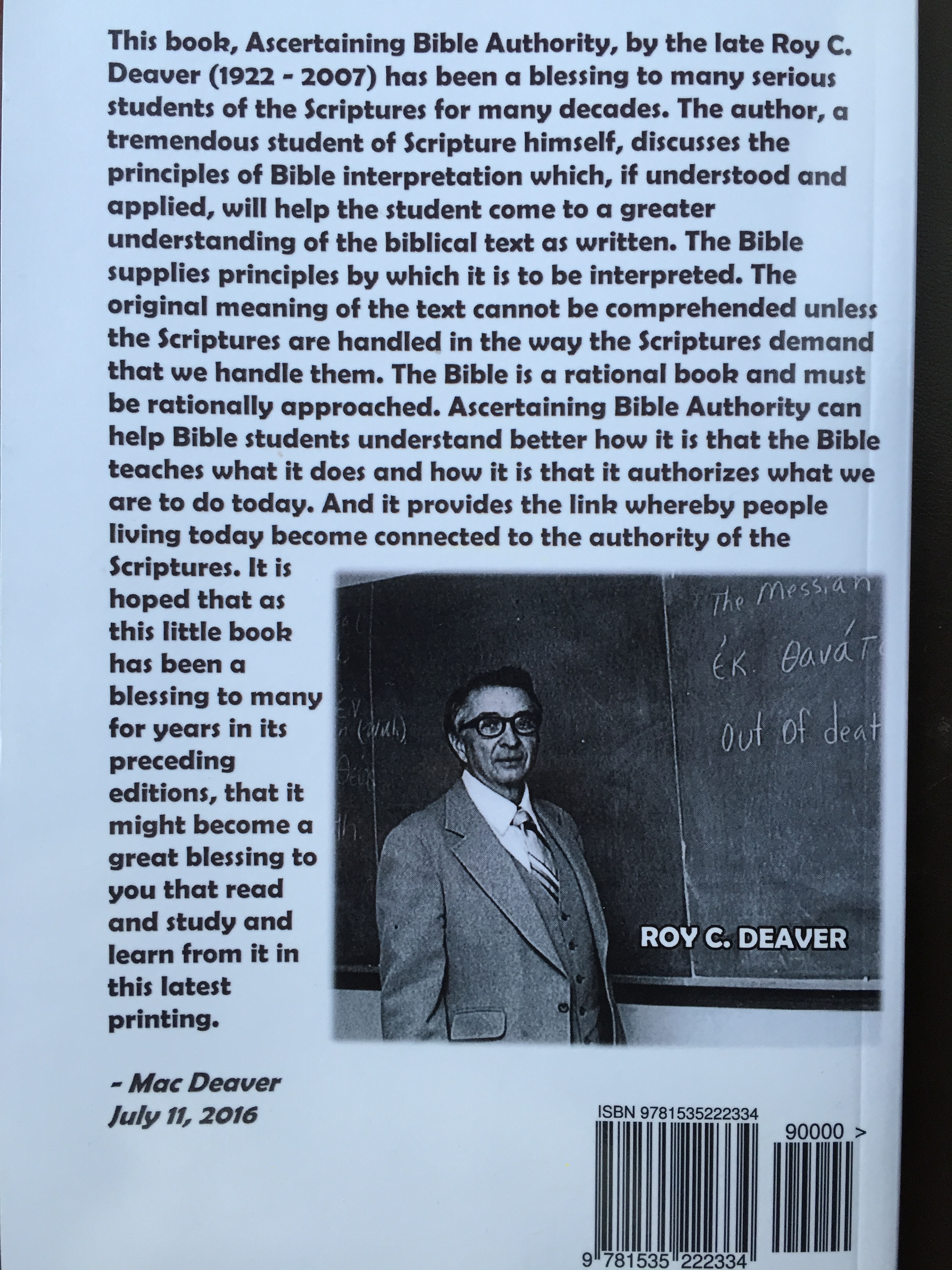
Back in print: “Ascertaining Bible Authority”

IMG_3797Roy C. Deaver’s much-used little book on how the Bible authorizes is now available for purchase online here and here. It is ideal for congregational study or in the preacher training classroom, where he spent so much of his life. Thanks to Stephen Bradd for getting the book in digitized form. Info for the book will be permanently listed on our website.


IMG_3798

Posted in Christianity and Culture

Society is out of touch with reality

By Weylan Deaver

Reality is what exists. Truth harmonizes with what is real. Truth is not a fabrication of the imagination. A fact is a true reflection of actual condition. When it comes to human behavior in a godless society, when “the sky’s the limit,” Judgment Day is still the destination, even if most don’t see it coming. People can do whatever they want, but none can do it with impunity. Denying truth does not make it false; loving the lie does not make it true. Sin is real, even if the doer does not see it. God still says certain activity is sinful, regardless what is acceptable to our president, courts, laws, customs, entertainers, academics, or neighbors. To name a few: Sex outside marriage is sin (Hebrews 13:4). Homosexuality is sin (1 Corinthians 6:9). Men dressing like women, or vice versa, is sin (Deuteronomy 22:5). Lying is sin (Revelation 21:8). Not being sober is sin (1 Thessalonians 5:6). Refusing to repent of every sin is sin (Acts 17:30). Refusing to obey the gospel of Christ is sin (2 Thessalonians 1:8). “Jesus Christ is the same yesterday and today and forever” (Hebrews 13:8, ESV). The Bible’s message does not evolve to accommodate political correctness, or to coddle the sensibilities of people in rebellion against the Lord. God states the facts, tells us what is right and what is coming. He warns us against the foolishness of the world (1 Corinthians 1:19-21). God educates us on reality. He does not ask us what we want; he tells us how it is. To adopt the Bible’s perspective is to see things accurately, that we might be prepared for eternity. A society that celebrates sin constructs its own coffin. In the church of Christ, we stand in God’s truth, as given in God’s book. Whether that appeals to anyone or not, reality still looms closer every day. “For we must all appear before the judgment seat of Christ, so that each one may receive what is due for what he has done in the body, whether good or evil” (2 Corinthians 5:10).

Posted in Announcements, Books

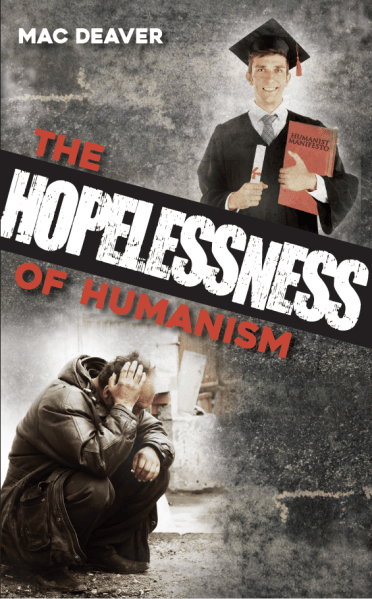
New Book: The Hopelessness of Humanism

unnamedThe Warren Christian Apologetics Center has released a brand new title by Mac Deaver critiquing the shortcomings of the humanist outlook. Their website describes it:

This 82 page book is a response to James A. Haught, Editor Emeritus of the Charleston Gazette-Mail, West Virginia’s largest newspaper. For several decades, Haught has published materials advocating a skeptical philosophy of life. Mac Deaver, in The Hopelessness of Humanism, has shown the logical implications and the practical results of a society based upon atheism and agnosticism.

Published in April 2016 by the Warren Christian Apologetics Center, it can be ordered from them at this link.

Posted in Christianity and Culture

Our Nation’s Root Problem

By Marlin Kilpatrick

Every tree has a tap root. The tap root supplies the tree with the proper nutrients that will make the tree grow. The tap root is the tree’s main source for survival. Any disease affecting the tap root may have devastating effects on the tree. Indeed, the consequences may be fatal.

Our nation’s “tap root” is in serious (if not fatal) distress. Our tap root is full of disease; it is putrid with all uncleanness. We have become a spiritually sick nation. It doesn’t take a Solomon to see our nation is heading for a fall, unless crucial corrections are made, and made promptly. We cannot last as a free nation when the One who made us free is mocked, scorned, and rejected. “Righteousness exalteth a nation, but sin is a reproach to any people” (Pro. 14:34).

Anyone who grew up in the 40’s and 50’s knows there was a time when our nation had at least some moral fiber. Compared with today, these years were truly an age of innocence. I was a Junior in high school before I heard the word “marijuana.” Today, marijuana (a drug) is considered beneficial for medicinal purposes, and is even being legalized in many of our states. Drugs, such as heroin, crack cocaine, et al., are common fare on many street corners in downtown U.S.A. Alcohol (another drug) freely flows among our teenagers and, often, in our places of employment. This environment has had a detrimental effect on the Lord’s church. Some members of the Lord’s church think nothing of keeping a six-pack of beer in their refrigerators. Unless alcohol is prescribed for medicinal purposes, its consumption is condemned in the Scriptures. Drunkenness is a matter of degree. To whatever degree one consumes alcohol as a recreational beverage, to that degree one is scripturally drunk. The claim that one may drink so long as he does not become drunk is surely not sound.

Our nation’s root problem is its rejection of God and His Word, the Bible. Most of our nation’s forefathers had at least a nominal knowledge of the Scriptures. Most of our forefathers were not New Testament Christians, but most had a high respect for the Bible, and they often quoted the Scriptures to explain their civil, as well as religious, convictions. Our nation is spiritually suffering as a result of several U.S. Supreme Court decisions, not the least of which are the 1973 Roe v. Wade decision, legalizing abortion, and the more recent legalization of so-called “same sex marriage.” If there were ever a misnomer for marriage, “same sex” is it. “Same sex marriage” is not biblical marriage; it is biblical fornication—period. There will be no fornicators in heaven. Fornication is a work of the flesh (Gal. 5:19-21).

Today evolution is taught in our public schools as a fact, not as a theory. Biblical creation is flatly denied by our school teachers and anyone who believes the biblical account of creation may be mocked. When we watch the National Geographic channel and a group of apes are being observed, it’s not at all uncommon to hear someone refer to these apes as “our nearest relatives.” Behind such an observation is the theory of evolution. One cannot believe Jesus and believe the theory of evolution. Jesus endorsed the Genesis account of man’s creation when he said, “have ye not read that he which made them at the beginning, made the male and female” (Matt. 19:4). Man has not evolved; rather, he was made by his Creator. The theory of evolution leads to many problems for society. If man is just an improved ape, then he will care nothing about spiritual matters. Is it any wonder why most people live as they do? When our boys and girls are taught the theory of evolution, we are sowing to the wind and, like Israel of old, we shall reap the whirlwind (cf. Hos. 8:7).

Our nation’s root problem can only be solved by a return to respect for God and His Bible. Today all accountable persons are amenable to the gospel of Christ. The gospel is God’s only power to save man from his sins (Rom. 1:16). To be saved we must throw off the moral degradation which has engulfed us. We must humbly submit our wills to the New Testament of Jesus Christ. There is no other alternative. If we continue on our downward slide into immorality in any form, we will one day reap what we have sown (cf. Gal. 6:7-8). Think about it.

Posted in New Testament

Other Tongues

By Mac Deaver

In John 8:43 the Lord once asked some of his contemporaries, “Why do ye not understand my speech? Even because ye cannot hear my word” (ASV). The footnote shows that the Greek word translated “understand” is actually the word for “know.” The Lord was asking why it was that those who spoke the same language did not know what he was saying. His explanation was that they could not hear his word. That is, though they spoke the same language as he did, they could not grasp the meaning of what he was saying. It was one thing to know the meaning of isolated words; it was another to comprehend the connection of words in sentence construction. In verse 45 he declares why it was that they could not comprehend what he was saying. In their case, it was a perversity of character. Since Jesus was telling the truth and their hearts were not attuned to the reception of it, they were not getting it. And in verse 47, he ascribes their lack of understanding to the fact that they were not “of God.” Dishonesty stood between them and understanding of truth.

But there are other reasons why someone might not understand or comprehend a message, one of which is that the sound of the message may, in fact, be presented in a language that he does not know. That is, the message is completely unintelligible to him because he does not know the words of that language. Each word is merely a sound that signifies nothing to him.

The New Testament doctrine of “tongues” is historically rooted in an event that God had long ago caused. When men refused to scatter on the earth, God confused their language. At the time only one language was being spoken (Gen. 11:1), and the people were not scattering out over the earth. So, in order to motivate human scattering, God made it impossible for some of the people to understand others of them. The details are not provided, but somehow in the power of God, he changed the language comprehension of some of them so that a language barrier now existed. And since humans tend to associate mainly with those with whom they can by words communicate, some people then left the area. This change in language was preceded by changing the relationship between humans and snakes (Gen. 3:15), changing the male-female relationship (Gen. 3:16), and by changing the relationship between man and the sustenance of life (Gen. 3:19). These changes followed the commission of the first sin. Later following the flood, another change took place: the relationship between humans and animals (Gen. 9:1-4).

So, the change in the then immediate language capacity was the latest of the changes that God brought about to position man as he desired him now to be on this earth. This was God’s own way of separating people so that they would “replenish the earth” (Gen. 1:28) and not simply stay in the vicinity where they had all been born. Evidently, there were none or few who would on their own at this time adventure out into the great unknown world. So, it was God himself who created the situation in which men could not understand other men. Because of human reluctance to venture out into the world, God created the language barrier between humans. We are not told how many languages were now being comprehended. We can only know that the number was sufficient in God’s eyes to cause the desired scattering.

Notice please that God divided the nations in the earth after the flood (Gen. 10:32). The division of the earth referred to in Genesis 10:25 is not geological; it is ethnological. God would later separate another group from all the rest of humanity, not by language but by a covenant. All of Abram’s descendants were to be distinguishable from the rest of the world. By means of the circumcision covenant that God made with Abram, God created the Hebrew nation (Gen. 17:1-14). Abram was “the Hebrew” (Gen. 14:13). His descendants became known as “Hebrews” (cf. Gen. 39:14).

But our point just here is that all of these changes were initiated by God himself. And the language barrier was only one of the changes he wrought in the earth. And as with all the changes just mentioned, it affected the course of human existence and history for all time. The issue of the language barrier did not need additional divine attention until it was necessary for all men to hear the gospel of Christ. As long as Jews were amenable to God through the law of Moses and as long as the Gentiles were amenable to God through moral law (Rom. 2:14-15), (that is, as long as there was divinely imposed ethnic segregation) there was no necessity of divine intervention regarding the language barrier in any way.

But when the universal religion of Jesus Christ became operative on Pentecost of Acts 2, the stage was now historically set so that eventually all men would become answerable to God through Christ (Acts 17:30-31). Several years passed before the gospel was preached to the first full-blood Gentile (Acts 10), but by the end of the first century, all accountable men then living were answerable to the gospel (Col. 1:23; Mark 14:9; 16:19-20).

But in order to fulfill the mission of taking the gospel to the whole world (Mark 16:15-16), the apostles made use of a gift in order to speak to men whose language they did not know (Acts 2:5-12). Later, when the Holy Spirit deemed it appropriate, other brethren were endowed with this gift as well (1 Cor. 12:4-11).

Since God had changed the structure of human accountability, it was up to God to make the announcement. Men could not be held accountable to a message that they never received since they were already living within the confines of divinely imposed religious responsibility. God had left Gentiles in Gentile-ism and the Jews in Judaism. But now that divinely imposed human amenability would no longer be sufficient in God’s mind to allow humans to any longer retain God’s favor. As the announcement of the change in amenability was made, human accountability changed. And since there were various languages spoken throughout the world, it was necessary (if God wanted the gospel carried throughout the world in a relatively short period of time) that men be able to speak languages that they had not studied and did not know in order to make the announcement known throughout the Roman empire.

Miraculous divine intervention was utilized in pointing out the places to go to for optimum success (Acts 16:6-10) and in providing the languages that must be utilized but were not by the teachers then known. It was God’s will that the change in amenability be announced within the historical context of divine miraculous involvement. He would not and did not leave matters simply to human decisions and human capacity. The work of taking the gospel to the world was finalized within the time of the miraculous workings of God. That is also the same time period in which he completed his divine book by inspiring the writing of the complete New Testament (2 Tim. 3:16-17; 2 Pet. 1:20-21; 1 Cor. 2:12-13).

That book had to be completed before God could withdraw the miraculous element from the earth, just as the preaching of the gospel had to be completely taken into all the world before God could hold all men now answerable to the gospel and judge all men by Christ. Men became amenable to the gospel as the gospel became accessible. They were being called out of two divine systems already in place. Those alive in the first century were being “transitioned” from Gentile-ism and Judaism into a new divinely imposed accountability to the gospel of Christ. Nothing like that historic moment has ever existed again. That is, the time period in which God was relocating Jews and Gentiles under obligation to the gospel was a period of time and a religious situation that could never be duplicated since Gentile-ism and Judaism were divinely replaced by Christianity.

The “tongues” that the Spirit provided were the means of God’s addressing the language barrier that existed then (and which still exists now but without any need for miraculous intervention). God settled for all time the issue of human amenability within a thirty year period (from about 30 A.D. to about 63 A.D.). Everyone had access to God’s announcement of the change of amenability! There was no geographical area on earth inhabited by people that was not contacted.

Tongues” were for a sign to the unbelieving world (1 Cor. 14:22). The kind of question raised by the yet unbelievers on Pentecost was no doubt raised time and time again. How is it possible for someone who does not ordinarily speak my language to speak it now (Acts 2:7-8)? The event itself signified that something divine and miraculous was occurring!

Thus, it is clear that “tongues” were languages. The disciples of John on Pentecost of Acts 2 spoke “with other tongues” (v. 4). These tongues were real languages (v. 6). They did not simply utter unintelligible sounds, but languages that were known and spoken by others. Furthermore, by the fact that “tongues” were always subject to rational interpretation, we know that they were sounds that made sense (1 Cor. 14:13).

It should also be observed that in 1 Corinthians 13, where Paul discusses the cessation of miraculous gifts (including miraculous tongues), he mentions three specific things that will cease as he compares the cessation of miracles to the permanence of faith, hope, and love. That is, in chapter 13 he is contrasting what is passing away and what remains. The miracles are coming to an end; faith, hope, and love are permanent features of the faithful church. So, in 1 Corinthians 13:8 he declares that prophecies, tongues, and knowledge will all come to an end (v. 8), and the gift of prophecy was miraculous (1 Cor. 12:10). He states that tongues shall cease, and miraculous tongue-speaking was another miraculous gift (1 Cor. 12:10). Thirdly, he says that knowledge will cease. This, of course, is knowledge that is miraculous to which reference had already been made (1 Cor. 12:8). Thus interestingly, each of the three items that Paul cites in 1 Corinthians 13:8 has to do with information! Miraculous information will cease being provided, he is saying. In verse 10, when he refers to “when that which is perfect is come,” he is contrasting that perfect or completed information with the partially and miraculously supplied information. When the perfect thing is finally here in its completed form, Paul is saying, then no longer is there a partial thing here. And when the perfect thing is here, there is no longer any need for the miraculous process that had delivered information up to the time of the perfected or completed form. When the perfect thing is come, that which is in part (the partial product) ceases. That is, there is no longer a merely partial thing. It has eventuated into the perfect or the now completed thing.

Finally, let me say a word about the transmission of scripture. God removed the miraculous element from the earth. Scripture would remain as promised (1 Pet. 1:25), but its permanence would obtain through translation. God would not keep scripture here by miraculous intervention. His divine providence would suit the situation so that capable people would be available at the right place and the right time to transmit scripture into languages that were then, as seen by God, now ready for scripture dissemination through them. Today those who are capable of translating scripture and those who have an inherent interest in certain people and places are all entailed in the marvelous providence of God. And neither group, translator or missionary, has access to the first-century gift of tongues.

Posted in Expository, New Testament

Turn the Sinner Back: Notes on James 5.19-20

It would appear that James declares the purpose of his letter at the very end (Davids 1994, 1367), in Jas 5.19-20, by calling his readers to do what he has just done by writing:

My brothers and sisters, if anyone among you wanders from the truth and someone turns him back, he should know that the one who turns a sinner back from his wandering path will save that person’s soul from death and will cover a multitude of sins (NET).

By leaving his purpose statement for the end, and crouching it in yet another recommended behavior, perhaps he hopes that his readers will not only repent of those sins and errors which he points out, but will themselves turn to their erring brethren and work toward their restoration as well.

The 54 imperatives in the 108 verses leave no doubt that James is concerned to straighten out problems among his readers. (The last imperative is in verse 20: “know.”) They also highlight what is evident from even a cursory reading, that the book emphasizes the necessity of obedient action among the faithful in order for faith to be genuine and effective for salvation. “Tests of a living faith” is the key that one writer finds to tie the letter’s diverse subjects together under a single theme (Hiebert 1978, 224). Continue reading “Turn the Sinner Back: Notes on James 5.19-20”