Posted in Expository, New Testament

They Asked Him a Question (Matt. 22:23-33)

By Weylan Deaver

One day Sadducees brought Jesus what they considered an unanswerable dilemma. They might have sprung their trap had they not been in error, and had they been dealing with someone other than Jesus. As it happened, they failed spectacularly and were, themselves, put to silence. It is recorded in Matthew 22:23-33 (also Mark 12, Luke 20).

One hallmark heresy of the Sadducees was denial of the resurrection. They asked Jesus a question stemming from their custom of a dead man’s brother marrying the widow of the deceased in order to raise children to carry on the name of the deceased. They describe a married couple without children. The husband dies and his brother marries the widow, but they have no children. That husband dies and a third brother marries the woman twice widowed. The scenario grows more far-fetched with the telling, with all seven brothers marrying the same woman, all seven dying, followed by the widow’s death. The question for Jesus is: “Whose wife is she in the resurrection?” It would seem the Sadducees have put Jesus in the position either of affirming an absurd marriage of seven husbands to one wife simultaneously on the other side of death, or that some marriage ties survive death while others do not. The other option is to deny the reality of resurrection, which is what the Sadducees did.

Interestingly, their hypothetical could have accomplished the same thing with only two dead husbands instead of seven. But, opposing the Lord, they knew neither where to start nor when to stop. Jesus stopped them in their tracks with his rebuke. He said the Sadducees were wrong. He said they did not know their Bible, and they did not know God’s power. He said marriage does not apply in the resurrection since people will be like angels (i.e. not married).

Then, Jesus took it further by falsifying the Sadducee’s denial of resurrection. When they read in Exodus 3:6 about the God of Abraham, Isaac and Jacob, they should have understood God as God of the living—not the dead. And, since Abraham, Isaac and Jacob had died long before God spoke those words to Moses, the Sadducees should have inferred that the spirits of the patriarchs were still alive, and, thus, had no trouble accepting the concept of resurrection from the dead. Consider several observations from this account.

First, Jesus was never silenced by intimidation. He boldly told the Sadducees, “you are wrong” (v. 29). Are we willing to say what needs saying, even in the face of spiritual enemies?

Second, we must know God’s pen and God’s power (v. 29). Ignorance of the Scriptures always puts one in error. People who claim to believe the Bible, but who don’t even understand the Bible, are modern day Sadducees.

Third, marriage is an earth-bound institution (v. 30). Like our mortal bodies, marriage does not survive the grave. The Sadducees mistakenly assumed that, if resurrection were real, things after it must be the same as things before it. They did not anticipate Jesus’ answer: In the resurrection, things are very different. And, that answer destroyed the Sadducees attempted dilemma.

Fourth, Jesus did not compromise God’s truth to fit human error (v. 30). He compared resurrected people to angels, knowing that Sadducees denied angels. Are we ever tempted to tread lightly with certain subjects because we know they are controversial, or might bring us criticism (for example, the Genesis creation account, biblical miracles, marriage-divorce, etc.)? Never let Satan’s fiction make you avoid God’s fact.

Fifth, Jesus had the highest view of Scripture (v. 31). He understood it was the means by which God spoke to the Sadducees, even though they were not born when the Old Testament was being written.

Sixth, the Sadducees ignorance was not for lack of information (v. 31), since God had spoken to them in the Scriptures. They had not reasoned rightly about what God wrote, which allowed them to get in serious error. Their ignorance was inexcusable.

Seventh, Jesus is the master logician (v. 32). The passage he quoted to the Sadducees was Exodus 3:6, where God is described as “the God of Abraham, and the God of Isaac, and the God of Jacob.” Those three patriarchs had been dead for centuries when God spoke those words to Moses from the burning bush. Implied is that those three patriarchs were not dead, but living. If the Sadducees had seen the implication taught in Exodus 3:6, they should have had no trouble with the concept of resurrection.

Eighth, it is possible to be amazed at something heard, without believing it (v. 33). Astonishment at the Lord’s teaching is a good first step, but no substitute for acceptance. God help us avoid the mistakes of the Sadducees.

Posted in Salvation

A Misunderstood Death

By Marlin Kilpatrick

There are numerous events recorded in the Bible about which we may misunderstand; this is why we need to daily study our Bibles. What the death of Christ makes possible for all people everywhere is often misunderstood by those who are in denominationalism. Very few people who have actually studied the Bible and ancient world history will deny there once lived a man named Jesus. And this Jesus, according to the New Testament, lived among men and was finally crucified by the Roman soldiers on a hillside outside of Jerusalem. So the historicity of the death of Christ is not man’s problem. But, through the perversion of the Scriptures by false teachers and their doctrines, there are many folks who, today, sincerely believe they are saved, when such is not true.

I once was in a private discussion with a denominational preacher. He claimed he believed in baptism as much as I, but not for the same reason. I pointed out to him that if we both do not believe that baptism is for the remission of our sins, we both are lost. I cited Acts 2:38, to which he replied, “I know that my Redeemer liveth and that he died for my sins on Calvary’s cross.” Dear reader, in such a claim lies one of the most misunderstood facts about the death of Christ. This preacher also claimed that Christ did everything for man on the cross and there’s nothing for man to do but accept the merits of Christ’s death and be saved. Such claims are indicative of a gross misunderstanding about the death of Christ.

Did Christ accomplish everything at Calvary? The answer to this question depends upon what is meant. For example, if it is meant that Christ accomplished everything he intended to accomplish in his death, the answer is yes! If, however, it is meant that by simply believing that Christ died for our sins, and without any further act(s) of an obedient faith, we are saved, then the answer is no!

Precious people, it is true Jesus did die for our sins on Calvary’s cross. In fact, the apostle John wrote, concerning Jesus’ death, “And he is the propitiation for our sins, and not for our sins only, but also for the sins of the whole world” (1 John 2:2). While Jesus died for the sins of mankind, this does not mean that all of mankind will be saved. On the contrary, Jesus said the majority of mankind will be lost (cf. Matt. 7:13,14).  If Jesus died for all men, but not all men will be saved, then what is the explanation of Jesus’ death?

Jesus died to make salvation possible for all men. When Jesus died he shed his blood (cf. John 19:34). The shedding of Jesus’ blood provides for all men the opportunity to be saved. The death of Christ only makes possible this opportunity, but to be saved, we must be washed in the blood of Christ (cf. Rev.1:5). Sinners are only saved when they are baptized into the death of Christ, in which they are washed from their sins; this is why baptism is “for the remission of sins” and why “…baptism doth also now save us” (cf. Rom. 6:3,4; Acts 2:38; 1 Pet. 3:21).

Friend, have you obeyed the gospel of Christ? If we fail to obey the gospel, we will be eternally lost (cf. 2 Thes. 1:7-9). The churches of Christ stand ready at any time to assist you in your obedience to the gospel. Think about it.

Posted in Christianity and Culture

An Education Itself

Who is an educated person? A man with a doctoral degree? A master’s degree? A bachelor’s? An associate’s? A high school diploma? One who can read? One who does read? A man who knows well the field in which he earns a living? One acquainted with history and who appreciates fine art? One who mingles with the academics? Webster defines educate as “to cultivate and discipline the mind and other faculties by teaching.” Thus, an educated man is taught and disciplined in respect to some area(s) of knowledge.

Has America made the mistake of making a god of the educative process with little to no regard for what the process is actually teaching? We’ve raised generations to such heights of “education” they now believe people are nothing but glorified chimpanzees. Many “educated” educators teach the next generation of “educated” to trust the state and doubt the Bible, to indulge the flesh and refrain from religion, to deify man and detest the Messiah. We’ve “educated” a horde of lawyers and judges to teach us that the Lord has no real place on the public scene, on public property, or — in essence — in the public psyche. Ironically, God has become almost a trespasser in a nation whose coins still vow trust in him.

The apostle Paul indicated there is such a thing as “falsely called ‘knowledge’” (1 Tim. 6:20, ESV). Surely it does not profit the mind to be full of falsehoods. Deceit will not deliver; lies will not last. The human mind was designed to run on higher grade fuel than error offers. Yet, there will always be he who “loves and practices falsehood” (Rev. 22:15), thereby hindering his own ability to perform as a man educated in what truly matters. There will be those “always learning and never able to arrive at a knowledge of the truth” (2 Tim. 3:7). What results is that the ostensibly educated are, in fact, blinded to genuine truth. This is why Festus could say, “Paul, you are out of your mind; your great learning is driving you out of your mind” (Acts 26:24). No doubt Festus fancied himself more rational than the apostle when it came to the gospel, but reality was otherwise.

Let us lay aside the question of who Americans think is educated and, instead, ask, “Whom does God deem educated?” That answer reveals a strikingly different perspective. There is no degree required. No particular school is mandated. No diploma, no class ring, no alumni association, no grade point average, no transcript. In fact, it consists in nothing else but learning and doing God’s truth (John 8:32), which puts one in very close contact with a man named Jesus. Antagonists of the gospel long ago came to see that Jesus had a most unsettling way of turning the socially unlearned into the spiritually enlightened. “Now when they saw the boldness of Peter and John, and perceived that they were uneducated, common men, they were astonished. And they recognized that they had been with Jesus” (Acts 4:13). You see, being with Jesus is the education.

Listen to and do what he taught and you will far outshine the rest. The psalmist wrote about God’s word, “I have more understanding than all my teachers, for your testimonies are my meditation” (Psalm 119:99). So, who is educated? Is it a Ph.D. who rejects the gospel and goes to hell, or a high school dropout who obeys the Lord and goes to heaven? Who knew what mattered? As C. S. Lewis put it in the book, Mere Christianity (p. 78): “If you are thinking of becoming a Christian, I warn you, you are embarking on something which is going to take the whole of you, brains and all. But, fortunately, it works the other way round. Anyone who is honestly trying to be a Christian will soon find his intelligence being sharpened: one of the reasons why it needs no special education to be a Christian is that Christianity is an education itself.”

Posted in Expository, New Testament

John 3:16 – More Than Meets the Eye

By Weylan Deaver

It’s one of the most familiar Bible verses, and often appealed to as the basis of salvation. “For God so loved the world, that he gave his only Son, that whoever believes in him should not perish but have eternal life” (ESV). While so much is packed into so few words, much also remains unstated. Many fail to realize that verse is summation, not explication. It summarizes what God has (love), what God did (gave), what a person does (believes), and what a believer should have (eternal life). What was involved when God “gave his only Son”? The verse has no particulars about the incarnation, the cross, the blood atonement, Jesus’ death, burial, resurrection. You have to go to other passages to flesh out the details of God’s gift. Likewise, “eternal life” is offered “whoever believes,” but details of heaven and of faith’s response are not given. You must go elsewhere for elaboration.

The problem is, many read “whoever believes” (v. 16) and assume it simply means mentally accepting facts about Jesus, and then getting “eternal life.” But, the very context of John 3 proves that “whoever believes” cannot mean salvation by belief only.

Jesus said, “unless one is born again he cannot see the kingdom of God” (John 3:3). If you cannot participate in God’s kingdom, you are not saved. And, no one sees the kingdom who has not been “born again.” This new birth is vital to participation in the kingdom, and the kingdom is vital to salvation. Therefore, whoever believes, if he would have eternal life, must become a believer who has been “born again.”

Jesus added detail to the concept of new birth when he said, “unless one is born of water and the Spirit, he cannot enter the kingdom of God” (John 3:5). Again, none “enter the kingdom” without a new birth consisting of both “water and the Spirit.” Therefore, whoever believes, if he would have eternal life, has to become a believer who has been “born of water and the Spirit.”

Jesus also said, “But whoever does what is true comes to the light, so that it may be clearly seen that his works have been carried out in God” (John 3:21). Truth demands action, not just mental acceptance. And, while many religious folk act as though “works” is a dirty word unrelated to salvation, Jesus taught otherwise. My works cannot save me, but God’s works do. When I do what God commands, I am doing God’s works, and that is essential to salvation. In fact, Jesus also said, “This is the work of God, that you believe in him whom he has sent” (John 6:29). So, John 3:16 mentions a believer, but does not mention works. But, John 6:29 tells us a true believer is already doing “the work of God” since belief, itself, is called a “work”! Therefore, whoever believes, if he would have eternal life, must be a believer who “does what is true.”

Further we are told, “After this Jesus and his disciples went into the Judean countryside, and he remained there with them and was baptizing. John also was baptizing at Aenon near Salim, because water was plentiful there, and people were coming and being baptized” (John 3:22-23). Why the emphasis on baptism? Because, as Jesus said in v. 5, “unless one is born of water and the Spirit, he cannot enter the kingdom of God” (Peter stated it, “Repent and be baptized every one of you in the name of Jesus Christ for the forgiveness of your sins, and you will receive the gift of the Holy Spirit” [Acts 2:38]). “Born of water” happens when one is “baptized” in water. Baptism means immersion, and immersion requires “plentiful” water, which is why John was where he was—there was plenty of water. If Jesus connected “water and the Spirit” in being “born again” (v. 5), nobody has the right to disconnect or discount either element. Both are required. Moreover, nobody has the right to redefine baptism (which means immersion) so that it means sprinkling or pouring water, neither of which requires much water. Bible baptism is immersion (physically in water and spiritually in the Holy Spirit). Such is the new birth. Therefore, whoever believes, if he would have eternal life, must be someone who has been immersed in order to be born again.

Finally, note the chapter’s last verse: “Whoever believes in the Son has eternal life; whoever does not obey the Son shall not see life, but the wrath of God remains on him” (John 3:36). Verses 16 and 36 both mention “whoever believes.” But, while obedience is implied in v. 16, obedience is explicitly mentioned in v. 36. Who gets to “see life”? The one who obeys God’s Son. The saved believer is the obedient believer. Believing is obeying, but obedience includes more than just believing.

God can put a summary in a single verse (such as John 3:16), but he never lists everything involved in obedience in any one verse. The only way to know the total requirements is to take all the pertinent passages together. In other words, take the entire New Testament. In our case, we’ve taken several connected truths from John 3, both before and after the words of v. 16. It is a monumental mistake to interpret John 3:16 as teaching salvation by belief alone. But, if belief by itself cannot save, then everything involved in salvation is not listed in John 3:16. And that means you have to go outside John 3:16 to learn what obedience entails.

Belief is a first step since “to all who did receive him, who believed in his name, he gave the right to become children of God” (John 1:12). Yes, “God so loved the world” (John 3:16), but benefitting from that love requires continual commitment to Jesus’ commands. “If you keep my commandments, you will abide in my love, just as I have kept my Father’s commandments and abide in his love” (John 15:10).

Posted in Christianity and Culture

Master of Illusion

By Weylan Deaver

Satan is master of illusion. Though pure evil, he can give the appearance of an angel of light (2 Cor. 11:14). The devil can make the righteous feel outnumbered, outgunned, and overpowered, when such is not the case at all. He can talk Christians into surrendering on his terms by getting them to overlook the vast spiritual resources God puts at their disposal. Long ago, the prophet Elisha was surrounded by a Syrian army bent on his capture (2 Kings 6:8-17). Elisha was not bothered by this, but his servant was greatly distressed. Elisha told his servant, “Fear not; for they that are with us are more than they that are with them.” Elisha then prayed for God to open the eyes of his servant so he could see what Elisha already saw. God did so, and the servant was able to see “the mountain was full of horses and chariots of fire round about Elisha.” God had the matter well in hand, and was more than able to conquer the Syrians, which he did. Elisha’s servant gained a new and accurate perspective. He learned the enemy’s strength was illusory, and that, if God is for you, there is more power at work than can be defeated. And there is more to a battle than meets the eye. Wickedness is at high tide in America: abortion, homosexuality, fornication, divorce, drunkenness, hatred, lying, atheism, false religions, etc. The list is long, but sin’s heyday will not last. The master of illusion is served by the deluded. We need to believe the Bible and dig in, not give up. After all, “If God is for us, who is against us?” (Rom. 8:31).

Posted in Announcements, Books

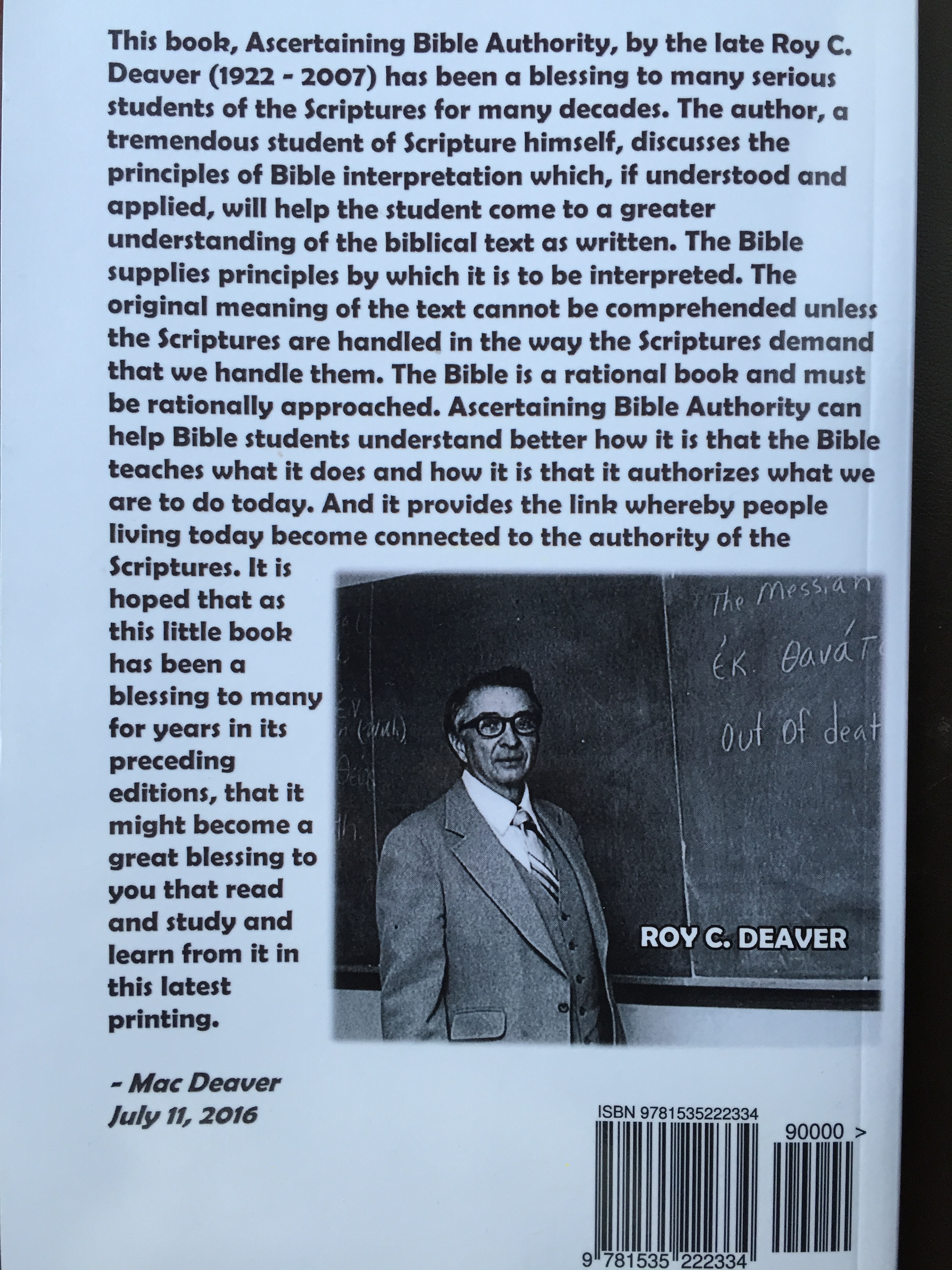
Back in print: “Ascertaining Bible Authority”

IMG_3797Roy C. Deaver’s much-used little book on how the Bible authorizes is now available for purchase online here and here. It is ideal for congregational study or in the preacher training classroom, where he spent so much of his life. Thanks to Stephen Bradd for getting the book in digitized form. Info for the book will be permanently listed on our website.
 

IMG_3798

Posted in Christianity and Culture

Society is out of touch with reality

By Weylan Deaver

Reality is what exists. Truth harmonizes with what is real. Truth is not a fabrication of the imagination. A fact is a true reflection of actual condition. When it comes to human behavior in a godless society, when “the sky’s the limit,” Judgment Day is still the destination, even if most don’t see it coming. People can do whatever they want, but none can do it with impunity. Denying truth does not make it false; loving the lie does not make it true. Sin is real, even if the doer does not see it. God still says certain activity is sinful, regardless what is acceptable to our president, courts, laws, customs, entertainers, academics, or neighbors. To name a few: Sex outside marriage is sin (Hebrews 13:4). Homosexuality is sin (1 Corinthians 6:9). Men dressing like women, or vice versa, is sin (Deuteronomy 22:5). Lying is sin (Revelation 21:8). Not being sober is sin (1 Thessalonians 5:6). Refusing to repent of every sin is sin (Acts 17:30). Refusing to obey the gospel of Christ is sin (2 Thessalonians 1:8). “Jesus Christ is the same yesterday and today and forever” (Hebrews 13:8, ESV). The Bible’s message does not evolve to accommodate political correctness, or to coddle the sensibilities of people in rebellion against the Lord. God states the facts, tells us what is right and what is coming. He warns us against the foolishness of the world (1 Corinthians 1:19-21). God educates us on reality. He does not ask us what we want; he tells us how it is. To adopt the Bible’s perspective is to see things accurately, that we might be prepared for eternity. A society that celebrates sin constructs its own coffin. In the church of Christ, we stand in God’s truth, as given in God’s book. Whether that appeals to anyone or not, reality still looms closer every day. “For we must all appear before the judgment seat of Christ, so that each one may receive what is due for what he has done in the body, whether good or evil” (2 Corinthians 5:10).

Posted in Announcements, Books

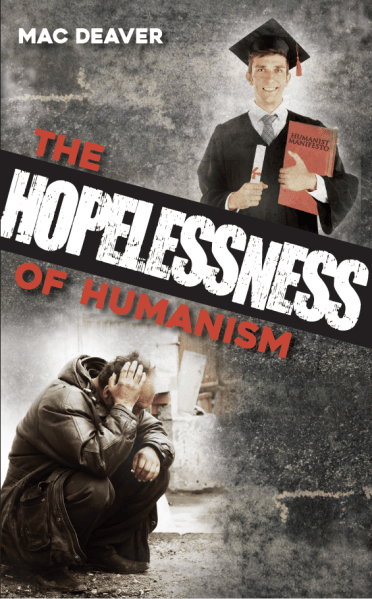
New Book: The Hopelessness of Humanism

unnamedThe Warren Christian Apologetics Center has released a brand new title by Mac Deaver critiquing the shortcomings of the humanist outlook. Their website describes it:

This 82 page book is a response to James A. Haught, Editor Emeritus of the Charleston Gazette-Mail, West Virginia’s largest newspaper. For several decades, Haught has published materials advocating a skeptical philosophy of life. Mac Deaver, in The Hopelessness of Humanism, has shown the logical implications and the practical results of a society based upon atheism and agnosticism.

Published in April 2016 by the Warren Christian Apologetics Center, it can be ordered from them at this link.

Posted in Christianity and Culture

Our Nation’s Root Problem

By Marlin Kilpatrick

Every tree has a tap root. The tap root supplies the tree with the proper nutrients that will make the tree grow. The tap root is the tree’s main source for survival. Any disease affecting the tap root may have devastating effects on the tree. Indeed, the consequences may be fatal.

Our nation’s “tap root” is in serious (if not fatal) distress. Our tap root is full of disease; it is putrid with all uncleanness. We have become a spiritually sick nation. It doesn’t take a Solomon to see our nation is heading for a fall, unless crucial corrections are made, and made promptly. We cannot last as a free nation when the One who made us free is mocked, scorned, and rejected. “Righteousness exalteth a nation, but sin is a reproach to any people” (Pro. 14:34).

Anyone who grew up in the 40’s and 50’s knows there was a time when our nation had at least some moral fiber. Compared with today, these years were truly an age of innocence. I was a Junior in high school before I heard the word “marijuana.” Today, marijuana (a drug) is considered beneficial for medicinal purposes, and is even being legalized in many of our states. Drugs, such as heroin, crack cocaine, et al., are common fare on many street corners in downtown U.S.A. Alcohol (another drug) freely flows among our teenagers and, often, in our places of employment. This environment has had a detrimental effect on the Lord’s church. Some members of the Lord’s church think nothing of keeping a six-pack of beer in their refrigerators. Unless alcohol is prescribed for medicinal purposes, its consumption is condemned in the Scriptures. Drunkenness is a matter of degree. To whatever degree one consumes alcohol as a recreational beverage, to that degree one is scripturally drunk. The claim that one may drink so long as he does not become drunk is surely not sound.

Our nation’s root problem is its rejection of God and His Word, the Bible. Most of our nation’s forefathers had at least a nominal knowledge of the Scriptures. Most of our forefathers were not New Testament Christians, but most had a high respect for the Bible, and they often quoted the Scriptures to explain their civil, as well as religious, convictions. Our nation is spiritually suffering as a result of several U.S. Supreme Court decisions, not the least of which are the 1973 Roe v. Wade decision, legalizing abortion, and the more recent legalization of so-called “same sex marriage.” If there were ever a misnomer for marriage, “same sex” is it. “Same sex marriage” is not biblical marriage; it is biblical fornication—period. There will be no fornicators in heaven. Fornication is a work of the flesh (Gal. 5:19-21).

Today evolution is taught in our public schools as a fact, not as a theory. Biblical creation is flatly denied by our school teachers and anyone who believes the biblical account of creation may be mocked. When we watch the National Geographic channel and a group of apes are being observed, it’s not at all uncommon to hear someone refer to these apes as “our nearest relatives.” Behind such an observation is the theory of evolution. One cannot believe Jesus and believe the theory of evolution. Jesus endorsed the Genesis account of man’s creation when he said, “have ye not read that he which made them at the beginning, made the male and female” (Matt. 19:4). Man has not evolved; rather, he was made by his Creator. The theory of evolution leads to many problems for society. If man is just an improved ape, then he will care nothing about spiritual matters. Is it any wonder why most people live as they do? When our boys and girls are taught the theory of evolution, we are sowing to the wind and, like Israel of old, we shall reap the whirlwind (cf. Hos. 8:7).

Our nation’s root problem can only be solved by a return to respect for God and His Bible. Today all accountable persons are amenable to the gospel of Christ. The gospel is God’s only power to save man from his sins (Rom. 1:16). To be saved we must throw off the moral degradation which has engulfed us. We must humbly submit our wills to the New Testament of Jesus Christ. There is no other alternative. If we continue on our downward slide into immorality in any form, we will one day reap what we have sown (cf. Gal. 6:7-8). Think about it.