Posted in Expository, Old Testament

My Thoughts Are Not Your Thoughts

It is so very easy to repeat what we have heard without ever looking into what we have heard for ourselves. And a lot of the time, it really doesn’t matter all that much. But sometimes it might.

How many times have passages been quoted and then given a meaning that was readily accepted and never challenged. Of course, at the time the passage is quoted in our hearing, if we don’t look it up ourselves and read the context in which it appears, we likely tend to accept whatever meaning was assigned to it by the one we heard quote it.

In Isaiah 55:8-9 Isaiah long ago wrote, “For my thoughts are not your thoughts, neither are your ways my ways, saith the Lord. For as the heavens are higher than the earth, so are my ways higher than your ways, and my thoughts than your thoughts.”

I’m quite sure that most of us recognize that passage and likely grew up hearing it quoted over and over again. And those of us who became preachers have quoted it often as suggestive of the idea that we can’t always know what the Lord wants or wills, and some things are beyond our comprehension because the Lord thinks on a higher plane than do we. In fact, it is a comforting thought to think that the Lord knows what is right and best even if in difficult circumstances wherein we find it impossible to know why something has occurred.

To be sure, there are passages that inform us of the truth that we do not always and cannot always know certain things because God has not revealed everything that is reveal-able (Deut. 29:29). He has only chosen to reveal certain things in His word and to make certain knowledge possible by means of his creation or world. God, in His word has revealed His expressed will. In providence, according to Scripture, is where God’s unexpressed will is located. We pray constantly for God’s unexpressed will in our lives to be done.

Romans 11:33-36 is a fascinating passage that, in its context, shows that in the historical development of the scheme of redemption, and His marvelous use of both Jew and Gentile, God demonstrated “the depth of the riches both of the wisdom and the knowledge of God!” Furthermore, He evidenced “how unsearchable are his judgments, and his ways past tracing out!” Indeed, we do have passages that teach us the extraordinary elevation of the thoughts and ways of God in His providence.

But, what is being discussed in Isaiah 55 is that the lofty thoughts and ways of God were the very thoughts and ways that God’s people were supposed to have themselves! Isaiah in this passage is not discussing the fact of God’s thoughts and ways being so far above mankind that mankind just cannot understand the thoughts and ways of God. In this passage that is NOT what is being affirmed.

Look at the verse just before: “Let the wicked forsake his way, and the unrighteous man his thoughts: and let him return to the Lord, and he will have mercy upon him; and to our God, for he will abundantly pardon” (v. 7). God’s people had become wicked and unrighteous. They had refused to make God’s thoughts their own thoughts, and they had replaced God’s ways with their own ways! They had a revealed law from God, but they had neglected it. They had prophets sent from God, but these they rejected. Instead of allowing God’s ways and thoughts to continue to be their own, they had substituted their own thoughts and ways for His, and now they were bound for captivity.

Obviously, not a lot of harm is done in misconstruing the meaning of Isaiah 55:8-9 because the usual but errant interpretation of it is a truth found elsewhere. But the text would, in its context, be of greater value in making the point divinely intended if we would allow the context to speak for itself. And as people who now are under the last will and testament of Jesus Christ, we had best be those people who make God’s thoughts our thoughts and God’s ways our ways.

Posted in Announcements, Debates

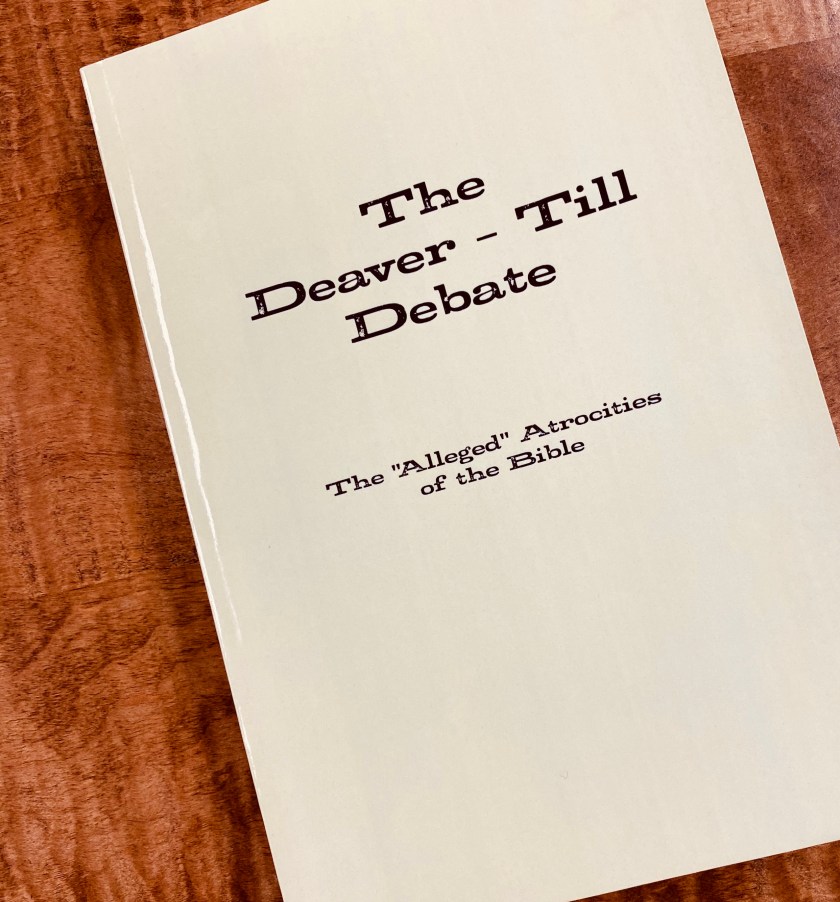
Deaver-Till Debate Now Available Online

Thanks to many hours by Cheri Deaver digitizing a stack of decades-old audiotapes, this four-night debate from 1991 is now available for free listening here.

Mac Deaver affirmed (and Farrell Till denied): “The alleged moral atrocities ascribed to the God of the Bible are not actual moral atrocities and, therefore, constitute no proof that the Bible is not inspired of God.”

Farrell Till affirmed (and Mac Deaver denied): “The alleged moral atrocities ascribed to the God of the Bible are actual moral atrocities and, therefore, constitute proof that the Bible is not inspired of God.”

If you want to prepare yourself for the kinds of things skeptics use to attack the Bible, this is a good introduction to that field. If you prefer to read this debate, it is available for purchase here.

In the future, we hope to make more old debate recordings available. If you’ve not already, take a look at the archives where we have hundreds of sermons you can listen to on a morning walk, while driving to work, mowing the yard, etc. Please do share our content on social media and encourage your friends to subscribe. Thanks!

Posted in Books, General

A Preacher’s Library

Recently, a young minister asked for recommendations on “must have” books. My reply was more explanation of my philosophy of books than a list of particular titles to get. After sending it, I thought it might be good to work into a post. Libraries have seen a seismic shift since I was in school, with many preachers now preferring digital volumes on a tablet to hard copies on a wooden shelf. I haven’t gone that route, but perhaps these ideas could apply to both digital and paper book libraries.

My library is in sections. One is comprised of religious debates. I like as many of those as I can get that involve gospel preachers. You never know when you’ll have to deal with a particular thorny issue, and debates are a good way to bone up on controversial subjects. Plus, debates are historic (some, more than others) and you ought to know some church history.

Which brings us to the church history section. Get Earl I. West’s four-volume Search for the Ancient Order. Collect biographies of preachers from the Restoration era (1800’s) in American history. Many a self-taught, or formal education-deprived preacher of days gone by, somehow managed to learn far more Bible than too many present day college and preaching school graduates. Today’s church has preachers trying to pull us into the dark pit of error that preachers in the 1800’s were crawling out of and exposing with the gospel’s light. That saying about those failing to appreciate history being doomed to repeat it is more than a platitude. The church’s immediate future—at least in America—seems precarious. What will motivate us to fight for her uniqueness now if we’re ignorant of the ground gained in hard fought battles of the past, through the debating and preaching of men who could discern truth from error? Get some good books that cover church history in its early centuries, medieval times, and the Reformation. But, remember, God’s true church has always been a minority, and history is written largely about those who made the biggest splash. That means the history of the church after New Testament days is mostly a study of apostasy in its many forms.

Stock your library with good apologetics books. Have at hand major arguments for the existence of God, the deity of Christ, and inspiration of the Bible. Get a book or two on issues raised by skeptics, and on harmonizing alleged Bible contradictions. If you’ve never taken a class on logic, buy a good textbook and familiarize yourself. Preachers who are not good thinkers easily become misleaders of others.

Depending on your level of interest and ability, have at least a few Greek reference works. At minimum, know your way around an interlinear New Testament, Thayer’s lexicon, Vine’s dictionary of Bible words. If you can do more with the original languages, great.

I’ve got a number of brotherhood lectureship books, old and newer. Lectureships themselves seem a dying phenomenon (like public debates and gospel meetings), at least in comparison to the number that used to be held. The books published from such events are of uneven quality, by nature, since not all preachers are equally adept at thinking, researching, writing—skills requisite for composing a great chapter (and a great book needs multiple great chapters). Few brotherhood lectureship books, in my estimation, are towering contributions to the subject covered. That said, they can be helpful, and a book may be worth having for a single chapter by a certain author. After you’ve preached long enough, glancing through the writers in an old lectureship volume is a trip down memory lane.

Good commentaries are vital. My approach is eclectic, rather than monolithic. That is, I’ll buy a single volume from a particular set of commentaries because of who wrote it, and another volume from a different set, and so on. Thus, my Old and New Testament shelves are a hodgepodge from here and there, with many series represented, but very few series complete. An entire set, composed of an impressive row of identically clad volumes, looks nice on a shelf, but aesthetics is not the goal. Plus, that approach does not comport with my preferred method of arranging commentaries. I put commentaries on the shelf in Bible book order. I have a couple on Leviticus, and nearly a dozen on Revelation, but I can go right to them because, for example, the Revelation commentaries are all next to each other at the end of my New Testament section, and the Leviticus commentaries are right after the ones on Exodus.

A word on commentaries: never let your guard down. If you can find a scholarly commentary by a member of the Lord’s church, consider it. Denominational scholars will always outnumber those of the Lord’s church. Precious few are our brethren, such as J. W. McGarvey in his day, who are known and respected outside the church of Christ. If you limit yourself to books by brethren, you’ll cut yourself off from a great deal of conservative scholarship. At the same time, books by brethren can be just as wrong on a given point as something from an academic at a Baptist seminary (in fact, many books from our own professors these days may as well have been penned by denominational writers, given their ecumenical outlook and disregard for the uniqueness of the Lord’s church). If I know an author rejects the verbal inspiration of Scripture, that’s a non-starter for me: why spend time and money on that? For any given book in the Bible, there are commentaries which, at least, respect the Bible’s origin and nature.

The lion’s share of my commentaries are by denominational scholars. Before letting yourself be overly influenced by the learning, reputation, or seeming erudition of such a writer, remind yourself that he likely wouldn’t have the right answer to the most basic question: “What must I do to be saved?” Read denominational writers with that in back of your mind, and it should foster a healthy perspective. I think of a late denominational academic who has very helpful things to say in his Old Testament commentaries. Yet, he compromises with theistic evolution. The works of man are often a mixed bag, so keep a weather eye. Never believe everything anyone says just because of who wrote it. Likewise, don’t discount something simply because the author is not a member of the Lord’s church. Always, if it comes to it, let Scripture be correct, and every commentator a liar.

I’m not a fan of broad, general commentaries (such as a one-volume treatment of the Bible, or a two-volume set covering the New Testament). These may help those without a background in preaching school, but more depth is called for if you’re preparing to teach an adult Bible class. Matthew may take up less than 40 pages in your Bible, but you should read hundreds of pages during class prep. Get the best commentary you can find that’s just on Matthew. Make it a habit to read at least one good commentary (if not two) when teaching through a Bible book (if you don’t know more than the rest of the class on the subject at hand, why are you teaching?).

Decades ago, in preaching school, I wanted as many books as I could get hands on. Age and experience reversed that thinking. Now, I don’t want as many books as money or space allow. I have a lot of shelving in my office, and a lot of that is empty, by choice. After decades having them in possession, not long ago I threw away dozens of books I never use (and didn’t want others to have, for example, due to error they taught). Dozens more, I donated to the church’s library. These days, basically, I want as few books as will give what I need for preaching and teaching. Whatever books you include in your own library, in the end, as my grandfather would say, there is no substitute for being familiar with the actual text of Scripture.

[Note: This article was first published by Tennessee Bible College on Sept. 8, 2020]

Posted in Epistemology, Logic/Philosophy

The Truth Is

All serious Bible students of the New Testament know that the concept of “truth” is of extremely high priority. Even in the Old Testament, Solomon once expressed that thought when he compared truth to something material that could be bought. He said, “Buy the truth, and sell it not; also wisdom, and instruction, and understanding” (Prov. 23:23). It remains something we all must have and must never discard. But in the history of mankind, many strange things have been uttered in conscious or unconscious attacks on the very idea of truth. In its defense, let us offer a few thoughts descriptive of truth as it is.

First, the truth is that truth is something thought or declared as a declaration. We can think in images or pictures. I can think of a flower. There are truths about flowers thought and/or stated, but flowers do not partake of truth. If there is an eternal Mind, however, then truth has always existed. Some things we cannot know but not because they have not been revealed, but because we cannot comprehend them (Psa. 139:6). God’s thoughts are precious and many (Psa. 139:17).

Second, the truth is that if truth exists, then no category of information is exempt from it as a characterization. If science or history or geometry or religion or philosophy, etc. are actual legitimate categories of inquiry, then any real findings in each one must be described, if at all, by truth. We cannot make mental progress and cultural progress unless such is so. When Adam and Eve were told to have dominion, the implications were multitudinous (Gen. 1:28). The world was flung wide open for exploration of truth.

Third, the truth is that truth can be distinguished from fact. Fact has to do with existing conditions, circumstances, states of affairs, etc. We observe facts such as a tree that is falling. It is a fact that it is falling. It is a truth stated when I, observing the fact, declare the truth of the fact, “The tree is falling.” Truth is sometimes told of past facts, present facts, and future facts. God’s word is salvation truth in proposition form (John 17:17). Jesus was the personification of that salvation truth in human form (John 14:6).

Fourth, the truth is that truth is, as a concept, ontologically prior to falsity. A false statement cannot at all be made unless it is in conflict with an already existent truth. To say that I am not human cannot be false unless it is true to say that I am human. This is a very fundamental feature of reality of tremendous implication in the discussion of the existence of God and human ethics. The idea of “good” is ontologically prior to the idea of “evil.” There can be no objective evil unless already there is an objective Good. This means that the existence of God cannot be attacked on moral grounds (using the so-called “problem of evil”) without invoking the very existence of God in the first place! The so-called “problem of evil” is a little late in arriving for the discussion!

Fifth, the truth is that truth is in conflict with falsity. John said that “no lie is of the truth” (1 John 2:21). This is a matter of definition. The “law of identity” would dictate in this regard that if something is true, then by definition, it cannot be false. If something is false, then by definition it cannot be true. At times because people do not know or do not want to bow to truth, they begin to play concept games with truth in an attempt to show that truth is not “fixed” as a characteristic of declarations. But it is!

Sixth, the truth is that truth fits facts as facts are. As non-facts become facts, the declaration of truth regarding those facts accurately depicts those facts. If I was not sick yesterday, then if someone says that I was sick yesterday, then he would be declaring a falsehood. However, if today I become sick, then the truth (if thought or spoken of my current condition) would state that I am sick. The facts “changed” in the sense that what was once not a fact now is one. Truth in describing the situation does not change. The facts may change, but truth correctly describing facts as facts remains the same. Truth is a constant whereas the facts are variables. Truth is consistently and permanently in harmony with the facts. Given the illustration, I can truthfully say that I was not sick yesterday. I can also truthfully say that I am sick today. The two statements could both be affirmed as truth because of the change in my condition. This is why I can say that while I was not sick yesterday, I am sick today without being at odds with myself. This would be a truthful declaration of a changed condition or circumstance. But it is not an admission that truth changed.

Seventh, the truth is that truth cannot be simply invented or imagined or “made up” so as now to exist. Truth must correspond to reality. If it does not, it attacks itself in concept because truth to be truth must be accurate. To be accurate is for it to have a relationship with what it attempts to represent. If I say that God exists, and if God exists, then my affirmation is true, but not because I invent the truth. The truth accurately or correctly represents the fact of God’s existence. Truth is the same for everyone. It is impossible for humans to have different “kinds” of truth that are in conflict with one another. If something is true, it is true for all humans. To say that something is true for every one is not a view that has always been popular, but when anyone attempts to defend the view of “partial” application of truth to humans, he is bound to go down in self-defeat since he must attempt to bolster his “partial” theory with a universal principle. In other words, when someone says that such and such may be “true” for you, but certainly is not “true” for me, the only way he can attempt to rationally justify his conclusion is to reach for a universal principle that what he just declared is true for ALL of us!

Eighth, the truth is that truth is information. This is so simple. It is so fundamental, and yet at times men fall over this truth. If God’s word is truth, then it is so because the information that God provides is correct. It is correct or accurate information, but it is information. Some brethren need to give further thought to this tremendous point. It is interesting that in 1 Corinthians 13, when Paul discussed the coming departure of the miraculous and the permanent arrival of “that which is perfect,” each of the three illustrations that he gave in verse 8 of the departing miraculous element had to do with information. God’s book is information (2 Tim. 3:16-17).

Ninth, the truth is susceptible to knowledge. Jesus declared that it is possible for us to know the truth (John 8:31-32). This is so because of the very nature of truth and because of the very nature of knowledge. Knowledge is not something floating around in the atmosphere. Knowledge exists, if it exists at all, in a mind.

Tenth, the truth is then that to deny truth as existent or as susceptible to knowledge is to engage in self-contradiction. The “law of contradiction” would govern this mistake. For someone to declare, “Truth does not exist,” is unintentionally affirming what he is seeking to deny. In effect, he is saying, “It is the truth that truth does not exist.” So, he is affirming explicitly that truth does not exist while implicitly affirming that it does. This is not rational behavior.

Eleventh, the truth is that truth is not abolished or eliminated by imprecise statements. Years ago brother Thomas Warren told of an experience he had once had in being invited to speak at a college. He was discussing “the laws of thought,” and particularly the “law of excluded middle.” He affirmed “Every precisely stated proposition is either true or false.” A professor objected, saying that such was not true. Brother Warren suggested that the professor give a proposition for consideration. The professor said that it would be easy to provide the illustration. He said, “What if I say that it is raining, when it is only sprinkling?” Brother Warren answered, “If it is raining when it is only sprinkling, your proposition is true. If it is not raining when it is only sprinkling, your proposition is false.” It is a matter of definition. The definition of “raining” would govern whether the statement was true or false. This is how extraordinarily fundamental the matter of “definition” is. This account also shows the absolute necessity of our being precise in our declarations. It is possible for a person to say, “It is raining,” when it is only sprinkling WITHOUT knowing how far the definition of “raining” extends. This is why we need to work on being precise in our own statements. The “law of excluded middle” as applied to propositions applies to “precisely stated” propositions and to none other!

Twelfth, the truth is that if anything exists, ultimately there is truth about that condition because for anything to exist, God must exist, and God is eternal Mind. And a mind thinks thoughts.

Thirteenth, the truth is that truth as obligation may be limited in time as to its application, but time itself cannot alter truth. This is why God can change his pure positive laws as contrasted in the Old and New Testaments. What some men were once obligated to do that we are not to do today shows the truth of what is here being affirmed. The fact that men today must do some things not earlier required of men again illustrates while (1) truth as accuracy does not change, (2) truth as obligation can and has. God doesn’t change (Mal. 3:6; Jas. 1:17). This is why moral law as such cannot change and remains constant throughout Scripture, but God’s pure positive law has changed (Col. 2:14; Heb. 10:9).

Fourteenth, the truth is that truth as statement of fact corresponds to fact (in accuracy), and if facts cease being facts, the statement declaring new facts is truth governing or applied to those new facts, but that statement declaring new facts is not falsification of the truth in its relationship to former facts. For instance, if a man told me yesterday that he lives at 222 Wildwood Street, and he tells me sometime later that he lives at 555 Brownwood Street, if he told me the truth both times, it was because, as earlier explained, the facts changed. The truth that he later declared regarding his new address does not attack or cancel or falsify what he earlier told me. Truth is incapable of attacking itself. Truth cannot be correctly used against itself. Truth is coherent in all its parts. No tension exists between any two truths—ever!