Posted in Baptism, Doctrine

Consequences of Baptist Doctrine

By Roy C. Deaver

[The following is excerpted from Deaver’s book, The Baptist Church and the New Testament Church, pp. 47-49.]

In view of the study already made regarding the Bible teaching on the essentiality of baptism, we need to consider now some of the consequences of the Baptist doctrine that one can be saved before and without baptism.

First of all, the teaching that baptism is not essential to one’s salvation means that the Baptist church is not necessary. Baptists teach that one can be saved without baptism, but that one cannot get into the Baptist church without being baptized…And, in which case the Baptist church is not necessary to one’s salvation.

Secondly, the Baptist idea that one can be saved without baptism means that it takes more to get into the Baptist church than it does for one to go to heaven. Baptists hold that one is saved by faith, the moment he believes, and that he is later baptized into the Baptist church because he has already been saved. If one can go to heaven because he is saved, and if one is saved by faith, and if one cannot get into the Baptist church without baptism—then, obviously, it takes more to get into the Baptist church than it does to go to heaven!

Thirdly, the doctrine of salvation without baptism means Baptist preachers cannot follow New Testament examples of conversion…The following quotation is from a book called The History of the Denton County Baptist Association and the Sixty Churches in Its Jurisdiction. This book was written by Mr. J. N. Rayzor, a prominent Baptist of Denton, Texas. The quotation is found on page 82. Here it is:

“An incident occurred in the Pilot Point church during Rev. J. B. Cole’s pastorate, which involved a point of doctrine that subjected Pastor Cole to criticism, and gave the incident much publicity and notoriety. Pastor Cole went fishing one day with a business man who was not a Christian, and he availed himself of the opportunity to talk to the lost man about his unsaved condition, and led him to an acceptance of Christ. Jo Ives, the man converted, said to Pastor Cole, ‘Here is water, what doth hinder me from being baptized?’ Obviously Brother Cole thought of the story of Philip and the Eunuch, and taking that incident an example, he led Mr. Ives out into the water and baptized him. Rev. Cole had been a Baptist but a short time and was not up on their conception of baptism, and how and when it should be administered. The news of the incident soon spread among the members, and then the show began. The following Sunday Mr. Ives presented himself to the church, asking membership, and his application was rejected and he was hurt at the action of the church and turned to another church which readily accepted his baptism. The criticism of the pastor caused him to ask a committee of eminent brethren to sit in judgment upon his conduct—Dr. A. J. Holt, J. B. Link, and R. C. Buckner. After reviewing the details of the incident they wrote the church, advising it to drop the matter, and Pastor Cole to go his way, but not to repeat the act.”

Note that Pastor Cole was advised by his eminent brethren never to follow this Bible example again. This is the story of a man who knew something about the Bible, and little about Baptist doctrine, and who thought he could follow a Bible example of conversion. But, he learned that such would not be tolerated.

Posted in General

A Prophet Like Moses

By Weylan Deaver

Fourteen centuries before Jesus was born, Moses told the Israelites, “The LORD your God will raise up for you a prophet like me from among you, from your brothers—it is to him you shall listen” (Deut. 18:15, ESV). After the church was established (Acts 2), Peter hearkened back to the prophecy of Deuteronomy and identified the prophet when he said, “Moses said, ‘The Lord God will raise up for you a prophet like me from your brothers. You shall listen to him in whatever he tells you’…God, having raised up his servant, sent him to you first, to bless you by turning every one of you from your wickedness” (Acts 3:22,26). Indeed, Jesus and Moses bear many striking similarities.

Both were Jews. Moses was a descendent of Levi (Exod. 2:1) through whom God delivered the Old Testament law. Jesus was a descendent of Judah (Rev. 5:5) who was born under that law (Gal. 4:4).

Both escaped death in infancy. In Moses’ time, the wicked Pharaoh (likely Thutmosis I) ordered all newborn baby boys to be thrown into the Nile River to drown (Exod. 1:22). In God’s providence, the baby Moses was rescued from such a fate. After Jesus was born in Bethlehem, Herod—perceiving a future threat to his power—commanded the murder of all boys two years old and under in the vicinity of Bethlehem (Matt. 2:16). Yet, the young Jesus was kept safe.

Both were deliverers. Moses delivered the Israelites out of Egyptian slavery (Exod. 3:10). Jesus delivered spiritual Israel (Rom. 2:28-29; Gal. 3:29) from the slavery of sin (Matt. 1:21).

Both knew God face to face. Among all the Old Testament prophets, Moses was uniquely near to God so that the Lord spoke to him as a friend, face to face (Exod. 33:11; Deut. 34:10). Of course, Jesus knew God on a level far superior to that, being himself God’s only begotten Son (John 1:18).

Both were prophets. A prophet was one who spoke on behalf of God. God sent Moses to Pharaoh with the promise that he would be with Moses’ mouth and teach him what to do (Exod. 4:15). Later, Jesus would repeatedly stake the claim that he was only teaching what he had received from his Father (John 8:26). So, the words of Moses and Jesus both originated with God.

Both were law givers. The law that God gave at Mt. Sinai after the Exodus was given through Moses (John 1:17). It was Moses who furnished the Lord with tablets of stone on which were written the divine commandments. Christ fulfilled all the Old Law (Matt. 5:17), nailed it to the cross (Col. 2:14), and inaugurated a New Covenant (Matt. 26:28), which is also called the law of the Spirit of life in Christ Jesus (Rom. 8:2).

Both worked miracles. By divine power, Moses turned the Nile into blood, initiated the other plagues, parted the Red Sea, and brought water from a rock at Kadesh. Jesus performed so many miracles that John reminisced—should they be all written down—they would fill too many volumes for the world to hold (John 21:25).

Both were mediators. Moses stood between Israel and the Lord to declare God’s word (Deut. 5:5). Moses mediated for Israel after the golden calf fiasco (Exod. 32) and saved thousands of lives. Now Jesus is mediator of a better covenant (Heb. 8:6). Paul wrote, “For there is one God, and there is one mediator between God and men, the man Christ Jesus” (1 Tim. 2:5).

Both suffered disrespect. Several men launched a rebellion against Moses’ authority, which the Lord put down most effectively (Num. 16). Jesus—in spite of his miracles—was still not believed (John 12:37). “And Jesus said to them, ‘A prophet is not without honor, except in his hometown and among his relatives and in his own household’” (Mark 6:4).

Both had family who temporarily failed them. Even Moses’ brother and sister, Aaron and Miriam, complained against him (Num. 12:1). Jesus had several brothers and sisters who—at least initially—rejected his claims (John 7:5).

Both were present at the Transfiguration. This event is recorded in Matthew 17. Though their earthly lives were separated by centuries, for a brief moment they were in each other’s presence: Moses with the prophet he foretold, and Jesus with the prophet who had written about him (John 5:46).

Both were baptized. Though we may not picture the Red Sea crossing as a baptism, the New Testament does. “For I want you to know, brothers, that our fathers were all under the cloud, and all passed through the sea, and all were baptized into Moses in the cloud and in the sea” (1 Cor. 10:1-2). Jesus was baptized by John in the Jordan River to fulfill all righteousness (Matt. 3:13-17).

Both prepared men to carry on their work. Moses readied Joshua to assume the mantle of leadership (Deut. 34:9). Jesus groomed a handpicked cadre of men whom he would send into all the world to preach the gospel (Mark 16:15).

Though their similarities run deep, God made clear who it is we are to obey when he made an announcement to the mountaintop gathering of Jesus, Moses, Elijah, Peter, James and John. “He was still speaking when, behold, a bright cloud overshadowed them, and a voice from the cloud said, ‘This is my beloved Son, with whom I am well pleased; listen to him’” (Matt. 17:5).

Posted in Expository, New Testament

A Funeral in Nain

By Weylan Deaver

All of us have attended funerals, perhaps even accompanied the casket to the cemetery. But none of us has been to a funeral where the deceased sat up. It did happen once, long ago. We know where, though we do not know his name and, were it not for Dr. Luke, we would not know about it at all, since he is the only writer to record it (in Luke 7:11-17).

Verse 11 brings a crowd, tagging along with Jesus and his disciples on the way to Nain, a town not elsewhere mentioned. It was in Galilee, probably along a road from Capernaum to Jerusalem. What was it about this carpenter’s son from Nazareth (a town of no reputation) that caused a crowd to follow him? Since the crowd is distinguished from the disciples, we might question their motives. Were they following just to be part of what was going on? Were they hoping to see some great sight? Were they bored, with nothing better to do? Were they truly interested in Jesus? What of us? Are we Christ-followers, or crowd-followers?

Verse 12 reveals a solemn ceremony. A dead man is being carried out of Nain (Jewish custom forbade burying within city limits). The mother of the deceased was already a widow, so her grief must have been acute. This was her only son. Her financial situation might now be precarious, indeed, with neither husband nor son to depend on. It speaks well of the townsfolk of Nain that a considerable crowd followed the funeral procession. Thus, two crowds met—one headed toward town and another coming out of it. Coincidence? Since God knew what would happen, and that Luke would record it, and that we would study it, surely more than mere chance was involved in the fateful meeting. But it reminds us life is fragile, and brief, and sometimes parents outlive their children.

Verse 13 shows Jesus’ compassion, as he singles out the grieving mother, telling her “do not weep.” There is no hint they had met before, or knew each other, or even that they are introduced on this occasion. Jesus tells her not to weep, but without explaining what is about to happen. He tells her not to weep while her son is still very much dead. Are we aware of the grieving? Can we, like Jesus, single out those in need of compassion?

Verse 14 finds the Lord issuing a command. Interrupting the funeral, Jesus touches the bier and the procession comes to a standstill. Jesus does not direct his words to the disciples, or to the crowd, or to the mother, or even to his Father in heaven. He speaks to the young man: “I say to you, arise.” Anyone can talk to the dead. But, when Jesus speaks, the dead actually listen.

Verse 15 tells of the incredible cure, as the formerly dead man sits up and starts talking. How could it be otherwise? A corpse can no more resist a divine command than could a storm on the sea of Galilee. In point of fact, the only ones capable of refusing God’s orders are living humans. Such is the sobering and remarkable power of free will that each of us has. Jesus turns the young man over to his mother. Just think of the conversations those two had later. Surely, were they still alive when the church began, this widow and her resurrected son would have been among the earliest Christians.

Verse 16 records the conclusion reached by the crowds. Glorifying God, they inferred that Jesus was a “great prophet” and that “God has visited his people!” Both counts were right, though the people could have gone further, since Jesus was much more than a prophet—he was Immanuel (literally, “God with us”). And, not only had God visited by way of a miraculous healing, but God was actually standing there among the crowd in the person of Jesus (if only they would see it). The people’s assertion that Jesus was a divine messenger would have been more on target had they said he was their Messiah. At least the people attributed what happened to God. How many today grow up in a sea of blessings, but never think to glorify God for them?

Verse 17 indicates the circulation of a report about Jesus. How could a lid be kept on such news? It spread like wildfire through Judea and vicinity. And this was just one miracle. Recalling that John said Jesus’ miracles were too numerous to chronicle (cf. John 21:25), can you imagine all the reports that went out, and all the conversations that must have taken place about Jesus? It must have been impossible to live in Palestine and not hear about Jesus. Truly, the report about him is still circulating, and has spanned two millennia to reach our own ears.

There is no discussion about sin in this story (contrast Matt. 9:5). There is no mention of faith in this story (contrast Matt. 9:22). There is no request made of Jesus (contrast Luke 7:3). And, refreshingly, there is no criticism of Jesus (contrast Luke 13:14). Instead, Jesus, himself, takes the initiative and the whole account seems to rest on the twin pillars of his compassion and his power. It was an unforgettable day in Nain when there began a funeral that could not be completed!

Posted in Apologetics, Debates, Existence of God, Reviews

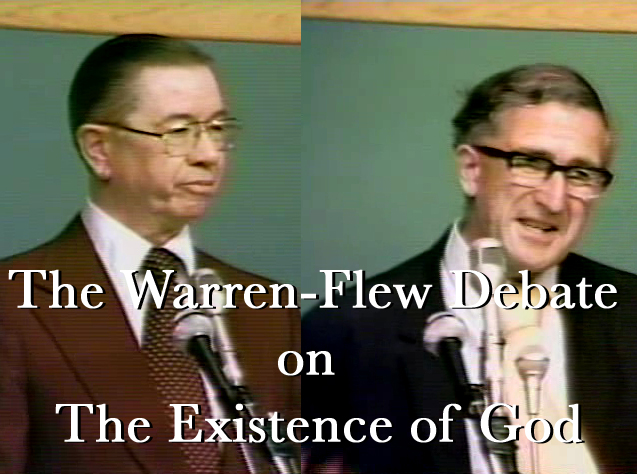
The Warren-Flew Debate

By Roy C. Deaver [1922-2007]

[Note: The following review was written by my grandfather soon after the debate occurred, and published in the December 1976 issue of Biblical Notes. The debate was momentous then, and continues to be. Thirty-one years after, in 2007, Flew would publish a startling book reversing everything he stood for in his debate with Warren. Flew would title his book, There Is a God (How the World’s Most Notorious Atheist Changed His Mind). In it, Flew refers to his debate with Warren on pp. 67-69. Warren died in 2000; Flew in 2010. The book and DVDs of the Warren-Flew Debate are still available and highly recommended—Weylan Deaver.]

On Thursday, September 16, 1976, Thomas Warren and I moved into a motel room in Denton, Texas to continue preparation for the Warren-Flew debate scheduled to begin on the following Monday night. We were joined on Friday by James Bales and Bob Camp. During these eight days we lived together, prayed together, worked together, studied together — in full and deep realization of the importance of the occasion.

During the months preceding the debate it was advertised as being “The Debate of the Century.” I believe that this is an apt description of it. It was reminiscent of the great Campbell-Owen Debate, but it might be more accurately likened to Paul’s meeting the Athenian philosophers on Mars’ Hill when “…certain also of the Epicurean and Stoic philosophers encountered him” (Acts 17:18). Upon that memorable occasion Paul preached the God whom they had left out. And in Denton, Texas brother Warren preached the God whom Dr. Flew (and all atheistic naturalism) has left out.

The debate was conducted on the campus of North Texas University, in the massive, beautiful coliseum. The debate was well-attended, with thousands of people having come from distant places. Wonderful fruits—even in generations to come—will be produced by these labors.

Since the debate it has been my privilege to speak a few times about the debate, and in these sessions we have devoted some time to answering questions. In this article I would like to consider several questions which have been asked.

How Was the Debate Brought About?

The University church of Christ in Denton, Texas conducts two Bible Chair programs within the city. One is directed by brother Gary Ealy; the other is directed by brother Rex Dean. These Bible Chairs work together in striving to accomplish the greatest good among the students. Each year they plan something “unusual” for the students. Last year (1975) they had Dr. Douglas Dean on campus for a special series of lectures on evolution. For 1976 the Bible chairs—together with the University church of Christ—planned the Warren-Flew debate. Since the debate was conducted by the Bible Chairs it was permitted to be held “on campus” and in the Coliseum.

An Evaluation of Dr. Flew

Many have asked: “How would you evaluate Dr. Flew?” Dr. Flew’s academic credentials are impressive and are unquestioned. He is a professor of philosophy at the University of Reading, in Reading, England. He is in constant demand as a “special lecturer,” and he travels the world as a spokesman for “atheistic naturalism.” He is without doubt one of the top atheists in the world today.

He writes almost constantly on the subject of “God.” brother Warren pointed out in the debate that he (Dr. Flew) seems to be almost “God-intoxicated.” Dr. Flew responded by saying: “I seem to be sobering up from my God-intoxication, and henceforth will not write upon the subject of God—except in response to those who attack me—but will devote more time to writing on social matters.” I consider this to be a highly significant statement from Dr. Flew—one which indicates that he keenly felt the force of Dr. Warren’s arguments.

In order that I might be of more help to brother Warren I have spent considerable time during the past year reading some of Dr. Flew’s books. I have found him extremely difficult to read (probably because of his British accent!). The vastness of his knowledge is apparent. Many have expressed disappointment that Dr. Flew did not do a better job in the debate. We emphasize that Dr. Flew’s failures were not the consequence of his not being a qualified opponent. No atheist has done more writing, or more speaking, or more debating than has Dr. Flew.

Dr. Flew is a personable, likable man. As brother Warren said, “You can’t help but like him.” It is my judgment that Dr. flew was shocked, bewildered, astonished, flabbergasted. So far as he was concerned “Christianity” meant Catholicism and denominationalism. He had never before encountered simple New Testament Christianity. And, he had never before encountered an opponent of Dr. Warren’s caliber. Dr. Flew, son of a Methodist minister, knows full-well that truth cannot be established upon the basis of feelings (emotionalism, subjective experiences). It must have been quite a shock to him when brother Warren said: “Dr. Flew, we fight that kind of thing just as much as you do. On that point you are just speaking to the wrong crowd.”

I think Dr. flew is honest and has some very strong feelings about truth. Dr. Flew entered the debate as a “positive atheist.” In a very short time he had become a “negative atheist.” Then, he began taking positions that were not atheistic, but that were agnostic. This he admitted. Then, he explained that he was “a spokesman for atheistic naturalism.” It seems to me that Dr. Flew left the debate as an agnostic rather than as an atheist.

Dr. Flew stresses that men “ought to be honest” and “ought to seek after truth.” We can continue to hope and pray that his honesty and concern about truth and evidence will yet bring him to the truth of God.

An Evaluation of Dr. Warren

I have known, loved, respected, and worked with brother Warren for near twenty-five years. I know him better than any other man knows him. I stand amazed in contemplation of his great abilities—natural and attained. He possesses the greatest natural brilliance of mind that I have ever seen. He has worked so hard for so many years in so many different academic disciplines in preparing himself to be an efficient servant of the Lord.

I know of his deep feelings related to the fact that as a people we are not doing enough to combat the forces of atheism and liberalism. It grieves him deeply to know that we sit back and allow the atheists to write our textbooks and to exert their infidel influences in the colleges and universities across the land.

More than twenty years ago he determined to do something about this situation. He knew that it would be necessary for him to hold the highest academic degree—and from a university of unquestioned prestige, and in the field which would be respected even by the atheists. To obtain this degree—his doctorate in Philosophy, from Vanderbilt University—he went into the lions’ den. To say the least, his professors were not favorable toward the traditional view (the Bible view) of God. Upon one occasion the professor said: “Mr. Warren, perhaps we ought to let YOU explain to the class the traditional view of God, since we so seldom have a man in this class who holds that view.” I know how hard and how fervently he prayed that—if the Lord so willed—he might be admitted to that program. At the time, Vanderbilt was admitting only six to eight students out of eighty applicants.

In reality, brother Warren’s debate with Antony Flew was that toward which he had been working for more than twenty years.

The more immediate preparation was made during the past year. The magnitude of this preparation is almost unbelievable (and is indescribable). He had very meticulously prepared over 400 charts for the debate. We used only 75 during the debate, but the others were there and ready to be used, if needed.

We thank God for brother Warren’s abilities, but—more than this, for the fact that these abilities are dedicated, consecrated, to the glory of God.

Why Did Dr. Flew Refuse to Make A Sound Argument?

This question comes in recognition of the fact that it is the case that Dr. Flew did steadfastly refuse to make a sound argument.

In logic, the term “argument” refers to the basic unit of reasoning. It means a “unit of discourse in which beliefs are supported by reasons.” An argument is a unit of discourse which seeks to prove that something is or is not the case. An argument therefore, is made up of two basic parts: (1) premises—the evidence—, and (2) the conclusion.

When a series of statements are intended to prove a point they may be (and, in fact, ought to be) reduced to a syllogism. An error which is concealed in three hundred pages becomes crystal clear when reduced to a three-line syllogism.

In order for an argument to be sound two things are necessary: (1) the syllogism has to be valid, and (2) the premises have to be true. A syllogism is valid when the premises (whether true or false) demand the conclusion. There is a difference in validity and truth. There are definite laws (five basic laws) governing validity, and if a single law of validity is violated the syllogism is not valid. If the syllogism is valid, then the logician asks: are the premises true? If the syllogism is valid, and if the premises are true—then the argument is sound.

Dr. Flew knows full-well what a sound argument is. He knows that argumentation is not assertion and is not insinuation. He constantly chides and ridicules religious people for refusing to make a sound argument. He constantly calls upon them to face up to the task of proving their position. The “Law of Rationality” holds that “We ought to justify our conclusions by adequate evidence.” Dr. Flew respects this law. Dr. Flew (of all people) did not refuse to make a sound argument because he did not know what a sound argument is!

Literally hundreds of people have expressed to me their disappointment because Dr. Flew refused to make an argument. He raised questions. He chided. He insinuated. He indicated that he would eventually get around to actual argumentation. But, he never did. He did a lot of talking and philosophizing, but he never did get down to the task of trying to prove his point. (Dr. James Bales observed: “A philosopher often spends his time throwing dust into the air, and then complains because he cannot see.”) One person said: “Dr. Flew would approach the microphone as if he were really going to do something this time, and then…just fizzle.”

It seems to me that the weak and disappointing efforts upon the part of Dr. Flew really show the force, the power, and the value of the debate. If Dr. Flew COULD have made a sound argument the conclusion of which would have been “I know that God does not exist” Dr. Flew WOULD have done so. The fact that Dr. Flew DID NOT proves that he COULD NOT, and that HE KNEW THAT HE COULD NOT! Dr. Flew’s failure to make an argument also indicated his profound respect for Dr. Warren. He knew that every word he said would be carefully and thoroughly examined by brother Warren, and that no error would be allowed to pass unnoticed. Dr. Flew could not make an argument which would stand up under the light of logical examination.

What Did Dr. Flew Say?

He stressed ideas of incoherence, inconsistency, and logical contradiction. These words relate to two basic points: (1) It is Dr. Flew’s view that the doctrine of eternal punishment in hell is inconsistent with the notion that God is all-loving; (2) He holds that the fact of evil in the world is contradictory to the theists’ concept of an all-loving and all-powerful God. The concept of “hell” is really disturbing to Dr. Flew. He said, “It upsets my British cool.” but, Dr. Flew admitted that the concepts of love and justice were not contradictory, and that God could be just in punishing a sinner for “one minute.” Dr. Flew thus placed himself in the position of judging God in connection with what constitutes just punishment.

The atheist habitually accuses the theist of affirming a logical contradiction. The theist affirms the existence of God who is all-loving and who is all-powerful. The atheist counters: “These concepts are contradictory. There is the fact of evil in our world. If God is all-good He would want to destroy evil; if God is all-powerful He would be able to destroy evil. If He wants to destroy evil, but cannot, then He is not all-powerful. If He is able to destroy evil, but does not want to destroy evil, then He is not all-good. If He is not all-powerful, or if He is not all-good, then He is not God.” But, the atheist fails to understand the relationship of the existence of evil to God’s plan for man’s redemption, and the atheist overlooks (and fails to understand) God’s respect for man’s free-moral agency.

Dr. Flew admitted the fact of human guilt and the fact of the existence of human conscience. He also admitted that atheism has no way of dealing with these. He admitted the existence of “law” higher than international law and that the Nazis were wrong in killing six million Jews. He failed to explain the source of this law.

Whether intending to do so or not, Dr. Flew rejected the theory of evolution. In answer to pointed questions he said that the first human being was not born of a non-human, and that the first human being was not the product of transformation from a non-human into a human! What else is left? Only creation by God.

Dr. Flew admitted that philosophy cannot deal adequately with the matter of origin. He said, “I begin with the universe and end with the universe.” This is a mighty restricted view of things, and fails to deal satisfactorily with either origin or destination.

Brother Warren powerfully refuted the theory of evolution. He stressed that the doctrine of evolution cannot be substantiated by the claims of science. Dr. Flew responded: “I am not a scientist—I am a philosopher.” I find this statement (and the attitude which it evidences) most astonishing. Here is a man who is a world-renowned atheist-philosopher. In rejecting the existence of God he puts himself in the position of having to accept the theory of organic evolution. This theory at least claims to rest upon scientific evidences. But, when the errors, inadequacies, and false claims of this theory are pointed out Dr. Flew simply says: “I am not a scientist—I am a philosopher.” It is astonishing—indeed, incredible—that a man would build his entire atheistic, philosophic house upon a doctrine which at least claims to rest upon science without knowing whether or not the scientific claims were true. How in the world could Dr. Flew be content simply to say: “I am not a scientist—I am a philosopher”? Keep in mind also that when Dr. Flew said that the first human being came (1) not by birth and (2) not by transformation that he rejected the theory of evolution.

What Basic Arguments Did Brother Warren Present?

First, brother Warren presented the cosmological argument. He argued (and proved) that for every effect there has to be a sufficient cause. He discussed our marvelous universe as an amazing effect. He declared that only the all-wise, all-powerful, all-loving God of the bible is sufficient cause. He considered man—marvelous man—as an amazing effect, and the all-wise, all-powerful, all-loving God of the Bible as the only sufficient cause. He considered the matter of the existence of law—law beyond national law, and beyond international law—the existence of which Dr. Flew admitted. Brother Warren argued that there can be no law without a law-giver. Brother Warren forcefully argued that the theory of evolution cannot explain (1) our universe, (2) man, or (3) the existence of law higher than international law.

Precisely stated, brother Warren’s argument would be as follows:

MAJOR PREMISE: If it is the case that our universe (or man, or moral law) is of such a nature

that it’s very existence can be explained only in terms of its having been cre-

ated by the all-wise, all-powerful, and all-loving God—then it is the case that

God does exist.

MINOR PREMISE: It is the case that our universe (or man, or moral law) is of such nature that

its very existence can be explained only in terms of its having been created

by the all-wise, all-powerful, all-loving God.

CONCLUSION: It is the case that God does exist.

Second, brother Warren made the moral argument. This argument overlaps the cosmological argument. Brother Warren emphatically argued that there does exist such a thing as outside, objective, moral law—that there is moral law beyond (greater than) international law. Brother Warren stressed that Dr. Flew admitted (1) the existence of this law, and (2) that the Nazis were wrong in murdering six million Jews. Brother Warren also stressed the fact of the existence of human conscience—that “Dr. Flew has a conscience, and Dr. flew admits that he has a conscience.” How explain the existence of moral law and the existence of human conscience? The theory of evolution has no explanation. These can be explained only in the light of creation by the God of the Bible.

Third, brother Warren stressed the argument based upon design—sometimes called the teleological argument. He had carefully and meticulously prepared beautiful charts on the human hand, the eye, the respiratory system, the skeletal system. Brother Warren argued that the marvelous design involved in these could be explained only in the light of an all-wise, all-powerful, all-loving Designer. Brother Warren presented a chart with a picture of an artificial hand. He asked Dr. Flew: “Did this artificial hand have a designer?” Dr. Flew admitted that it did have a designer. Amazing indeed! The artificial hand has a designer, and could not exist without the fact of the designer, but the natural hand does not have a designer! Dr. flew admitted that the automobile has a maker, but denies that the automobile-maker has a maker.  “He just growed.”

Time and space would not allow consideration here of the beautiful and fantastic details with which brother Warren pressed this argument. Its force was completely devastating to atheism.

Why Didn’t Brother Warren Use More Bible in the Debate?

The fact is that brother Warren did use the Bible frequently in the debate, but (for obvious reasons) he did not build his argument upon what the Bible says. As brother Warren said to a certain man who had asked this question: “What passage would YOU cite to Dr. Flew to prove that God exists?”

The argument that the very nature of the Bible proves the existence of God is another entire debate. We felt that to introduce this argument during this debate would have allowed Dr. Flew too much room in which to wander, and consequently, would have detracted from this debate. Brother Warren, in his final speech, did offer to debate Dr. Flew on the “Bible argument,” preferably in Reading, England.

What Do You Think Will Be the Greatest Benefits of the Debate?

There have been and there will continue to be great and wonderful benefits from the debate.

1. Because of the debate many people of the world will hear of the church of our Lord who otherwise would not have heard of it.

2. Some have already been baptized into Christ as a consequence of having heard the debate, and others will be.

3. I think the debate will cause New Testament churches—especially those in the Dallas-Fort Worth area—to become more militant in the battle for truth. The whole world will know that we have absolutely nothing to fear in going up against the forces of atheism.

4. Most probably, there will be other debates. Wouldn’t it be wonderful if one or two debates of this type could be conducted every year—on campuses of colleges and universities everywhere. It seems to me that congregations should—beginning right now—set aside funds to help so that at least one debate per year can be conducted.

5. I think the debate will astound the philosophical world. Dr. Flew will be discredited as a debater in the eyes of his fellow-atheists. Can you imagine an honest, sincere student in one of Dr. Flew’s classes—with a copy of the WARREN-FLEW DEBATE in his hand?

6. The debate will emphasize to God’s people everywhere—and especially to Gospel preachers—the value of and the importance of real education. What an example we have in Thomas Warren.

7. Undoubtedly, the greatest benefits (which cannot be measured) will come from (1) the book, and (2) the video-tape. The book is now being published, and the video-tape will soon be available. These will be tremendous tools in combating the forces of atheism.

CONCLUSION

Brethren, the debate was wonderful and will prove to be one of the most significant events in the history of God’s people.

We express our sincere thanks to Gary Ealy, Rex Dean, Perry Hall, the elders and members of the University church of Christ in Denton, Texas—for making the debate possible. We thank God for—and continue to pray for—brother Thomas Warren. We express our gratitude to the God of heaven by whose providence the debate was brought about. Also, our sincere thanks to Dr. Flew for his willingness to have his atheistic philosophies tested upon the polemic platform. Likewise, we express sincere thanks to brethren Bob Camp and James Bales for their wonderful assistance before and during the debate.

We fervently pray that God will continue to use this great work to His glory and to the salvation of thousands of souls.

I COULD NEVER BE AN ATHEIST

I would have to honest with myself. I would have to be concerned about evidence. I would have to be concerned about proper reasoning. Before I could be an atheist I would have to be able to prove that:

1. Life can come from non-life;

2. Something can come out of nothing;

3. Order can come out of disorder—cosmos can come out of chaos;

4. Chance can produce arrangement;

5. There can be a design without a designer;

6. Like does not produce like;

7. There can be an effect without a cause;

8. Mind can be produced by matter;

9. There is no real purpose in life;

10. There is no hereafter;

11. The Bible is not the word of God;

12. There is no God!

How would YOU like to have the task of proving (1) that the Bible is not the word of God, and (2) that God does not exist?

Posted in Restoration History

I Left the Meeting Scared

By Roy C. Deaver [1922-2007]

In 1967 I was working with the Brown Trail church in Hurst, Texas. Beginning in 1961, this congregation had developed a very strong interest in evangelizing by means of the mail system. Especially during the years 1965 through 1967 there was a great deal of pressure put upon the Brown Trail elders to investigate what was going on among the people in the “Independent Christian churches.” We kept hearing rumors that there were many among these people who were really concerned about becoming “one” with those of us in churches of Christ. The Brown Trail elders were—to say the least—very skeptical. Yet, they were deeply concerned about getting the gospel message to any and to all.

The elders decided to invite Don DeWelt and Seth Wilson to come to Hurst, Texas to spend two days with them, and with a few other gospel preachers. Brown Trail would pay their plane fare. Don DeWelt was a professor in Ozark Bible College (a college operated by the Independent Christian Church people), and Seth Wilson was Dean of the College.

So, on May 19 and 20, in 1967, the proposed meeting took place. We spent a great deal of time in discussion of the use of mechanical instrumental music in Christian worship. The elders discussed in detail the hermeneutical principles based upon which we were forced to the conclusion that the use of mechanical instrumental music in Christian worship is wrong! It was stressed repeatedly that there simply is no Bible authority for it!

All present listened patiently as DeWelt and Wilson presented their view. They made no special effort to attempt to justify by the Scriptures the use of mechanical instrumental music in Christian worship. It was clearly their view that it simply makes no difference: It is all right to have it, and it is all right not to have it. In fact, Wilson pointed out that he preached for a church which had on the sign in front “Church of Christ.” He stressed that this church where he preached DID NOT USE mechanical instrumental music in worship. “But,” he declared, “not because we are opposed to it—we simply do not have it.” DeWelt emphasized that he had not in any sense changed his mind about mechanical instrumental music in worship.

These men clearly and strongly felt that there could be (and that there ought to be) unity simply upon the basis that it makes no difference—whether we do or whether we do not. In their thinking, it was not necessary for them and their brethren to regard the use of the instrument as being sin.

I left that meeting on the last day as scared as I have ever been in my life about the church of our Lord. It had become crystal clear to me that these men had not changed their thinking one particle, and that they had absolutely no intention of changing their thinking. On this point, we had been terribly misinformed by many who had insisted that we meet with these men. The thing which scared me was this: They had not changed their position at all, and had no intention of doing so. BUT, THEY KNEW THAT THEY SAW AMONG US A WILLINGNESS TO ACCEPT THEM (FELLOWSHIP THEM) WHILE THEY CONTINUED TO HOLD THEIR VIEWS INDICATED! It frightened me then, and it frightens me now to know that on this point, they were right.

Why can’t brethren wake up? Why is it that many cannot be warned? These men (and those who follow their leadership) are not interested in unity based upon plain Bible teaching. They are not about to give up the instrument. But, as liberalism takes its toll, they know that many in churches of Christ are willing to accept them ON THEIR TERMS.

Posted in Biography

Roy Deaver, My Granddad

Roy C. Deaver

By Weylan Deaver

My grandfather, Roy C. Deaver, left this life on March 2, 2007 at the age of 84. To the church, he was Roy Deaver the preacher. I’m sure no man knows how many thousands of sermons he preached across the country—how many souls heard the gospel through his voice, even if it was raspy for years after a horse accident that broke his ribs and temporarily paralyzed his vocal cords. He was Roy Deaver the defender of truth in countless debates with error, yet always concerned for the soul of the one he was opposing. He was Roy Deaver the helper, always willing, when asked, to visit a congregation in peril and help them work through threatening problems, or help a preacher prepare for an upcoming debate. He was Roy Deaver the writer, penning thousands of pages in articles, class notes, books, and his personal publication, Biblical Notes. He was Roy Deaver the teacher, spending decades in the classroom giving his all to the training of another generation of preachers to carry on the work. He was Roy Deaver the Greek scholar, always ready with a new jewel from the New Testament in koine. He was Roy Deaver the administrator, serving as founding president of Fort Worth Christian School and founding director of the Brown Trail School of Preaching and vice-president of Tennessee Bible College. He was Roy Deaver the elder, concerned for the individual sheep in the flock where he served. In fact, at one time, he was an elder, preached every Sunday, taught classes all week, directed the preacher school, conducted numerous gospel meetings, and did all this simultaneously. How he did that I may never know, but the Lord blessed him with the energy and drive to rise early, stay late, and do all for the gospel’s sake. In fact, he used to pray to God to “wear us out in Thy service.” He meant it.

To his grandkids, he was “Dede.” However the name came about, it stuck, and that’s what I called him all my life. You might not think his frantic schedule allowed any time left for grandkids, but somehow it was there. I’m sure I roamed into his study many times as he concentrated on some important thing, but he never shoed me out or made me feel unwelcome. He was more likely to stop whatever he was doing and divert attention to the visiting grandson. When I was little, he sawed a scrap of lumber into two rubberband guns for my brother and me. I still have mine, and it saw fierce combat in heated battles of my fun-filled youth. When I was nine, he took my brother and me to the movie theater to see Star Wars. I’m convinced he didn’t understand a frame of the entire movie, but he did it for the grandkids. Country music was something he did understand (having sung on the radio, himself, with his own band, way back in the day), and he twice took me to see the Statler Brothers in concert. When I was an early teenager, he and my grandmother taught me how to drive a car (his stick-shift, silver Subaru) in the cow pasture. If I asked him a question, he might reply that it would be a good subject for me to do some research on (now I torture my own kids with the same answer). He liked to go for drives in the Tennessee countryside. One time, I was in a Beatles music phase, and I went with him, taking an audiotape of those songs to play loudly in his car. Looking back, I’m sure the music was not to his taste, but he didn’t complain and let me blast it out anyway. Talk about longsuffering.

Mine was a childhood of privilege, growing up as the proverbial “fly on the wall” when men like Thomas B. Warren would come visit my grandparents’ while I was there. I heard gospel preacher talk. It was instilled in me that their business—the Lord’s business—was important. I liked hearing him introduced at some lectureship by someone who couldn’t say enough good things about my granddad. I liked that he was known and appreciated wherever I went across the South. When, as a kid, I got to ride with him each night on the way to his debate with J. T. Smith on the orphan home issue in 1984 in Gainsboro, Tennessee, it was a privilege to ride with the man I knew was the “hero” of the debate—at least in my eyes. On the drive back home, I got to hear all the post-debate conversation among the grownups in the car. I imagine I even injected my own immature observations, which were not discouraged. He always loved horses, and I spent my share of time in the saddle right behind him, holding onto the belt loops of his blue jeans. One day when I was about eight, he and I were riding in a back pasture in Fort Worth. In my best effort to impress him with a logical thought, I said to Dede, “Some trees have thorns. Pecan trees don’t have thorns. But, just because a tree doesn’t have thorns doesn’t mean it’s a pecan tree.” Duly impressed, he said to the little kid sitting behind him in the saddle, “Weylan, that’s logic.” I replied, “But there’s so many things I don’t know.”

And, there still are “so many things I don’t know.” But I do know this. Precious in the sight of the Lord is the death of his saints. Dede, I will see you after a while.

Posted in Announcements

BiblicalNotes.com

Biblical Notes was launched by Roy C. Deaver in May 1965 as a personal tool to teach the gospel. The monthly journal eventually became a quarterly, edited by Roy’s son, Mac Deaver. In March 2010 the last issue was published and mailed to subscribers. Mac’s son, Weylan Deaver, then moved Biblical Notes to an online presence. Our goal is to build a catalog of material from the archives, in addition to publishing new content beneficial to the teaching and defense of the gospel, to the glory of God.