Posted in Apologetics, Baptism, Doctrine, Expository, Heaven, Holy Spirit, Inspiration, Nature of Man, Resurrection

The Man Within

My friend, Glenn Jobe, and I study together a lot over the telephone. We have wrestled together for years over various concepts and passages. We have studied together regarding death and what happens immediately following death. It has been very helpful to me in the light of my late wife’s passing on July 30 of 2021. We continue to study. Much of the thought contained in this article is due to Glenn’s wonderful thinking. Recently, in a telephone conversation with my good friend, Charles Pugh, we were discussing the resurrection. And, he and I (just as Glenn and I) were wrestling with some complicated matters involved in the resurrection and the resurrection body. Following that conversation, I was stirred to study with more focus in trying to solve some of the hard questions that arise regarding what the Bible says about what happens to us at death and what is entailed in the concept of resurrection.

It is good to note that in 2 Cor. 4:16 Paul refers to our “outward man” and our “inward man.” In Eph. 3:16 he again refers to the “inward man.” This article is putting extreme focus on the time at which Christians first are blessed with the “inward man.”

In working on the matter, the thought came to me several weeks ago that we already have the body that is to be raised on the day of the resurrection, and that body is within us now. I called Glenn to ask him if he knew of any passage that would “crush” this idea. We had a good and very profitable conversation. While a question still in our minds was not resolved regarding one passage, it seemed that the idea of our already having the resurrection body is possible. And in further contemplation and with another phone call to Glenn, it does seem to me that the Bible teaches that the Christian’s body that will be raised from the dead is a body that the Christian has presently within his physical body in this life. Furthermore, that body within is the very body that enters Paradise at physical death. That body is certainly not physical (1 Cor. 15:50). What does this mean then? Let us think about this very carefully. And I think that if what I contend for in this article is true, it unravels the complications of the resurrection that have baffled us for years. That is, the explanation provided here does at least two things. First, it preserves the distinction between the physical body and the spiritual body. Second, it shows how that there is continuity of personal identity that continues in a non-physical (spiritual) body following physical death that makes it possible for an actual resurrection to occur according to New Testament teaching.

According to Paul, two bodies are involved in discussion of the resurrection. There is the physical (or, “flesh and blood”) body (1 Cor. 15:50), and there is the “spiritual” (or, non-flesh and blood) body (1 Cor. 15:42-49). He gives a comparison of them.

He calls the physical body the “natural” body (v. 46). This body is “of the earth” (v. 47), and it is the first body that man receives. The second body is the “spiritual” body and is “of heaven.” The first body bears the image of the “earthy.” The second body bears the image of “the heavenly” (v. 47-48). The two bodies stand in stark contrast to one another. Not only do they differ in nature as to realm of formation (earth or heaven), but they differ, consequently, in their natures. The natural body is given to “corruption,” it is “sown in dishonor,” it is “sown in weakness,” it is “sown a natural body.” The second body, however and in great contrast to the first, is “raised in incorruption,” it is “raised in glory,” it is “raised in power,” and “raised a spiritual body” (v. 42-44). Remember, the first body (“first man”) is “of the earth,” and the second body (“second man”) is “of heaven” (v. 47). Thus, the two bodies have natures that fit the two environments: earth and heaven. This entails the conflict of flesh and spirit (Gal. 5:17). And as long as we are alive in this world, we are composed of physical body, soul, and spirit that comes from God (1 Thess. 5:23; Gen. 1:27; 2:7; Heb. 12:9; Mal. 2:14-15). The “soul” seems to be the animation or vitality initiated at the point of contact between flesh and spirit. When the spirit leaves the physical body, the physical body is dead or lifeless (Jas. 2:26). When physical death occurs, Solomon said the body as composed of dust goes back to the earth, and the spirit returns to God (Eccl. 12:7).

Now, the concept of resurrection entails the nature of man as composed of both body and spirit. Since man is made in God’s image and his spirit comes from God, then the separation of the physical body from human spirit necessarily implies two different consequences. Even the unsaved man who dies is immortal in that his human spirit is not quenched or snuffed out. He, too, enters eternity and faces judgment (John 5:28-29; Matthew 10:28; Jas. 1:27). There is no Bible description of the spiritual body of the wicked that enters eternity and goes to judgment.

But we do have in 1 Cor. 15 and 2 Cor. 5 elaborate discussion of the situation engulfing the righteous dead as to their spiritual or eternal bodies. Of course, language used is definite but accommodative to help us understand what takes place when we die even though it is difficult for us to get a clear picture of how it all is. But the new body is viewed as new clothing (cf. Rev. 3:4), just as the old (physical) body is (Jude 23). The spiritual body is a dwelling place “not made with hands, eternal, in the heavens” (2 Cor. 5:1). It is new clothing “from heaven” (v. 2). If it were not for this new set of clothes, after death we would be “naked” (v. 2-3) [Compare this point to the “bare” (or naked) grain in 1 Cor. 15:37]. In this first body, we presently “groan,” and therefore long for a new and better one (v. 2; cf. Rom. 8:23, 26). When a person becomes a Christian, he is a new creation or creature living in the earthly body (2 Cor. 5:17).

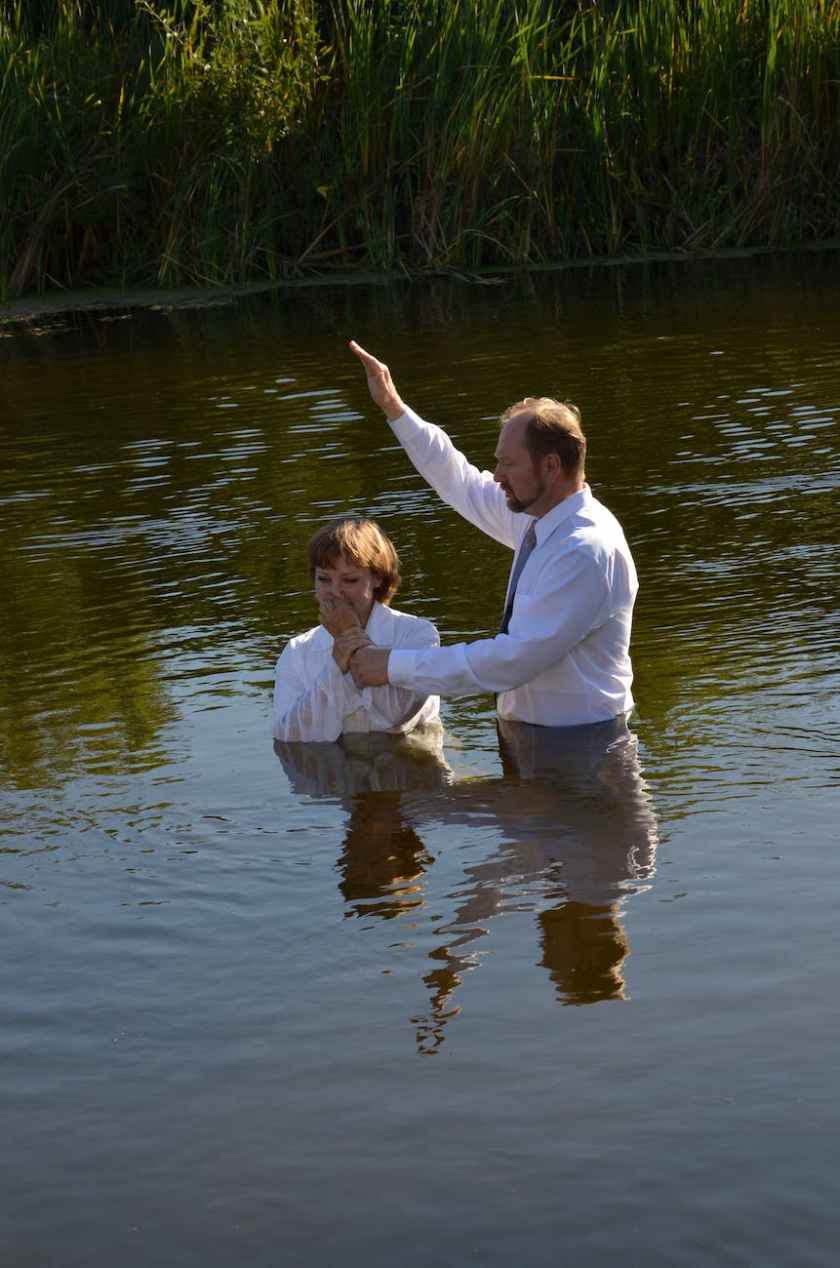
A person becomes a Christian by faith, repentance, confession of faith and immersion in water and in Holy Spirit (John 8:24; Luke 13:3; Rom. 10:9-10; Acts 2:38; 1 Cor. 12:13). And while a believing, having confessed, penitent believer is still in the water of baptism, he is regenerated by the Holy Spirit (Tit. 3:5-6). This occurs as the Holy Spirit engulfs or surrounds the human spirit. That is why it is referred to as a baptism (1 Cor. 12:13). The Greek preposition ἐν in that passage should be translated “in” in English. No one was ever baptized “by” the Holy Spirit. Only Jesus is said to do that (Matt. 3:11; Luke 3:16; cf. Acts 2:33). Furthermore, it is the same preposition used of John’s baptizing people “in” water per Matt. 3:11 as the element in which they were baptized. If John baptized in the element of water, Jesus then baptizes us in the element of the Holy Spirit. Now, following this baptism in Spirit, the Spirit now enters inside the human spirit (Gal. 4:6). When the immersed person rises from baptismal waters, he is “in Christ” because he is now “in Spirit” (Rom. 8:9). This is why he can be said to be a part of the non-personal spiritual body of Christ on earth, which is the Lord’s church (Col. 1:18). From water baptism (which he leaves) and in Holy Spirit (in which he remains), he rises to walk in a new life (Rom. 6:3-4). Thus, this person is now a spiritually alive person and a new creature. And in addition to the physical life that he had before baptism, he now possesses spiritual life while he remains in his mortal or earthly body (Rom. 8:11).

He is now a new creature, spiritually connected to (being “one” with) the Holy Spirit (1 Cor. 6:17). So, he can be renewed each day by this spiritual fellowship or “communion” with the Holy Spirit (2 Cor. 4:16; 13:14). This is how the Spirit leads him (Rom. 8:14), enabling him to produce Holy Spirit fruit (Gal. 5:22-24; cf. Eph. 5:3-14). Being “led by the Spirit” enables him to rightly claim to be a child of God, to hold sin down, and to have continual cleansing of his sins (Rom. 8:14; 1 John 1:7). When a man forfeits the Spirit, he reenters “flesh” or, in other words, his physical body no longer has spiritual life in it (Rom. 8:11). The physical body is once again the sin-dominated body that the person had before he became a Christian (“the body of this death,” Rom. 7:24).

Just as we, in the past, could not yet see that the gift of the Holy Spirit is, in fact, the baptism of the Holy Spirit, we could not yet see that the regeneration and indwelling of the Spirit is the initiation or production of the new spiritual body. We have viewed the conversion as the human spirit being regenerated (and rightly so). But we failed to comprehend that this new creation was not of a spirit without a spiritual body. We took it to be the production of a new creature but simply with his old, earthy body awaiting the future time when he would receive his new spiritual body in the resurrection.

Sometime back, I wrote an article claiming that the new spiritual body is provided immediately following death. That article, “A Tale of Two Bodies,” was published here in 2021. What I affirmed in it was progress, doctrinally speaking, in that it showed that the resurrection body is not given at the time of the resurrection but before it. And while this was an advance in the way to think about resurrection, now, looking back, I see that there is more to be said, and that, actually, the resurrection body is given a Christian earlier than the point for which I argued in that previous article. The more complete understanding of what Paul is saying in 2 Cor. 5 entails the idea—it now seems to me—that the new spiritual body that we receive is not received following death at all. Rather, it is received when we are converted to Christ! The regeneration and indwelling of the Holy Spirit actually constitutes the new spiritual body, the body that enters Hades if and when we die, and the body that will be either raised from Hades or changed at the last day (1 Cor. 15:51; 1 Thess. 4:13-18; 2 Cor. 5:1-2).

Now notice, Paul is not saying in 2 Cor. 5 that Christians on earth will be given in the future a body from God or a “habitation” from heaven. He is saying that when we die (our earthly body being “dissolved”), we already have in place this other spiritual body in which we leave this earth at death! In other words, he is saying that one does not need to worry about being “unclothed” at death (in putting off this physical body) because his human spirit is already housed in his new body. He already has his new set of clothes. When we die, we are already dressed for our entry into glory and into the presence of God (cf. Rev. 22:4).

And when Paul says that we long for the day when we will be “clothed upon with our habitation which is from heaven,” he is saying that we long for the day when we will no longer be burdened as we are now in this physical body. Having put it off, we will experience the revealing or manifestation of our spiritual body that we have had since our conversion. We will see Christ in glory as he is when we die (cf. Phil. 1:23). When Christ at his coming is manifested to faithful Christians living on earth, they will be like him for their spiritual body manifestation at that time will be observable by him and to them as well (1 John 3:2). This is the “revealing of the sons of God” of which Paul spoke in Rom. 8:19. It is “the redemption of our body” (Rom. 8:23). The redemption of the body occurs at death; the resurrection of the body occurs at the last day. The redemption of the body concerns the saved; the resurrection of the body concerns all men.

Notice that in 2 Cor. 5 Paul affirms that God made it possible for Christians to have their new spiritual bodies by means of the Holy Spirit. God is the One who made it possible for us to have the new clothes or the new spiritual body by giving us the Holy Spirit, who is the earnest of our inheritance (v. 5; cf. Eph. 1:13-14). This is the Spirit that made it possible for us to have spiritual life in our “mortal bodies” (Rom. 8:11). So, when our mortal body (“earthly house”) is “dissolved,” our new house is revealed. It is not then given to us. Rather, having been given us at our conversion, we continue to have it so that the spiritual life that we had in the mortal body continues to exist without the mortal body. How? The spiritual life is in our new heavenly body. This new body is “from heaven” (2 Cor. 5:2).

As stated earlier, Paul distinguishes between the “outward man” and the “inward man” (2 Cor. 4:16-18). The “outward man” (physical man) is presently “decaying.” The “inward man” (spiritual man) is being “renewed day by day.” In this life, we can see the “outward man,” but we cannot with physical eyes see “the inward man.” However, Paul shows in this passage that we must see the “inward man.” It is one of those invisible things (v. 18) that we must by faith see (cf. 2 Cor. 5:7). Notice, Paul says that when this decaying outward man “be dissolved, we have a building from God, a house not made with hands, eternal in the heavens” (2 Cor. 5:1). “Be dissolved” is an aorist tense verb, but “we have” is present tense. Paul is telling us that at the point when we Christians put off the “outward man,” we keep on having this “building from God” or this “inward man.” We already have it! It is “in the heavens” in the sense that this is the domain of all of our spiritual blessings. Paul said that all of our spiritual blessings are “in the heavenlies” (Eph. 1:3).

Now, think about this. Jesus had told Nicodemus, “Except one be born from above, he cannot see the kingdom of God” (John 3:3-5). Water is of the earth, just as our first body is (1 Cor. 15:42-46). The birth from above is spiritual and concerns our human spirit (Rom. 6:17). Question: Can a man be born without a body? Answer: No. And Jesus called our transition from the world of sin to spiritual life a “birth.” Paul contrasted our outward man with our inward man. It has been very easy for us to miss the point that the inward man is actually a “complete” man. That is, we never concluded that the inward man had a body since we know that we are still in this first body. However, we have simply missed what we were being told. It is not the case that our human spirit (if we are Christians) is inside one body only (the earthly). He is within two bodies—the physical and, since conversion, the spiritual. Our inward man is a man. It is the same man that is in this earthly body which we can see. But our spirit is now also inside a new body which we as yet cannot see. It is one of those invisible things of which Paul speaks (2 Cor. 4:16-18). Paul encourages us to keep on looking at those things that keep on not being seen. But eventually, when the old, first body is laid aside, the new body will be seen. It is the new man that is being renewed day by day now (2 Cor. 4:16; Rom. 12:1-2). The spiritual body within is getting stronger day by day as our physical body gets weaker and weaker. And consider this point: The church is the non-personal and yet spiritual body of Christ. Christ’s personal glorified body is in heaven at the right hand of God (1 John 3:2; Acts 7:56). This is why I refer to our being the “non-personal” spiritual body of Christ. But also, note that if the church is actually now the spiritual body of Christ (Col. 1:18), then that is so by virtue of the fact that as Christians our spiritual bodies compose it! Our physical bodies cannot possibly be the spiritual body of Christ. Would anyone contend that the Lord’s spiritual body on earth is composed of earthly bodies? Would anyone on earth like to contend that the Lord’s spiritual body on earth is composed of human spirits who have as yet no spiritual body? How can they have no spiritual body and yet be the spiritual body of Christ?

At our new birth, we were given a new body from heaven (from above). This is our “building from God, a house” that God produced, an “eternal” body, “in the heavens” (2 Cor. 5:1). But how is it “in the heavens,” if we have it now? It is like saying that we are not in the world because we are not of the world. We are certainly in the world in one sense (1 Cor. 5:9-10). But we are not of the world in another sense (John 17:16). Our new body is not of this world. John had written, “But as many as received him, to them gave he the right to become children of God, even to them that believe on his name: who were born, not of blood, nor of will of flesh, nor will of man, but of God” (John 1:12-13). Christians have been born of God. They have been born from above. They are new creatures whose spiritual bodies are from heaven where their citizenship is.

Consider Phil. 3:20-21 carefully. (1) Our “citizenship is in heavens” (plural). (2) We are now currently waiting for the return of the Lord. (3) The Lord will “fashion anew the body of our humiliation,” (4) “that it may be conformed to the body of his glory,” and (5) this is accomplished according to the same power and authority by which he is able “to subject all things unto himself.” Paul is, of course, alive on earth in his earthly body at the time of this writing (before physical death has occurred; cf. 1 Thess. 4:13-18). In context, Paul had already referred to some of the Lord’s enemies who “mind earthly things” (Phil. 3:19). If what we said about 1 John 3:2 is correct, and if our contention is that our spiritual body was created at our conversion, how do we square those points with Phil. 3:21, where we are told that Jesus shall “fashion anew the body of our humiliation”?

In Greek, the word “shall fashion” (or change) means to remodel or transfigure (Harper, p. 267). Now, since “flesh and blood cannot inherit the kingdom of God” (1 Cor. 15:50), and since we already have and are “our inward man” (2 Cor. 4:16), and since the first body is to be “dissolved,” how can the Lord “fashion anew the body of our humiliation”? In 2 Cor. 5:1 the word for “dissolved” means “to dissolve, to destroy, demolish, overthrow, throw down…” (Harper, p. 218). If there is to be both a remodeling or changing of the body and at the same time a dissolving (destroying, overthrowing) of the body, how can these things be?

I suggest that changing (or remodeling or fashioning anew) our body is simply a reference to the releasing of the new spiritual body from its attachment to the physical one. Flesh and blood are not remodeled. They are dissolved or destroyed. The Lord’s fashioning anew the body of our humiliation means that he he will release the spiritual body from the physical body when he returns. Its new form will be by virtue of its disconnection from the physical body in which it now resides. Remember, Paul is writing from the viewpoint of the those living on earth. He is not writing from the viewpoint of faithful Christians whose spiritual bodies have already been released from their earthly bodies. So, he is discussing the release of a spiritual body from a physical body and not the creation of a spiritual body at the Lord’s coming. This refashioning would be the equivalent of “the revealing of the sons of God” in Rom. 8:19.

Furthermore, let us remember that what Paul says regarding the Lord’s fashioning again the body of our humiliation (Phil. 3:21) has the background of his comments earlier made with regard to the Lord’s incarnation. Speaking of Christ Jesus, Paul wrote that he “emptied himself, taking the form of a servant, being made in the likeness of men; and being found in fashion as a man, he humbled himself, becoming obedient even unto death, yea, the death of the cross” (Phil. 2:7-8). He said that Jesus gave up “the form of God” (v. 6-7). So, he gave up the divine form (not the divine essence or substance) and took on human form. Jesus retained his eternal identity (John 1:1-2, 14) when he became the son of Mary (Luke 1:35).

Our new body that is conformed to the glorified body of Christ is the new form of the body of humiliation (the physical body). Jesus “humbled himself” in leaving divine form for human form (Phil. 2:8). He humbled himself in being formed as a man. The Lord’s physical body was the body of his humiliation as ours is to us. And notice that the transformation that obtains in our body of humiliation being conformed to the body of his glory is “according to the working whereby he is able even to subject all things unto himself” (Phil. 3:21).

Compare this to what Paul says in Col. 2:11-12. When we were baptized into Christ, Paul says that such constituted “the putting off of the body of the flesh.” Now, that is not the physical body that was put off; it was the body of sin or sin-dominated body. Paul said he was still in the physical body (Gal. 2:20). He is referring to the sin-dominated body or “the body of this death” (Rom. 7:24). And putting off the body of flesh, “having been buried with him [i.e. Christ] in baptism” (Col. 2:12), Paul says that we “were also raised with him through the faith [i.e. the gospel] in the working of God, who raised him from the dead” (v. 12). So, there is a “working” or divine operation that raises us up in our spiritual resurrection from spiritual death at the time of our conversion. That is our “first resurrection” (cf. Rev. 20:6). Regarding our second resurrection, God’s “working” changes us or conforms us to the Lord’s glorified body (Phil. 3:21). This is the fashioning anew of the body of our humiliation. Now, how is it if “flesh and blood cannot inherit the kingdom of God” that God can “fashion anew the body of our humiliation”? If the physical body goes back to dust, and the spirit goes back to God who gave it, then the fashioning anew refers to the release of the spiritual body within from the physical body without. The new form or fashion of the spiritual body is without its attachment to the physical one. Our glorified body is disconnected from the body of our humiliation. Presently our glorified or spiritual body remains within the body of our humiliation.

Consider some points Paul makes on death, burial, and resurrection in 1 Cor. 15:

1. Our physical bodies are not going to be raised from the dead because “flesh and blood cannot inherit the kingdom of God (v. 50; cf. Gen. 3:19). The body goes back to the earth (Eccl.12:7), and the earth will finally be burned up (2 Pet. 3:10-12).

2. At the resurrection the righteous dead (those who will inherit the kingdom of God) will be “raised incorruptible,” and the righteous then-living ones will “be changed” (v. 51-52).

3. “Death is swallowed up in victory” (v. 54) as our spirit is released from its first set of clothes (the flesh and blood body characterized by its corruption and mortality; cf. Jas. 2:26).

4. Victory is obtained before resurrection and at the point of one’s death (v. 54).

5. Eternal clothing (or the new body) is already in place at the time of one’s death (v. 52-54).

6. The buried body is likened to the seed that a farmer plants (v. 36).

7. The seed has to die in order that and before its body comes forth (v. 36).

8. The seed is not the same as the body that it becomes (v. 37).

9. God prepares each body that each kind of seed becomes (v. 37-38).

10. There are various kinds of flesh (v. 39), two basic kinds of bodies (v. 40), and various kinds of glory (v. 41).

11. Paul then declares that the resurrection involves what he has just declared (v. 42). (1) A man must die in order that a body might come forth from the grave; (2) the man’s physical body (as seed) that is planted is not to be confused with the body that comes forth; (3) the body that comes forth, like all bodies, is designed by God (v. 37-38); (4) the identification of “fleshes” and “bodies” and “glories” (v. 39-41) indicates that the resurrection entails the full nature of man (both the physical body and the spiritual).

Remember, Paul is discussing the resurrection of the saved (v. 20-23). It is not a discussion of the resurrection of the lost, although certainly some points made would apply to all men. But the concepts of “incorruption,” “glory,” “power,” “spiritual body” refer to saved people only (v. 42-44). While all men who die will be raised (John 5:28-29), only the righteous are raised in incorruption, glory, power, and in a spiritual (or heavenly) body. The spiritual body is the “heavenly” body (v. 46-49). Remember, when we were baptized into Christ, we were born from above (John 3:3-5). We received that spiritual or heavenly body that is the one and only one of our two bodies (physical and spiritual) that will come forth from the grave.

Before listing several formal arguments, let me comment on 1 Cor. 6:13-20. In our second book on the Holy Spirit, Except One Be Born From Above, I explained the passage (p. 229-237), showing how Paul’s discussion of the Christian’s body actually entailed an identification of three different bodies: (1) the Holy Spirit-filled body, (2) one’s own body, and (3) the body of sin (p. 233). When a Christian, walking in the light (1 John 1:7), still commits a momentary act of sin, he sins without “the body of sin” or the sin-dominated body. But Paul says that when a Christian commits fornication, he sins against his own body (“the Holy Spirit-filled body”). And I wrote, “The Christian in the commission of fornication has created a situation such that the Holy Spirit has been driven out of his body…The Holy Spirit cannot indwell an unholy heart or remain in an unholy body (cf. 2 Cor. 7:1)” (p. 234).

In the past when I have been asked what happens to the personal presence of the Holy Spirit when a Christian apostatizes from the faith, I would answer that he leaves the body. Why is this? Because the Holy Spirit’s presence in the physical body of the saint is proof of the saint’s future inheritance in glory (Eph. 1:13-14; 2 Cor. 5:5). This personal presence makes the saint’s physical body a “temple” of God (1 Cor. 3:16-17; 6:19-20). So, if the Christian apostatizes from the faith, he forfeits the personal presence of the Holy Spirit in his body, whose presence constitutes the Christian’s “earnest” of his inheritance.

In Gal. 4:19, we find a most informative truth in Paul’s description of the apostates in the churches of Galatia. Some brethren had been led away from the purity of the gospel (Gal. 1:6-10). Some Jews had falsely instructed them that they had to submit to circumcision in order to be faithful to Christ. In other words, they were being told that Gentiles had to become Jewish proselytes before they could obey the gospel. Some of them fell for the falsehood, and Paul said of these, “Ye are severed from Christ, ye who would be justified by the law; ye are fallen from grace.” These were apostate brethren. They had stopped obeying the truth (5:7). He reminded them that if they were “led by the Spirit,” they were not under the law of Moses (5:18). This reminds us of Rom. 8:14, where Paul wrote, “For as many as are led by Spirit of God, these are sons of God.” Now, in Gal. 4:19 Paul says, “I am again in travail until Christ be formed in you.” Marshall’s The Interlinear Greek-English New Testament translates the Greek word ὠδίνω to mean “I travail in birth.” Harper’s Analytical Greek Lexicon gives this definition of ὠδίνω: “to be in travail (Gal. 4:27; Rev. 12:2); met. To travail with, to make effort to bring forth (Gal. 4:19)” (p. 282). For the Greek word μορφωθῇ translated “is formed,” Harper gives the meaning as “to give shape to, mould, fashion, (Gal. 4:19)” (p. 273). Thus, Paul is figuratively expressing the idea that he is in spiritual labor until Christ is formed or moulded or shaped in them once again!

Now remember, the formation of a Christian’s spiritual body happens originally when that having confessed, penitent believer is baptized into Christ (John 8:24; Luke 13:3; Rom. 10:9-10; Gal. 3:26-27; 1 Cor. 12:13). The formation of a convert’s spiritual body takes place when he becomes a Christian. That first formation entails (1) the surrounding of the human spirit by the Holy Spirit himself when the Holy Spirit enters his physical body. This is the immersion of a human spirit in the Holy Spirit, at which point the human spirit is regenerated (that is, given spiritual life—1 Cor. 12:13; Titus 3:5-6; Rom. 6:3-4). This the precise point when one is added to the church (i.e. becomes a part of the spiritual body of Christ). The formation of a person’s spiritual body also entails (2) the movement of the Holy Spirit to within the heart of the forgiven and now regenerated person who is, in fact, a Christian (Gal. 4:6). The process of baptism in Spirit plus indwelling (1 Cor. 12:13; Rom. 8:9-11; 2 Tim. 1:14) constitutes the “formation” of the Christian’s spiritual body! Don’t confuse the human spirit with Holy Spirit. All humans have a human spirit (Gal. 1:26-27; 1 Thess. 5:23). Only Christians have been regenerated by and are indwelled with the Holy Spirit (Acts 5:32; 2 Tim. 1:14).

So, when Paul says that he is in spiritual travail until Christ be formed in the Galatian saints, since Christ is personally at the right hand of the Father (Acts. 2:33; 7:55), he can only be “formed” in them again by his Spirit whose form had been forfeited when they fell from grace. That spiritual form (or body) can be reinstated if they heed Paul’s instructions. Amazing!

Let’s conclude with a few arguments:

Argument One

1. If (1) our new birth entails being born of water and Spirit, and if (2) our new birth entails being born from above, and if (3) water is from below and Spirit is from above, and if (4) our human spirit was regenerated by the Holy Spirit, and if (5) we became a new man or a new creature by means of this birth of water and Spirit, and if (6) the concept of being born entails having a body, then we received a new spiritual body when we were born again and became a new man.

2. (1) Our new birth entails being born of water and Spirit (John 3:3-5), and (2) our new birth entails being born from above (John 3:3-5; 1 Cor. 12:13), and (3) water is from below and Spirit is from above (observation; Col. 3:1-4), and (4) our human spirit was regenerated by the Holy Spirit (Titus 3:5-6), and (5) we became a new man or a new creature by means of this birth of water and Spirit (Titus 3:5-6; Rom. 6:1-4), and (6) the concept of being born entails having a body (Gen. 2:7, 23; John 1:13; 1 Cor. 15:47-49).

3. Then, we received a new spiritual body when we were born again and became a new man.

Argument Two

1. If the new birth is comparable to and superior to the old birth, and if the old birth essentially entailed the fundamental concept of a body, then the new birth essentially entails the concept of a body.

2. The new birth is comparable to and superior to the old birth (John 1:13; 3:3-5), and the old birth essentially entailed the fundamental concept of a body (1 Cor. 15:42-49).

3. Then, the new birth essentially entails the concept of a body.

Argument Three

1. If those who are born again or born from above already have a spiritual body within, and if the physical body will go back to dust at death, then it is the spiritual body that enters Hades at death to be raised on the day of the resurrection.

2. Those who are born again or born from above already have a spiritual body within (see Argument Two), and the physical body will go back to dust at death (Gen. 3:19; Eccl. 12:7).

3. Then, it is the spiritual body that enters Hades at death to be raised on the day of the resurrection.

Argument Four

1. If (1) the church’s condition as the spiritual body of Christ on earth is analogous to the condition of a Christian’s spiritual body following physical death, and if (2) that analogy is based on the church’s relationship to (being in) the Spirit now, and if (3) that relationship between the Christian and the Holy Spirit entails the fact that the Christian is a part of a new creation, then the church’s spiritual body following physical death is a body created by the Holy Spirit.

2. (1) The church’s condition as the spiritual body of Christ on earth is analogous to the condition of a Christian’s spiritual body following physical death (Col. 1:18; 1 Cor. 15:44-49), and (2) that analogy is based on the church’s relationship to (being in) the Spirit now (Rom. 8:9-11; 2 Cor. 5:4-5), and (3) that relationship between the Christian and the Holy Spirit entails the fact that the Christian is a part of a new creation (2 Cor. 5:17).

3. Then, the church’s spiritual body following physical death is a body created by the Holy Spirit.

Argument Five

1. If (1) a Christian’s spiritual body is a body created by the Holy Spirit, and if (2) it remains our body following our physical death, then we have our spiritual body before we die a physical death.

2. (1) A Christian’s spiritual body is a body created by the Holy Spirit (see Argument Four; and John 3:3-5), and (2) it remains our body following our physical death (1 Cor. 15:42-49).

3. Then, we have our spiritual body before we die a physical death.

Argument Six

1. If (1) what is sown is what is raised in 1 Cor. 15, and if (2) what is sown is sown a natural body and raised a spiritual body, then the body remains an individual’s body though it changed from natural to spiritual.

2. (1) What is sown is what is raised in 1 Cor. 15 (15:42-49), and (2) what is sown is sown a natural body and raised a spiritual body (1 Cor. 15:42-44).

3. Then, the body remains an individual’s body though it changed from natural to spiritual.

Argument Seven

1. If (1) an individual Christian’s body remains his own body but is changed from a natural body to a spiritual body, and if (2) his spiritual body is not a flesh and blood body, and if (3) his natural body puts on a spiritual body, then his spiritual body was within his natural body before he died a physical death.

2. (1) An individual Christian’s body remains his own body but is changed from a natural body to a spiritual body (1 Cor. 15:42-49), and (2) his spiritual body is not a flesh and blood body (1 Cor. 15:50-58), and (3) his natural body puts on a spiritual body (1 Cor. 15:53-56).

3. Then, his spiritual body was within his natural body before he died a physical death.

Argument Eight

1. If (1) the natural body (physical body) has spiritual life in it on earth by means of the Holy Spirit’s presence in it, and if (2) the natural body is the mortal body, and if (3) the spiritual body is the immortal body, and if (4) the natural body will not be raised but the spiritual body will be raised, then the natural body has spiritual life within it by means of a spiritual body within it.

2. (1) The natural body (physical body) has spiritual life in it on earth by means of the Holy Spirit’s presence in it (Rom. 8:9-11; 6:1-11), and (2) the natural body is the mortal body (1 Cor. 15:44; 2 Cor. 5:1-5), and (3) the spiritual body is the immortal body (1 Cor. 15:42-49; 2 Cor. 5:1-8), and (4) the natural body will not be raised but the spiritual body will be raised (1 Cor. 15:50, 42-49).

3. Then, the natural body has spiritual life within it by means of a spiritual body within it.

A Concluding Thought

Not only does the previous argumentation show that the Christian’s resurrection body is provided to him when he becomes a Christian, but it also provides a unique form of new apologetic argumentation for the inspiration of Scripture and, thus, for the existence of God. The myriad of details involved in the history of man, as told in Scripture, is such that from man’s first appearance on earth to his final destiny, his history reveals the necessity of the divine inspiration of the Book that records that history!

No one but God himself could have told the story of human experience (with all the essential features of it), revealing the necessity of divine redemption in such a complete and coherent way as to provide such a profound account of the nature, the condition, the purpose, and the need of man from time to eternity.

Argument on Inspiration

1. If the Bible provides an account of the totality of human experience (from time to eternity) which is impossible to be the written production of mere man or of any combination of men, then the Bible is the word of God.

2. The Bible provides an account of the totality of human experience (from time to eternity) which is impossible to be the written production of mere man or of any combination of men. [Note: The proof of this second premise is the story of Scripture beginning with man’s first appearance on earth and concluding with his resurrection and/or transformation into his final phase.]

3. Then, the Bible is the word of God.
Posted in Doctrine, Expository, Holy Spirit, Miracles

Luke’s Unique Writing Technique

Recently while teaching from Acts 17 in Bible class, I pointed out that Luke in Acts 17:13 employs a certain writing technique in expressing a particular thought. Usually, the New Testament is quite precise in its wording. However, in the midst of much precision, we find several times in a few passages some designed ambiguity. In Acts we find displayed a certain kind of writing that requires the reader to analyze a passage carefully to distinguish between definite concepts presented that are mixed together in one expression. So the reader must identify the different concepts and then separate them in his own thinking. Otherwise the meaning of the passage will be missed. For the reader to get the meaning necessitates that he come to the realization of this designed ambiguity (admixture of definite concepts) in the one expression. As we consider this writing technique in several verses, we will see that at times it is very simple to understand what the verse is telling us without much mental exertion. But we will finally come to a text where the truthful information is more difficult to get at (and which has troubled some of us Bible students for years).

Let us consider some cases (in order, except for the one that has given us the most difficulty). We begin with two samples that are quite simple in Acts 13:44-46. Paul and Silas are in Antioch of Pisidia. After having taught in the Jewish synagogue, Luke informs us that a week later Paul and Silas are met by “almost the whole city” and that almost the whole city “was gathered together to hear the word of God” (v. 44). Now, the whole city didn’t know whether or not what Paul and Silas were preaching was, in fact, the word of God. However, Luke knows. And by inspiration Luke informs us that what almost the whole city came to hear (without knowing yet what it actually was) was, in fact, the word of God. So the passage is combining two thoughts. First, what Paul and Silas were preaching was the word of God. Second, what almost the whole city came to hear was what they were preaching. So, in verse 44, we find these two concepts presented without differentiation. Now, having preached the word of God to “almost the whole city,” what happens? The Jews rejected the message and blasphemed (v. 45). Then we read, “And Paul and Barnabas spake out boldly, and said, It was necessary that the word of God should first be spoken to you. Seeing you thrust it from you, and judge yourselves unworthy of eternal life, lo, we turn to the Gentiles” (v. 46). Notice that what they thrust from them was the word of God. Their rejection was actual and intentional. They thrust it from them because they thought it was NOT the word of God! They were rejecting what they didn’t believe to be true. Too, they judged themselves unworthy of eternal life by rejecting the message that, in fact, was the word of God. They did not knowingly judge themselves unworthy. They ignorantly judged themselves to be unworthy. In other words, their self-condemnatory judgment was not intentional, but it was real. So, notice the combination of concepts. First, the Jews intentionally and actually thrust the word of God from them. Second, they did that because they did not believe it to be the word of God. Third, by intentionally rejecting what was, in fact, the word of God, they unintentionally judged themselves unworthy of eternal life. It is not difficult at all to identify and separate the various facts involved in this case.

In Acts 17:10 we find that Paul and Silas come to Beroea. They teach in the Jewish synagogue and find an audience willing to consider what they say. But when unbelieving Jews in Thessalonica learn that Paul and Silas are preaching in Beroea, they come to Beroea and stir up trouble. Notice how Luke presents this to us in Acts 17:13: “But when the Jews of Thessalonica had knowledge that the word of God was proclaimed at Beroea also, they came thither likewise, stirring up and troubling the multitudes.” Now what do we find? The Jews that have come to Beroea are the unbelieving ones whom Paul faced in Thessalonica (17:5-9). Some Jews did believe and a church was established (17:4; cf. 1 Thess. 1:1). But in Acts 17:13, Luke is not talking about these Christians. He is referring to those Jews in Thessalonica who had just rejected the gospel. Some of these folk came to Beroea to cause problems for Paul and Silas. But notice what Luke says in verse 13. These unbelieving Jews “had knowledge that the word of God was proclaimed of Paul at Beroea also….” What is Luke saying? He is not telling us that the unbelievers in Thessalonica have now suddenly become believers. He is saying that they knew Paul was preaching in Beroea what he had been preaching in Thessalonica. And Luke knows that what Paul preached in Thessalonica was, in fact, the word of God. So notice, first, the unbelieving Jews had knowledge that Paul was preaching in Beroea as he had been preaching in Thessalonica. Second, they do not know that what he was preaching was the word of God though Luke claims that they “had knowledge that the word of God was proclaimed….” Third, Luke knows that what Paul was preaching was the word of God. So, we find a combination of three concepts expressed as one thought without Luke’s distinguishing between what the Jews believed about the message preached and what Luke believed. But again, in the context, it is very easy to determine these facts.

Consider a third case. In Acts 18:5 Paul, Silas and Timothy are in Corinth. Paul is “testifying to the Jews that Jesus was the Christ.” Now in Acts 18:6 Luke writes, “And when they opposed themselves and blasphemed, he shook out his raiment and said unto them, Your blood be upon your own heads; I am clean: from henceforth I will go unto the Gentiles.” What do we find here? First, since they rejected his message they were unintentionally opposing themselves. They did not mean to be doing that, but Paul says that they were, in fact, doing that. They were doing what they did not intend to be doing! Second, they blasphemed (unintentionally, of course) in what they were saying about Jesus. Since they remained ignorant in their unbelief, they intentionally spoke against Jesus and unintentionally blasphemed against God since they were speaking against the Son of God. They certainly were NOT trying to oppose themselves and did not know that they were. They did NOT intend to be blaspheming, but Luke says that they, in fact, were doing so.

Let us now explore a passage of increased difficulty. In Acts 21:4 Paul is at Tyre and Luke is with him. They meet in worship with the disciples. Luke informs us that the disciples tell Paul “through the Spirit, that he should not set foot in Jerusalem.” Then Luke tells us that Paul and company continue on their journey (v. 5-6). Where is Paul going? To Jerusalem. Paul goes from Tyre to Ptolemais and then on to Caesarea on his way to Jerusalem. At Caesarea a prophet, Agabus, warns Paul of coming bondage in Jerusalem. Luke says the prediction came from the Holy Spirit (v. 11). Then, those traveling with Paul and some brethren at Caesarea all began trying to persuade Paul not to go to Jerusalem. But we learn in verse 14 that it is the will of the Lord for Paul to go to Jerusalem. So, we now go back to verse 4 where Luke had said that the disciples at Tyre said to Paul “through the Spirit, that he should not go to Jerusalem.” Just what are we to make of this? If, in verse 14, Luke claims that the conclusion reached by the brethren at Caesarea was that the Lord’s will was for Paul to go to Jerusalem, then how are we to take the seeming prohibition from the Holy Spirit in verse 4 that Paul was not to go to Jerusalem? Just here, the scholarly J.W. McGarvey astutely writes, “The knowledge was supernatural; the advice was the result of their own judgment” (A Commentary on Acts of Apostles, p. 255). Otherwise, we have Paul violating divine prohibition and then confronting the fact that his going to Jerusalem was the Lord’s will! McGarvey was exactly right. And his understanding of the passage underscores the point that I am trying to make in this article. In Acts 21:4 Luke combines two thoughts that he himself does not distinguish. He combines them into one expression. What is the one expression? “…and these said to Paul through the Spirit, that he should not go to Jerusalem.” Now, taking this passage together with the passage that follows (21:10-14), we have the following facts. First, the Holy Spirit was giving warning that Paul would face bondage in Jerusalem. Second, brethren in Tyre and Agabus at Caesarea both received revelation to this effect. Third, this prophecy was what was given by the Holy Spirit. Fourth, the attempt at Tyre to prevent Paul’s going to Jerusalem was like the attempt at Caesarea. Fifth, the brethren at Caesarea were finally convinced that the will of the Lord was for Paul to go to Jerusalem, and this is the conclusion that had been reached at Tyre, even though Luke did not mention it. Sixth, he simply stated that after the brethren at Tyre learned that Paul would be in danger in Jerusalem, they attempted to prevent his going. This was their own uninspired judgment. When Paul persisted and left Tyre on his way to Jerusalem, the brethren at Tyre evidently concurred that it was the will of the Lord for him to go on to Jerusalem (v. 5-6). So, what was the ambiguity in Luke’s writing in Acts 21:4? He combined the inspired warning from the Holy Spirit (that Paul would be in danger in Jerusalem, cf. 21:11) with the uninspired judgment of the brethren at Tyre that he should not go to Jerusalem.

In Acts 26:10-11 we have a very simple case. Paul is presenting a defense lesson before King Agrippa. He reports to the king that in former days prior to his conversion, he had persecuted Christians. “And punishing them oftentimes in all the synagogues, I strove to make them blaspheme; and being exceedingly mad against them, I persecuted them even unto foreign cities” (v. 11). Now, what is Luke telling us? He is telling us that Paul at the time that he stood before Agrippa knew that what he had tried to get Christians to do was to “blaspheme.” But, what Luke does not say—and does not need to say—is that at the time Paul was persecuting Christians, he did not realize that it was blasphemy. This is the unstated fact that Luke does not mention. Paul would not have persecuted Christians if he had known that Jesus was God. Paul came to learn that what he was trying earlier to have Christians say about Jesus was, in fact, blasphemy since Jesus, as Paul would learn later, was God (cf. Acts 9:1-9). So, what is the combination of concepts that Luke mixes in Acts 26:11? It is that (1) Paul tried to get Christians to blaspheme, while (2) not knowing that it was blasphemy.

Finally, the most difficult sample of this unique writing style of Luke is found in Acts 8. It is the most complex case, and before going into it in detail, I suggest that the reader consider a passage from the writer, John, in John 5:18, for a similar writer’s viewpoint. In John 5:18 we read, “For this cause therefore the Jews sought the more to kill him, because he not only brake the sabbath, but also called God his own father, making himself equal with God.” Why does John say that some Jews wanted to kill Jesus? He said it was for two reasons: First, Jesus broke the sabbath, and, second, he made himself equal with God. Now, we know that Jesus claimed to be God. But did Jesus break the sabbath? We know that he did not actually break sabbath law because that would have been sinful, and Jesus knew no sin (2 Cor. 5:21). So we are left with the question: In what sense, if any, did he break sabbath law? And the answer is that Jesus broke sabbath law only in the sense of breaking human tradition regarding sabbath law (cf. Matt. 12:1-8; 15:9). So, in John 5:18 the meaning is that Jesus broke what the Jews thought was sabbath law (but which, in fact, was not).

Now, we are ready to explore Acts 8:18. This verse is in the midst of a discussion of a given situation that exists in Samaria. Philip had been preaching in Samaria. Some Samaritans had been convinced by the gospel and Philip had baptized them in water (8:12). Among those who had been baptized was a previous sorcerer named Simon (v. 9-10). Since entering the kingdom entailed both immersion in water and in Spirit (John 3:3-5; Rom. 6:3-4; 1 Cor. 12:13), and since these Samaritans had as yet been baptized in water only, and since Peter held the keys to kingdom entry with regard to Jews, Samaritans, and Gentiles (Matt. 16:18-19; Acts 1:8), it was necessary that Peter be present in Samaria for kingdom entry to be completed. So, the apostles in Jerusalem sent Peter along with John to Samaria (v. 14). The water-only baptism experienced by the Samaritans heretofore was a baptism “into the name of the Lord Jesus” only (cf. Acts 19:5). The complete baptism that initiated one into the kingdom was not simply into the name of the Lord Jesus but was “into the name of the Father and of the Son and of the Holy Spirit” (Matt. 28:19). So, Peter and John came down so that these disciples in Samaria, who had been baptized into the name of the Lord Jesus only, could now be immersed into the name of the Father and of the Holy Spirit (which was immersion in the person of the Holy Spirit himself [1 Cor. 12:13; cf. Acts 2:33]).

We know from other passages that the Father gave the Holy Spirit to Jesus, and that Jesus gave the Holy Spirit to humans by immersing them in Holy Spirit. John the baptizer had promised that those water-baptized disciples of his would later be immersed in Holy Spirit by the One coming after him (Matt. 3:11; Luke 3:16), and which began to occur on Pentecost (Acts 2:33). The kingdom came in Acts 2 because disciples, having been baptized in water only were now baptized in Holy Spirit, which combination gave them kingdom entry. The church was established in Jerusalem as recorded by Luke in Acts 2:1-4.

Now, in Acts 8:14 Peter and John come to Samaria. The Holy Spirit “was fallen upon none of them” as yet, but these not-yet-Christian disciples had been baptized in water only by Philip. Peter and John laid their hands on each one of the water-only baptized persons (v. 17). Since only Jesus could distribute the Spirit (John 1:33), the question arises as to why Peter and John laid hands on these people. I would suggest that it was for two reasons: first, to identify each one who was to receive the Spirit, and, second, to connect their reception of the Spirit to their reception earlier of the water. It demonstrated that the one baptism by which one entered the kingdom (Eph. 4:5; John 3:3-5) entailed two elements—water and Spirit. These Samaritans had been baptized in water by Philip’s hands. They are now to be baptized in Holy Spirit by Jesus directly from heaven (“for as yet it was fallen upon none of them”), and their kingdom entry completed. The “hands” of the apostles thus were for (1) identification (water-only baptized people have hands laid on them) and (2) association (the Samaritans had not entered the kingdom though by the laying on of Philip’s hands they had been immersed in water). Now they are to enter the kingdom due to the laying on of the hands of either Peter or John. So, the coming of the Spirit is by laying on of hands associated with the previous laying on of Philip’s hands (cf. Acts 19:6 where Paul lays his hands on twelve men to immerse them in water so that they can receive the Holy Spirit). Philip had done in Samaria what Peter had preached on Pentecost: sinners must be immersed in water for remission of sins so that they can then receive the Holy Spirit (cf. Acts 2:38). (Do not get confused over Cornelius, who received the Spirit first and the water second since he was not a sinner [this is discussed at length in other articles].)

After praying to God that these Samaritans would now receive the Holy Spirit (thus completing kingdom entry), we read, “Then laid they their hands on them, and they received the Holy Spirit.” This is what happened in Acts 19:6 by means of Paul’s hands. He laid hands on these men in order to immerse them in water, and while under the water they received the Holy Spirit, the proof of which was the empirical verification by tongue speaking and prophesying, which miraculous power was provided by the Holy Spirit now present in each one of them. Note that this case is not like what we find in Acts 8 because Peter did not have to be present for kingdom entry for these Jews in Ephesus. That’s because Peter had been present in Jerusalem in Acts 2 on the day that the Jews first entered the kingdom, which was in harmony with Peter’s holding the keys for Jewish entry (cf. Matt. 16:18-19; Acts 2:1-4, 8).

Now in Samaria we come to Luke’s unique writing technique. In verse 18 we read, “Now when Simon saw that through the laying on of the apostles’ hands the Holy Spirit was given, he offered them money, saying, Give me also this power, that on whomsoever I lay my hands, he may receive the Holy Spirit.” The question is this. Is Luke telling us what Simon really saw or what Simon only thought he saw?

Remember John 5:18. Did the Jews want to kill Jesus because he actually violated sabbath law or because they thought he violated sabbath law? Remember Acts 17:13. Did the Jews really know that the word of God was being preached in Beroea, or did they only know that the same message was being preached in Beroea that had been earlier preached in Thessalonica (which they thought was NOT the word of God)?

I submit to you that in Acts 8:18 Luke is telling us what Simon thought he saw but which Luke knows he did not see at all. Luke had already told us in verse 16 that the Spirit was coming from above (vertically). Remember, the Greek for “unless one is born again” in John 3:3 can be translated as “unless one is born from above.” The Holy Spirit did not come through anyone’s hands (horizontally), but the Holy Spirit did, in this case, come due to prayer (v. 15). Simon, not being clear on some facts, misjudges the case. Simon assumes that with their hands the apostles are actually distributing the Holy Spirit! Let me say loudly and clearly: No human ever gave the Holy Spirit to anyone. Ever. The laying on of hands never entailed such purpose. Neither Paul nor Ephesian elders nor anyone else ever handed out the Holy Spirit to anyone (2 Tim. 1:6; 1 Tim. 4:14). The Holy Spirit himself is the only one who ever gave a miraculous gift to a Christian (1 Cor. 12:11). No apostle (or non-apostle) gave the Holy Spirit or a miraculous spiritual gift. Only Jesus could give the Spirit (Matt.s3:11). Only the Spirit could give a miraculous gift (1 Cor. 12:11). Hands had their purposes, and the early church was taught as foundation doctrine the purposes of “the laying on of hands” (Heb. 6:1-2).

If someone objects and says that I am simply guessing about Luke’s use of any alleged writing technique as applied to Simon, I would reply: That what Simon thought he saw he didn’t see is proven by Peter’s explanation and accusation regarding Simon. In verses 20-21 we see the seriousness of Simon’s mistake. Notice the following facts. First, while Simon attempted to buy the power to bestow the Holy Spirit (that he thought came through hands), Peter says that, actually, what he did amounted to attempting to buy the Holy Spirit himself (v. 20 [“the gift of God” here is the Holy Spirit (v. 18, 20; cf. Acts 2:38; 10:45; 11:17)]. Second, Simon thought the gift of God could be purchased with money (v. 20). Third, Simon had nothing whatever to do with the matter of giving or receiving the Holy Spirit (v. 21). Fourth, his heart was not right before God (v. 21). Fifth, he was in the grip of wickedness (v. 22). Sixth, he needed to repent so that perhaps God would forgive him of the thought of his heart. Seventh, as things stood, Simon was “in the gall of bitterness and in the bond of iniquity” (v. 23). Even though we have not tried to buy the Holy Spirit with money, most of us in the churches of Christ in my lifetime have followed the absolutely abhorrent view of Simon thinking that apostles could hand out the Holy Spirit. We’ve made the same false assumption as did Simon—that “the gift of God” is the ability to perform miracles. That’s what Simon wanted to be able to give others. What he should have seen is that the gift is the Spirit (Acts 2:38). There is no such thing as the laying-on-of-hands “measure” of the Holy Spirit among mere men (John 3:34).

Now, a final point, which is this: Peter’s accusation that Simon had attempted to buy the Holy Spirit (rather than simply some miraculous power) can only be true if Simon did not actually see what he thought he saw. Let me explain. Look at the following:

1. Apostles’ hands → power to give (i.e. cause) → the Holy Spirit (i.e. effect) → to others

2. Simon wants to buy → power to give (i.e. cause) → the Holy Spirit (i.e. effect) → to others

3. Peter says Simon is asking to buy → the gift of God/Holy Spirit (i.e. effect)

How can Peter’s accusation be true? How is it that Simon had tried to buy the Holy Spirit? The answer is that Simon thought he saw cause and effect. The cause, he thought, was the laying on of hands. The effect he knew was that the Holy Spirit was given. Peter’s accusation is true (that Simon was actually attempting to buy the Holy Spirit) because the cause that Simon thought he saw was not actual. What was actual was the effect (i.e. the gift of God, the Holy Spirit). Simon imagined a cause, and that’s why Luke writes it from the viewpoint of what Simon saw. Peter didn’t see it as Simon saw it. Simon the sorcerer and Peter the apostle cannot both be right.

There are two things in Simon’s mind that are relevant: power to bestow the Holy Spirit, and the Holy Spirit himself (v. 19). But the power to bestow the Holy Spirit was not actually the cause of the coming of the Spirit. That power was NOT in the hands of the apostles! This proves that what Simon thought he saw (v. 18), he didn’t see at all. Thus, again, Luke’s unique writing technique is employed. In explaining Simon’s predicament, Luke shows us several things. First, Simon did see that Peter and John laid hands on people. Second, Peter and John prayed for the coming of the Holy Spirit. Third, though the Spirit was coming from above, Simon “saw that through the laying on the apostles’ hands the Holy Spirit was given.” And, that was a wrong conclusion reached by Simon!

Posted in Church History, Doctrine, Holy Spirit, New Testament

The Cleansing of Cornelius

I have written several articles on Cornelius and the initial entry of the Gentiles into the kingdom of Christ (the last was “Some Fresh Truth Applied To a Stale False Assumption”). It has been proven beyond doubt that Cornelius was no sinner.

But just now I want to discuss some additional evidence in support of this truth. That evidence comes from Luke’s account of Peter’s remarks at the “Circumcision Conference” recorded by Luke in Acts 15. The information is really insightful.

You may recall that in Jerusalem, as recorded in Acts 15, the issue of whether or not Gentiles who want to become Christians must first become Jewish proselytes is being discussed. In Peter’s remarks he makes the point that he had been selected to be the one by whose “mouth the Gentiles should hear the word of the gospel, and believe” (v. 7). Then he declares that God, the heart-knower, bore witness to the Gentiles (showing that they were to be received into the church) by giving them the Holy Spirit even as he had earlier given the Holy Spirit to John’s disciples on Pentecost (v. 8; cf. Acts 2:1-4). And he says, “and he made no distinction between us and them, cleansing their hearts by faith” (v. 9).

Interestingly, the definite article “the” appears before the word “faith.” What Peter is saying is that the Gentiles hearts at Caesarea had been cleansed by “the faith” or “the gospel” (cf. Jude 3; Heb. 11:39—in both of these passages, the article “the” appears before the word “faith”).

Furthermore, it is most crucial to understand that the word “cleansing” is an aorist participle, which means that the action in the word “cleansing” is punctiliar or point action (finished action), and that the action is antecedent to (before) that of the main verb (Ray Summers, Essentials of New Testament Greek, p. 94). The main verb is “made distinction” or “distinguished.” So, the cleansing that occurred took place before God made no distinction between the Jews and the Gentiles. Now, just when did God make no distinction? In Acts 10, in a vision to Peter at Joppa, God declared that some Gentiles were now clean. Peter is then sent to Caesarea to the house of Cornelius, and he enters that house. He says that God had showed him that he was not to call any man common or unclean (Acts 10:28). He had a right to be in the house of this Gentile. His visit to this house is where God demonstrated that God was making no distinction between Jew and Gentile regarding inclusion in the church! See Acts 11:1-18. Peter back in Jerusalem later defended his course of action in Caesarea based on the fact that God had showed him that the previous distinction that had existed historically for years was no longer in effect!

But the visit of Peter to the house of Cornelius is subsequent to the “cleansing” of these Gentiles. They were cleansed prior to his visit to Caesarea. But how were they cleansed? At the conference in Jerusalem, Peter says that they were cleansed by “the faith” (Acts 15:9).

Now, Peter had just said that his mouth was the one that God had used so that the Gentiles should hear the word of the gospel, and believe (v. 7). But remember, that God had sent the Holy Spirit into the hearts of the Gentiles BEFORE they heard Peter’s sermon at Caesarea. Peter said that the Spirit fell on these Gentiles as he “began to speak” (Acts 11:14), not during the lesson, and not following the lesson. Revisit Peter’s sermon in Acts 10:34-43, and consider carefully the composition of the very first part of it.

Now, these Gentiles surely believed what Peter did say at Caesarea. Peter said that these Gentiles were intended by God to hear and believe his words (Acts 15:7). After all, Peter held the key to Jew, Samaritan, and Gentile entry into the church (Matt. 16:19; Acts 1:8). Since Peter held the “keys” to kingdom entry for Jews, Samaritan, and Gentile, it was essential for him to be present when the first Gentiles came into the kingdom. These Gentiles could now receive “the water” in order that they might become compliant with the requirements for kingdom entry (Acts 10:48). They already had Holy Spirit baptism (Acts 11:15-16); now they had to be immersed in water (John 3:3-5). The complete new birth was one of water and Spirit!

But the “cleansing” of these Gentile hearts at Caesarea did not take place at the time of Peter’s sermon there. And it was not contemporaneous with their baptism in Spirit or in water. Remember, the “cleansing” had taken place prior to God’s making no distinction between Jew and Gentile by Peter’s arrival at the house of Cornelius.

So, when did God cleanse the hearts of Cornelius, his kinsmen, and his near friends by “the faith” (Acts 10:24; 15:9)?

When we go back and look at Peter’s sermon as recorded by Luke in Acts 10, we find out! When Peter opened his mouth and began his lesson (Acts 10:34; 11:15), the Holy Spirit fell on these Gentiles. This was only possible because they were already cleansed by “the faith.” In his sermon, Peter declares that these Gentiles already knew “the word” which had been preached by John and “the good tidings” or gospel of peace preached by Jesus Christ. They already knew “that saying”! (Acts 10:36-37). These Gentiles had already heard the gospel message that Jesus Christ is the son of God. They already knew that God anointed Jesus with Holy Spirit (Acts 10:38). Remember, too, that John had preached that Jesus would be the one who would administer Holy Spirit baptism following John’s water-only baptism (Matt. 3:11; Luke 3:16), and when Peter began his sermon and the Holy Spirit came on the Gentiles, he remembered what John had said about Jesus being the one who would baptize in Holy Spirit (Acts 11:15-16). Even though neither John nor Jesus had been sent to Gentiles, these Gentiles at the house of Cornelius had already believed in Jesus, and therefore, knew the gospel that Jesus was the Saviour of mankind. Evidently, Cornelius was well aware of what was happening in Israel during the days of John and during the ministry of Jesus. After all, Cornelius respected the Jews “and gave much alms” to them (Acts 10:2).

So, we come back to the question, “When did God cleanse the hearts of these Gentiles by ‘the faith’?” The answer is that it occurred when they believed the gospel that John and Jesus preached (Acts 10:36-37; 15:9). That is why it was possible for the Holy Spirit to enter their hearts. Their hearts had already been cleansed by “the faith”! The new obligation of submission to the gospel already existed for this group of Gentiles because they already had access to the message. If they had rejected it, they would have forfeited the good standing before God that they already had. (This fact is similar to the fact that Jews in the area of the Jordan River were obligated to believe John the baptizer when he began preaching to them so that a new obligation was now imposed on them [Luke 7:29-30]).

Now, there are two basic reasons why most Christians today have concluded that Cornelius, before Peter got to his house, was a sinner. (1) They view the world of the first century the same as the world of the twenty-first century as far as amenability to the gospel is concerned. So (2) they view all men in the first century who had not yet been baptized in water for the remission of their sins as lost men. Both views are false as already explained in previous articles. But here, I want to conclude this article which stresses the significance of the “cleansing” in Acts 15:9 with an argument:

  1. If Cornelius was cleansed by “the faith” prior to Peter’s coming to Caesarea, then the “words whereby thou shalt be saved” in Acts 11:14 (which Peter would preach to him) cannot be a reference to salvation from sin but must be a delivery from the divine system for the Gentiles which was about to be terminated (i.e. Patriarchy/Moral Law-ism [Rom. 2:14-15]).
  2. Cornelius was cleansed by “the faith” prior to Peter’s coming to Caesarea (Acts 15:8-9; 11:15; 10:36-38).
  3. Then, the “words whereby thou shalt be saved” in Acts 11:14 (which Peter would preach to him) cannot be a reference to salvation from sin but must be a delivery from the divine system for the Gentiles which was about to be terminated (i.e. Patriarchy/Moral Law-ism [Rom. 2:14-15]).

The salvation or delivery of these Gentiles was somewhat like the “salvation” of Noah and his family who were “saved through water.” That salvation was not a salvation from sin, but a delivery from physical destruction (1 Peter 3:20). Cornelius’ salvation was salvation from a divine arrangement (Gentile-ism) which would no longer be the basis of his judgment (cf. Rom. 2:14-15).

Posted in Baptism, Doctrine, Holy Spirit, Salvation

Some Fresh Truth Applied to a Stale False Assumption

I want to revisit the controversial case of Cornelius. Much has already been written about him (e.g. here, here, and chapter 8 in Except One Be Born From Above, and chapters 10-11 in I Will Pour Forth of My Spirit, etc.). Without wishing to repeat all of it, still, a little repetition will be essential before getting into some newer material.

Throughout my preaching life, the brotherhood has, when attempting to analyze the kingdom entry of Cornelius as recorded by Luke in Acts 10, viewed Cornelius as an alien sinner before Peter came to his house, on the basis that he had not been baptized in water for the remission of his sins. This is a great and consequential mistake. Consider the following True/False questions:

True/False: Cornelius was obviously an unforgiven sinner when Peter came to see him (in Acts 10) as shown by the fact that he had not yet been immersed in water for the remission of his sins.

True/False: Cornelius was obviously a non-sinner when Peter came to see him (in Acts 10) as shown by the fact that he was immersed in the Holy Spirit just as Peter began his sermon.

Now, one of those two statements is true and one is false. Which is it? I have proven in other writings that the first is false and the second is true. But what I want to do here is add fresh insight to further bolster that conclusion.

As already pointed out, when our brethren treat Cornelius as an example of an alien sinner (with good character, no doubt), they do so because they view him as amenable to the gospel before he actually was. They view him as a man in the world today in the 21st century who has yet to hear the gospel. But Cornelius is not like any man today in that condition. Cornelius is a God-fearing, faithful Gentile serving God as any faithful Gentile had for thousands of years, including Abraham (cf. Romans 4). Cornelius is privileged to live during the unique period when God is “transitioning” Jews and Gentiles from Judaism and Moral law-ism (i.e. Patriarchy) into amenability to the gospel. Remember that no Jew in the book of Acts nor any Gentile became amenable unto the gospel until the gospel became accessible to him.

Furthermore, the descriptions concerning Cornelius’ standing before God cannot be taken as descriptions of a lost man. There are seven descriptions provided in Acts 10 and one more in Acts 11 (10:2, 4, 15, 22, 28, 31, 35; 11:9). According to these verses, Cornelius is a righteous man. Ask yourself how is it that God would describe a saved man if Cornelius is not one of them? The descriptions of Cornelius cannot be successfully gainsaid. He is in good standing with God before he meets Simon Peter.

But now to a different point, and I will take it from Acts 10:15. As one devout soldier and two house-hold servants of Cornelius journey to Joppa to find Simon Peter, a trance comes upon Peter and he sees a vision. We will not here discuss the difference between trance and vision, but it is clear from the text that Peter experiences both. Well, what was revealed to Peter? Verse 11 says, “and he beholdeth the heaven opened, and a certain vessel descending, as it were a great sheet, let down by four corners upon the earth.” Verse 12 informs us that Peter sees all kinds of fourfooted beasts and creeping things of the earth and birds of the heaven. And in verse 13 we learn that Peter hears a voice that says to him, “Rise, Peter; kill and eat.” But then we learn of Peter’s reluctance to obey the order. He respectively responds that he has never eaten anything that is common and unclean. And then Peter hears the voice again, but now it does not simply present a command, but rather states a fact, and then a new command is given. The fact is that God has cleansed something or someone. The text says exactly, “What God hath cleansed, make not thou common” (v. 15). So we have one fact: God has cleansed something or someone. Second, Peter is now under obligation to recognize that fact. Furthermore, and evidently for emphasis this strange scene is presented to Peter three times (v. 16; 11:10).

Now, remember that the Jewish background for this scene has to do with the law forbidding certain animals to be eaten. The Jews were to maintain a difference conceptually between unclean and clean, and the application of that distinction applied to persons and things and included what they could and could not eat (Lev.10:10; ch. 11). It is interesting that in the scene provided to Peter, the Lord uses animals to refer to people. This is clear from Peter’s own explanation of the scene to the apostles and the other brethren in Judea later (Acts 11:1-18). It is certainly the case that the creatures in the vision represent people.

So, we know that the statement in 10:15 refers to people. Secondly, we know that it applied to certain Gentile people. Cornelius, his household, kinsmen, and friends who lived nearby (10:2, 24, 45) were the ones who were immersed in the Holy Spirit during Peter’s visit (10:44, 45).

But now consider this crucial point. God had said to Peter, “What God hath cleansed, make not thou common” (10:15). The extremely interesting point just here is that the verb “hath cleansed” is in the Greek text an aorist tense verb. According to Ray Summers in Essentials To New Testament Greek, “The function of the aorist tense is a matter of tremendous importance. The time of action is past. The kind of action is punctiliar” (point action rather than linear or a continuation of action, MD). According to Summers, “the aorist indicates finished action in past time” (p. 66). So, what God is saying to Peter is that at the moment that Peter is experiencing the trance and the vision, that is a moment before which God had already cleansed some Gentiles! At a particular point of time in the past, the cleansing had already taken place. The Gentiles to which the visionary scene applies had already been cleansed by God. That is why Peter is not only allowed to go into the house of Cornelius, but is rather by God commanded to go into it (cf. 10:28). Did God command Peter to break the law of Moses? The answer is obvious. Should Peter have gone into the house of Cornelius? The answer is again obvious. But just what had occurred that so changed the relationship between Jew and Gentile that now for the first time made it possible for such a visit to rightly occur?

So, we face two questions: first, who were the ones whom God had already cleansed, and second, when did that cleansing take place? The answer to the first question is “all the righteous Gentiles.” Particularly, the vision applies to Peter’s contemporaries, but it also applies to all the righteous Gentiles who had ever lived and died. They were all now clean before Jehovah God! Of course, Peter is present when the divine demonstration is provided to declare what had recently occurred. Some Gentiles now stand before God as “clean.” What Gentiles? All of those who righteously had lived in their system (Gentile-ism, moral law-ism, Patriarchy; see Rom. 2:14-15). Cornelius stands on equal footing with Abraham, an Old Testament Gentile, who is now actually clean. But Abraham is long dead; Cornelius is alive on the earth. And though Peter can’t do anything with regard to Abraham personally, he does have an obligation to the righteous Gentiles then living. He was not to consider them as common or as unclean. The second question has to do with when the righteous Gentiles were cleansed. Remember that at the time Peter sees the vision, the cleansing had already occurred at a specific moment in the past. To Peter, it was finished action in past time. And of course, the cleansing occurred when Jesus died on the cross, and was raised from the grave (cf. Rev. 1:5; 1 Cor. 15:1-3; Heb. 2:9; Rom. 4:25). It had been at least ten years, and maybe more, since Jesus had gone back to glory. So, it is certainly conceivable that the righteous Gentiles whom Peter sees in Caesarea (or at least some of them) had been living as actually “clean” people before God for quite some time as they had continued to serve God under their law from God (Rom. 2:24-25). This indicates to some degree why there was no hurry to get the gospel to the Gentiles following Pentecost of Acts 2. The Gentiles had their own religion in which they were to serve. Peter by inspiration had affirmed in his Pentecost sermon, however, that the gospel was intended by God to go to the Gentiles (Acts 2:39), but he had never understood the truth of that announcement until Cornelius explained matters to him in Caesarea following Peter’s experience with the vision (Acts 10:9-17, 28-35). Cornelius heretofore was doing just fine, but he was not in the church. Jesus had died to purchase the church (Acts 20:28). God wanted the Gentiles to become one with the Jews in the church (Col. 2:17; Eph. 2:11-22). Now, for the first time Cornelius became obligated to leave his former religion in order to enter the church (or, kingdom). In this respect he was just like the Ethiopian eunuch who was doing just fine, as well, as a righteous Jewish proselyte before Philip met him (Acts 8:26-40). Philip taught him what he needed to know in order to enter the kingdom. His amenability, like that of Cornelius, was being changed.

Notice also that when Peter begins his lesson, he affirms that he now comprehends what had been evading him. In 10:34-35 we read, “And Peter opened his mouth, and said, Of a truth I perceive that God is no respecter of persons: but in every nation he that feareth him, and worketh righteousness is acceptable to him.” Those who were at that very time doing those very things (fearing God and working righteousness) were already acceptable to God.

Go back to Acts 10:2 and reread that Cornelius feared God already. Go back to 10:22 and reread that Cornelius was a righteous man already. So, what Peter rightly concluded was not simply about what would be the case in the future; it was about the past and the then present. It is the right conclusion to which God in the vision exposed Peter. All of those who feared God and worked righteousness were already acceptable to God! They always had been. That is how it was possible for those at the house of Cornelius to be immersed in the Holy Spirit before they were baptized in water (10:48). Their subsequent baptism in water was essential to their kingdom enter, but it was not for the remission of past sins. Those sins were already covered by the precious blood of Jesus Christ (Rev. 1:5; Eph. 1:7; Col. 1:14; Heb. 2:9). They were already clean!

The blood of Christ had been applied to the hearts of every faithful Jew who had passed from this earth (Heb. 9:15). Too, we are told that Jesus tasted death for every man, which included Gentiles (Heb. 2:9). The death, burial, and resurrection of Jesus were all historically in place and spiritually applicable to the cleansing of all faithful people in history before Peter arrives in Caesarea. We simply cannot understand the various cases of kingdom entry in Acts if we fail to grasp this vital truth. The Jews for the first time began to be amenable to the gospel of Christ in Acts 2. The Gentiles for the first time began to be amenable to the gospel of Christ in Acts 10. Again, I repeat that no man in the first century became amenable to the gospel until the gospel became accessible to him. God was the One responsible for arranging the segregation between Jews and Gentiles which had for centuries been in place. And God was equally responsible for changing (for all time) amenability status of Jews and Gentiles to the gospel beginning in Acts 2.

Furthermore, this means that Peter’s conclusion in Jerusalem, when speaking to the brethren there, that “Then to the Gentiles also hath God granted repentance unto life” (11:18), does not apply to the righteous Gentiles! That conclusion is applied to the unrighteous Gentiles who were as yet unclean and who, therefore, needed to repent! Remember that Cornelius is never told to repent any more than the Ethiopian officer was told to repent. But, it is the case that in the book of Acts, most of the Gentiles that we read about are the unrighteous ones, just as most of the Jews who come into the kingdom are called out of their sins. They were the ones who needed to repent in order to enter the kingdom (cf. Acts 2:38; 3:19; 14:8-19; 17:16-34; cf. Eph. 2:11-22), but such was not the case with the first Gentiles to enter the kingdom in Acts 10 nor with the first Jews to enter the kingdom (Acts 2:1-4). But the audience to whom the apostles and prophets preached throughout the book of Acts, whether (1) righteous Jews, (2) unrighteous Jews, (3) righteous Gentiles, or (4) unrighteous Gentiles all had to be immersed in both water and Spirit (or Spirit and water) in order to enter the kingdom (John 3:3-5).

Now, what has here been said agrees with what we have concluded with regard to the nature of the “salvation” offered by Peter as referenced in Acts 11:14. The “words, whereby thou shalt be saved, thou and all thy house,” do not denote a salvation from sin since Cornelius and his house had already been cleansed by God. The “salvation” rather referred to deliverance from the divinely arranged religious system for the Gentiles which (though having been in place for hundreds of years) would now no longer be operative to any Gentile as the privilege of entering the kingdom and the obligation to enter the kingdom became accessible to and obligatory upon him. Cornelius no longer would be acceptable to God simply on the basis of his being a faithful Gentile. Now, he must become a Christian in order to maintain right standing before God. If the reader doubts the accuracy of using the word “saved” in Acts 11:14 to refer to anything other than forgiveness of sin, he must recall that “save” in l Peter 3:21 refers not to a forgiveness of sins that takes place but to a physical deliverance. Also, he needs to remember that in 1 Corinthians 7:14, the unbeliever’s “sanctification” by means of the believer, and the children’s “holiness” or “cleanliness” because of the believer has nothing to do with the unbeliever’s salvation from sin or holiness or sanctification through conversion.

Let’s conclude with the following arguments based on what has been said:

Argument One

1. If Cornelius was a righteous man at the time that Peter “began to speak” to him, then the salvation referred to in Acts 11:14 could not be a salvation from alien sins.

2. Cornelius was a righteous man at the time that Peter “began to speak” (Acts 10:22; 11:15).

3. Then, the salvation referred to in Acts 11:14 could not be a salvation from alien sins.

Argument Two

1. If Cornelius had been “cleansed” by God before Peter met him in Caesarea, then the salvation referred to in Acts 11:14 could not be a salvation from alien sins.

2. Cornelius had been “cleansed” by God before Peter met him in Caesarea (Acts 10:15, 34-35).

3. Then, the salvation referred to in Acts 11:14 could not be a salvation from alien sins.

Argument Three

1. If the “salvation” referred to in Acts 11:14 could not be a salvation from sin, then it was a salvation or deliverance from the divinely arranged religious system for the Gentiles that was being terminated in order for Gentiles to become amenable to the gospel.

2. The “salvation” referred to in Acts 11:14 could not be a salvation from sin (per preceding arguments).

3. Then, it was a salvation or deliverance from the divinely arranged religious system for the Gentiles that was being terminated in order for the Gentiles to become amenable to the gospel (cf. Acts 2:39 with Eph. 2:13-22).

Posted in Baptism, Doctrine, Holy Spirit, Salvation

Cornelius Was No Lost Sinner

[The following article is a response to an earlier article written by my friend, Dave Miller. Dave’s article is written on the assumption that the world of the first century was basically like the world of the twenty-first century. That is, as far as amenability to the gospel is concerned, Dave views the world to whom the apostles preached as composed of lost sinners only. This assumption cannot be correct, but as long as Christians study the book of Acts with this assumption, they can never understand kingdom entry that occurs in the first century as recorded by Luke].

In a recent article entitled, “Gentiles Received the Spirit Before Baptism?” in the August, 2022 issue of Reason & Revelation, the director of Apologetics Press and our good friend, Dave Miller, takes a very unique approach to the Gentiles’ reception of the Holy Spirit as recorded in Acts 10 prior to their baptism in water. Brother Miller, like so many other Christians, still thinks Cornelius was a lost sinner before Peter arrived in Caesarea. I have shown in our book, Except One Be Born From Above, why this position is false. However, some brethren still cling to it. And since brother Miller is one of them, he feels the need to explain how it is that Cornelius and his household and near friends as sinners could receive the baptism of the Holy Spirit before they were baptized in water. His approach is unique in that in John 14:17 where the Saviour said that the world cannot “receive” the Holy Spirit, Miller takes the position that the word “receive” means rather that the world would not be able to “seize” or to “take away” the Holy Spirit as the world could and did seize Jesus. He thinks that the word translated “receive” should be taken to be something else. It is a desperate effort in the handling of alleged sinners and their reception of the baptism of the Holy Spirit, to be sure, but it is not correct.

In the first place, the baptism of the Holy Spirit is never promised to any alien sinner as he continues to remain an alien sinner. Never! My good friend knows and admits that Cornelius, his household, and his near friends received the baptism of the Holy Spirit. And he knows that they were baptized (immersed) in Holy Spirit prior to their baptism in water.

Second, the word translated “receive” is, as translated, in complete harmony with the rest of the doctrine of the Holy Spirit in both Old and New Testaments. The world (alien sinners) cannot receive the regeneration of the personal Spirit and the subsequent indwelling until following forgiveness (Acts 2:38; Titus 3:5-6; Eph. 1:13-14; Acts 5:32). Only the forgiven are given spiritual life by the Holy Spirit, and only the forgiven are added to the church (Acts 2:47), and only the forgiven are indwelled by the Holy Spirit (Rom. 8:9-11; Eph. 1:13-14).

Third, Apologetics Press’ own Defending The Faith Study Bible (copyright 2019), which uses the New King James Version, has in the text, of course, “receive.” Is there any reputable English translation of standing that does not translate the Greek word in John 14:17 by the word “receive” or an equivalent? My friend’s effort is a desperate one. But in replacing the word “receive” with another word such as “take” or “seize,” what would my friend hope to gain? He is taking the position that the Bible DOES NOT teach that an alien sinner CANNOT RECEIVE the Holy Spirit! This is not unique, however. In Curtis Cates’ 1998 book, Does The Holy Spirit Operate Directly Upon The Heart Of A Saint?, brother Cates unfortunately took the position that not only can an alien sinner produce Holy Spirit fruit, but that it is absolutely essential that he do so before he can be baptized in water (see pages 146-148). Cates did this in spite of the Lord’s declaration in John 15:1ff. that a person not connected to the vine (Jesus) could not bear fruit! I told brother Cates to his face in Memphis, Tennessee that he had taken the same position that Ben Bogard had taken in his debate with N. B. Hardeman on the fruit of the Spirit. Brother Cates didn’t at the time seem to be aware of this truth. Bogard took the position that one must produce Holy Spirit fruit prior to water baptism, and thus he claimed that water baptism had nothing to do with salvation from sin. Both Cates (Christian) and Bogard (Baptist) failed to understand Holy Spirit baptism and the fruit of the Spirit. Unfortunately, it is still not very clear to brother Miller either.

Fourth, the principle identified in Haggai 2:10-14 shows us that if something clean touches something unclean, the unclean contaminates what had been clean. The clean cannot cleanse the unclean by coming into contact with it. But given the desperate effort of our friend on Cornelius, Dave is implying that a man who is a spiritually unclean person (a practicing sinner) can come into spiritual contact with the Holy Spirit (being immersed in Him), and somehow, the Holy Spirit is not contaminated by an individual who remains contaminated! This peculiar arrangement imagined by our friend does not square with Bible doctrine. Imagine: a sinner’s heart (completely saturated with sin) comes in contact with HOLY Spirit, and the sinner remains a sinner and the Spirit becomes unclean! The Bible position is that when a person is forgiven and is no longer contaminated, the Spirit is joined to his spirit so that the two are ONE SPIRIT (1 Cor. 6:17). Cornelius was forgiven of his sins by the death and resurrection of Jesus (Rev. 1:5; Rom. 4:25). Jesus died for Cornelius and Abraham, and they were cleansed by his blood and justified by his resurrection before they ever had access to the gospel of Christ (Heb. 2:9; Rev. 1:5; Rom. 4:25).

Fifth, clearly brother Miller is trying to help save water baptism for the remission of sins and as the entry point into the church. He knows that Cornelius is not in the church prior to baptism in water. But what he does not yet comprehend is that no one ever entered the church without being immersed in the Holy Spirit as well as water. Water-only never placed one person into the kingdom. But Cornelius received the Holy Spirit before he received the water. And since Dave sees Cornelius as an alien sinner, he writes his article in an attempt to prove that the Bible does not teach that alien sinners cannot receive the Holy Spirit! Well, let me just say this: it is the Bible position that alien sinners cannot be immersed in the Holy Spirit! Miller says they can. The Bible says they cannot. Dave’s confusion is apparent.

Sixth, why do brother Miller and many brethren assume that Cornelius is an alien sinner? Because he has not been immersed in water. Why do they think that Cornelius needs to be immersed in water? Because he is an alien sinner. But, dear reader, this whole perspective regarding Cornelius is totally misguided, and it is based on the failure to remember the historical context in which Cornelius lived. When we are reading the book of Acts, we are not seeing the same kind of world that we have today. The world in which Cornelius lived was composed of Jews and Gentiles who had divinely provided religions by which they could attain unto glory before the gospel was first preached on Pentecost of Acts 2. The world today is composed of alien sinners and Christians. The world of the first century was composed of people who became amenable to the gospel as the gospel became for the first time accessible to them! Cornelius was not amenable to the gospel before Peter reached him. He was a righteous Gentile on his way to glory before Peter came to see him.

All righteous Jews and all righteous Gentiles were judged by the law under which they lived (Rom. 2:14-15). And all of them that died prior to any hearing of the gospel went to glory. Abraham went to glory as well as Isaac, and Jacob (Matt. 8:11) without baptism in water for remission of sins. How could this be? The Jews (descended through Jacob) were judged by the law of Moses, and the Gentiles (Abraham and Isaac) were judged by the moral law (what we have called “Patriarchy,” [Rom. 2:14-15]). So, in the book of Acts, we have seven classes of people who will hear the gospel preached throughout the history recorded by Luke in Acts. We have (1) faithful Jews who are added to the church, including the apostles (Acts 2:1-4; 13:43); (2) unfaithful Jews who needed to repent (Acts 2:5-47); (3) unfaithful proselytes who needed to repent (Acts 2:5-47); (4) faithful Gentiles (Acts 10); (5) unfaithful Gentiles (cf. Acts 14:8ff.; 17:22-34); (6) faithful proselytes (Acts 8:26-40) [Note: the Ethiopian eunuch was a faithful proselyte (Acts 8:26-40); Lydia was either a faithful Gentile or a faithful proselyte (Acts 16:11-15)]; and (7) Samaritans (Acts 1:8; Acts 8). The book of Acts is NOT simply a history of conversions. It is a history of kingdom (or church) entry, and those who entered came from one of the seven classifications just mentioned. Not everyone who entered was a lost sinner! The world was not like that. Some were lost. In fact, most were. But some were righteous Jews and Gentiles and proselytes who entered when the gospel reached them. Read Acts 13:43 very, very carefully. Some people was already in the grace of God when the gospel first reached them. Cornelius is one of these righteous people. How do we know?

Seventh, notice how Luke in Acts 10 describes Cornelius: (1) a devout man, (2) one that feared God with all his house, (3) who gave much alms to the people, (4) and prayed to God always (v. 2). Then again, Luke says of Cornelius that (5) his prayers and his alms had gone up as a memorial before God (v. 4). Again, Cornelius is described as (6) a righteous man and one that feareth God, and well reported of by all the nation of the Jews (v. 22). (7) He is NOT unclean (v. 28). Again, (8) his prayer was heard and his alms had in remembrance in the sight of God (v. 31). Furthermore, Peter finally affirmed that (9) Cornelius and those like him were acceptable to God because they were God-fearers and righteous-workers (vs. 34-35). How can anyone in the light of all this evidence claim that Cornelius was a lost sinner? There is simply no need to try to justify a sinner’s reception of the baptism of the Holy Spirit. Acts 10 provides no such case. Peter’s description in Acts 10:34-35 in context applies to Cornelius. If Cornelius’ prayers were acceptable and a memorial (vs. 4, 31), then Cornelius was acceptable, too!

Think of it this way. If the disciples of John (including the apostles and the Lord’s own mother) that numbered about one hundred and twenty people had died the day before Pentecost, they would have gone to heaven because they were righteous Jews (Acts 1:12-15). If Cornelius had died the day before Peter arrived in Caesarea, he would have gone to glory because he was a righteous Gentile. And that brings us to the final obstacle to some people’s seeing Cornelius for what he was.

Eighth, Cornelius was (1) to hear words from Peter (Acts 10:22); (2) to hear all things that have been commanded thee of the Lord (Acts 10:33); and he was to hear (3) words whereby thou shalt be saved, thou and all thy house (Acts 11:14). First, remember that Cornelius already knew about John the baptizer and Jesus (Acts 10:37-38). Peter did not bring new information to Cornelius respecting them. The fact that he was baptized in the Holy Spirit at the very beginning of Peter’s sermon shows that the reception of Holy Spirit baptism preceded instruction that could have provided necessary faith to salvation from sin. His heart was already right before God before Peter began his sermon. But, as a Gentile, he had no responsibility to John’s baptism which was, to the Jews in the area of the Jordan River, for remission of sin (Mark 1:4). He was a pure Gentile practicing his God-given religion knowing of things happening in the Jewish community to which he was not amenable. However, that situation was now to change at Peter’s arrival to his house. The Gentiles were for the first time becoming amenable to the obligation of entering the kingdom by means of the gospel, which requirement entailed baptism in both water and Holy Spirit (John 3:3-5). Cornelius would no longer have right standing before God if he refused to enter the kingdom. God was now for the first time bringing Jews and Gentiles together in the kingdom (Eph. 2:11-22; Acts 11:18). The first Gentiles to enter were righteous as was the case with the first Jews to enter (Acts 2:1-4). Peter preached words to Cornelius whereby he could be saved—not saved from sin, but saved from his divinely provided situation which would no longer be operative in his life. From now on, he must be not simply a good Gentile, but a faithful Christian. His salvation was deliverance from a divinely provided religion that was no longer to be satisfactory. It was good enough for Abraham, and it was up until Acts 10, good enough for Cornelius. But he lived during the “transition era” in which all Jews and all Gentiles were delivered out of their amenability to previous divine arrangements. That is what the “great commission” was about: it changed the amenability of all men from Judaism and Patriarchy to the gospel of Christ!

If someone objects by saying that the word “saved” in Acts 11:14 must mean “saved from sin,” he is simply not thinking the matter through completely. The word “saved,” though usually in context refers to a spiritual deliverance, cannot always mean that. In 1 Pet. 3:20 Peter tells us that eight souls were “saved” through water. Noah and his family were saved. This was not a spiritual deliverance. It was a physical deliverance from the flood. Again, consider the word “sanctify” (to set apart from common condition or use). It usually refers to spiritual sanctification, but not always. In 1 Cor. 7:14 it cannot refer to spiritual sanctification. We are told that the unbelieving husband or wife is sanctified in the Christian husband or wife. This cannot mean that a non-Christian can be saved simply by marrying a Christian. It means that a non-Christian married to a Christian will be set apart for divine consideration because of his/her relationship to the Christian who is a child of God. So, the reader should be able to see that words like “saved” and “sanctified” have to be understood in their historical context. The same is true of Cornelius. His “salvation” has to be understood in his historical context. Brother A. G. Freed years ago affirmed that Cornelius was “told words by which he is saved from the sinking ship of patriarchy” (Sermons, Chapel Talks and Debates, p. 152). I couldn’t say it any better.

Remember, what the Lord said to Nicodemus in John 3:3-5 is exactly what he meant, and it applies to every case of kingdom entry in the book of Acts without exception. Don’t insert what Jesus never said to Nicodemus. And, as I pointed out in our book, Except One Be Born From Above (p. 274)—

Jesus never said:

(1) Water must come first and then the Spirit;

(2) Spirit must come first and then the water;

(3) Water and Spirit must come at the same time;

(4) One’s forgiveness had to occur at the moment of kingdom entry;

(5) Forgiveness would occur in every case of water baptism;

(6) One born of water-only could enter the kingdom;

(7) One born of Spirit-only could enter the kingdom.

Brother Dave did say in his article that “The Gentiles’ reception of the baptism of the Holy Spirit had nothing to do with their salvation.” He is correct in that it had nothing to do with their salvation from sin! But it was, along with immersion in water, essential to their kingdom entry.

What Jesus said in John 3:3-5 fits every case of kingdom entry recorded by Luke, including that of Cornelius and every other Gentile. “…Except one be born anew (from above), he cannot see the kingdom of God…Except one be born of water and Spirit, he cannot enter into the kingdom of God.”

Posted in Doctrine, Holy Spirit, Inspiration

John 14-16, The Holy Spirit, And The Writing Of Scripture

How many times have we heard it said that the baptism of the Holy Spirit was given to the apostles only (excepting Cornelius and his household and near friends—Acts 10), to enable them to write scripture? How many Christians still hold to this unfounded idea?

Not long before his death, Jesus met with his apostles in an upper room to observe the Jewish Passover feast (Mark 14:12-16). He observed the Passover, instituted the Lord’s Supper, predicted his betrayal, and spoke of various matters (Matt. 26:17-29; Luke 22:7-38; John 13-17). The passage from John provides some extraordinary information regarding the coming of the Holy Spirit.

Many times in the past, some gospel preachers have tried to distance us Christians from what the Lord promised regarding the Holy Spirit in John 14-16 by making the statement, “The Lord was talking only to the apostles,” thus attempting to suggest that whatever the passage said about the Holy Spirit was intended for the apostles only. And if intended for the apostles only, then the Lord’s statements were not intended for any other Christian in days to come.

Let me kindly suggest just here, that whatever the merit of the claim regarding the fact that the Lord was talking to the apostles only, the suggestion that therefore what was said could not apply to anyone else is going to have to be supported by something other than the fact that the statement or statements were made only to the apostles. Surely, no one in his right mind would be willing to affirm that everything the Lord said to the apostles only was intended (in application) for the apostles only!

For example, in John 14:6, to the apostles only Jesus said, “I am the way, and the truth, and the life: no one cometh unto the Father, but by me.” Obviously the “no one” who could not come to the Father but by Jesus applied to the apostles, but not to the apostles only, because it included all other men as well. So, even in the context, we know that to say that something was said TO an apostle ONLY does not entail the idea that it could not then apply to anyone else also.

Now if somehow at this point asks me, “Are you saying that everything in John 14-16 that was said to the apostles only applies equally in the same way and in the same sense to EVERYONE else?” I would answer, “No.” But that leaves “some things” in the passage that do apply both to apostles and to non-apostles as well, including the promise of the Holy Spirit whom the world cannot receive (John 14:17; 3:3-5; Acts 2:1-4, 38; 1 Cor. 12:13).

Now, I do not want to take up an analysis of the complete context of John 14-16 in an effort to see everything that applies in the same way and in the same sense to both apostles and to non-apostles. However, I do want to explore what restricting all of the passages on the Holy Spirit to “the apostles only” means with regard to the doctrine of inspiration and the writing of New Testament Scripture.

In John 13:30, Judas, one of the original twelve apostles, left the upper room before Jesus spoke about the coming of the Holy Spirit. The words of Jesus in John 14-16 were not spoken to Judas, so our first relevant point is that not even all of the original apostles were the recipients of the Lord’s words in chapters 14-16 of John regarding the Holy Spirit. The second point is that of the eleven apostles left, not all of them wrote Scripture, even though all of them did preach (Mark 16:14-20). Matthias later replaced Judas (Acts 1:15-26), but we have no Scripture from Matthias. Of the original group of twelve apostles (Matthew 10:2-4), the only ones who wrote Scripture were Matthew, John, and Peter. Of course, later Saul of Tarsus would be converted, and he became an apostle born out of due season (Acts 9:1-18; 22:16; 1 Cor. 15:8-9). But he was not present when the Lord spoke in John 14-16. So, thus far we have the following:

  1. Eleven apostles heard Jesus in John 14-16 (these were the apostles to whom he spoke);
  2. One apostle (Judas) was not present so the Lord did not speak directly to him;
  3. One apostle replaced Judas later (Matthias), so that he was not present either in John 14-16;
  4. One apostle (Paul) became such later, so that the Lord did not speak directly to him either in John 14-16.

So, of the twelve original apostles, one (Judas) was missing in John 14-16. The replacement (Matthias) was not present either because he had not been selected yet, and Saul who became Paul the apostle was not present either. So, of the apostles present on Pentecost of Acts 2 when the church began, there were only eleven of them who had been present in the upper room in John 14-16. And Paul was not yet a Christian and certainly not an apostle yet. Did all twelve of the apostles in Acts 2 speak by virtue of their having the Holy Spirit within? Of course (Acts 1:26-2:4)! But one of them never heard Jesus in the upper room promise him the Holy Spirit. Since he did receive the Holy Spirit, it was NOT because the Lord had spoken to him in John 14-16.

What is our point? Our first point is that what Jesus said TO the apostles ONLY in John 14-16 about the coming of the Holy Spirit was not said EVEN TO ALL OF THE APOSTLES! The second point is that since others became apostles later and did receive the Holy Spirit, their absence from the upper room in John 14-16 DID NOT EXCLUDE them from the application of the Lord’s remarks with regard to the coming of the Holy Spirit even though the Lord did not address them directly in the upper room. If Matthias and Paul both received the Holy Spirit, it was not because the Lord spoke to them as a part of the APOSTLES ONLY group in John 14-16 because they were not apostles at the time. If the Lord’s words applied to them, it was not because the Lord had spoken directly to them in John 14-16 about the coming Spirit. Now, as noted, we have no inspired writings from most of the apostles including Matthias. We do have inspired writings from the apostle Paul.

But now, consider: if most of the apostles did not write Scripture (and they did not, though they preached by inspiration), and if Matthew, John, Peter, and Paul (as apostles) did not write the totality of Scripture, then who were the writers of the rest of the New Testament?

Well, Scripture claims that non-apostle prophets did that. Notice these passages:

“And God hath set some in the church, first apostles, secondly prophets, thirdly teachers…” (1 Cor. 12:28-29).

“So then ye are no more strangers and sojourners, but ye are fellow-citizens with the saints, and of the household of God, being built upon the foundation of the apostles and prophets, Christ Jesus himself being the chief corner stone;” (Eph. 2:19-20).

“And he gave some to be apostles; and some, prophets; and some, evangelists; and some, pastors and teachers;” (Eph. 4:11).

All apostles were prophets, prophets being those through whom God spoke by his Holy Spirit. The word “prophet” refers to someone who speaks for someone else. Prophets of God spoke for God. Prophets received revelation and spoke or wrote by inspiration (cf. 1 Cor. 2:12-13). In Paul’s list in 1 Corinthians 12 and in Ephesians 4, prophets are second only to apostles. And this group included those non-apostle men whom God selected to write the rest of the New Testament. These were John Mark, Luke, James, and Jude. The apostle writers were Matthew, John, Peter, and Paul.

Now consider that about half of the New Testament writers, then, were non-apostles! That means that if they were in fact inspired to write Scripture, their receiving the Holy Spirit in order to write Scripture was not because the Lord was speaking to APOSTLES ONLY in John 14-16! They were NEVER apostles, and yet the same preachers who try to disconnect brethren today from the Holy Spirit on the basis that the Lord was talking to apostles only in John 14-16, evidently forget about this group of inspired writers to whom the Lord in John 14-16 was not speaking at all! And yet our restrictive preachers allow them “in” to receive the Holy Spirit so as to write Scripture (though they claim that these prophets did not receive the “baptism” of the Holy Spirit), but they keep us Christians today “out” of the application of any of the Lord’s remarks regarding the coming Spirit in John 14-16. What a hermeneutical mess!

Furthermore, when preachers today claim that the baptism of the Holy Spirit was for the purpose of enabling the apostles to write Scripture (as this precise point has been made by some of our preachers for years and years), it seems as though they forget the second class of writers (the prophets) altogether! Why? Because our preacher friends do not concede that the prophets were ever baptized in the Holy Spirit! Well if the prophets wrote Scripture without the baptism of the Spirit and the apostles received the baptism of the Spirit, certainly it wasn’t the “baptism” of the Holy Spirit that enabled them to write Scripture any more than the “baptism” of the Holy Spirit enabled Old Testament writers to write Scripture either. No one today in our brotherhood claims that David or Moses received the baptism of the Holy Spirit in order to write Scripture! What an absolute confusion some of our preachers experience with regard to the Holy Spirit. But a focused consideration of the above material ought to provide some clarity on the matter. While having the Holy Spirit was necessary to a person’s speaking or writing by inspiration (1 Cor. 2:12-13; 1 Pet. 1:10-11; 2 Pet. 1:20-21), the “baptism” of the Spirit had nothing to do with either inspired speaking or inspired writing.

Please note that our opponents on the doctrine of the Holy Spirit go to John 14-16 and claim:

  1. In speaking of the Spirit, Jesus is talking about the baptism of the Spirit even though the word “baptism” in the context cannot be found;
  2. They claim that this “baptism” of the Spirit was promised to the apostles ONLY thus eliminating about half of the New Testament since about half was written by non-apostle prophets who according to our opponents never received the baptism of the Spirit but received the so-called “laying-on-of hands” measure of the Spirit.

Now, if it is true that Jesus is in John 14-16 speaking of Holy Spirit baptism (and our opponents claim that he is), and if it does apply to some non-apostles (New Testament prophets), and if non-apostle prophets wrote Scripture without receiving Holy Spirit baptism, then the apostles clearly did not write Scripture because they had received Holy Spirit baptism but rather because from the Holy Spirit they had received the gift of prophecy (1 Cor. 12:10-11). This shows that Holy Spirit baptism has nothing at all to do with the writing of Scripture! The gift of “prophecy” is what enabled men to write Scripture. This came FROM the Holy Spirit but was NOT the Holy Spirit any more than “the gifts of healings” constituted the Holy Spirit (1 Cor. 12:4-11).

Furthermore, if Holy Spirit baptism has nothing to do with the writing of Scripture (and it does not), and if prophets and apostles wrote Scripture by means of the gift of prophecy (and they did), then if the non-apostle prophets who wrote the rest of the New Testament were “guided into all the truth” as well as the apostles in order to write Scripture (and they were—John 16:13), then there is no way for our opponents to restrict the application of the Lord’s remarks in John 14-16 on the Holy Spirit to apostles ONLY!