Posted in Christianity and Culture

If You Give a Fool a Favor

By Weylan Deaver

How often does it make headlines that an atheist group is upset that prayers are being said somewhere, or that some religious symbol is in the public, or that something is said or written that makes unbelief feel the least bit unwelcome? It does seem that adamant atheists think that Bible-believers’ main duty in America is to make sure atheists are not made uncomfortable in any way by their presence. The best expression of Christianity is one that is neither seen nor heard by any potentially offended unbeliever. A recent grievance from the godless is chronicled by Fox News contributor Todd Starnes in a July 24, 2013 online article, “Chaplain Ordered to Remove Religious Essay From Military Website.” Evidently, it is no longer a given that chaplains can do the very things that make them chaplains, lest some atheist see and feel discrimination (which has become one of the longest four-letter words in English). The Air Force chaplain’s column dealt with the origin of the phrase, “no atheists in foxholes.” Naturally, an atheist group complained. The Air Force capitulated and, within hours, the essay was removed. In the ongoing offensive to eliminate what offends, we rarely step back to analyze the scenario’s illogic. If the atheist is right about God’s non-existence, then nothing in the universe has intrinsic value, including his own feelings and mental comfort. Therefore, if the atheist is right, why should anyone care what he approves, since his views are just as meaningless as anyone else’s? In other words, if the atheist is right about atheism, then he is implying the rest of us have no obligation to listen to him about anything. Atheism implies its own worthlessness. Let that sink in. It has always been that “The fool hath said in his heart, There is no God” (Psalm 14:1). What does it say of our military, or society that we craft any custom or policy based on the complaints of fools?

Posted in Doctrine

Pope Tweets and Purgatory

By Weylan Deaver

Twitter is a very popular social media site where millions of people post short messages, called “tweets,” consisting of 140 or fewer characters. Twitter users include celebrities, politicians, athletes, academics, conservatives, liberals, government agencies, schools, businesses, etc. and cover any and every interest imaginable. Twitter users pick accounts they want to follow, which lets them keep up with their favorite tweets. Even Francis, the new Roman Catholic Pope, has a Twitter account. Yes, the Pope tweets.

Tom Kington has an article in The Guardian (July 16, 2013 http://www.guardian.co.uk) titled “Vatican offers ‘time off purgatory’ to followers of Pope Francis tweets.” Excerpts follow, in italics.

“In its latest attempt to keep up with the times the Vatican has married one of its oldest traditions to the world of social media by offering ‘indulgences’ to followers of Pope Francis’ tweets.

The church’s granted indulgences reduce the time Catholics believe they will have to spend in purgatory after they have confessed and been absolved of their sins.

The remissions got a bad name in the Middle Ages because unscrupulous churchmen sold them for large sums of money. But now indulgences are being applied to the 21st century.

But a senior Vatican official warned web-surfing Catholics that indulgences still required a dose of old-fashioned faith, and that paradise was not just a few mouse clicks away.

‘You can’t obtain indulgences like getting a coffee from a vending machine,’ Archbishop Claudio Maria Celli, head of the pontifical council for social communication, told the Italian daily Corriere della Sera.

Indulgences these days are granted to those who carry out certain tasks – such as climbing the Sacred Steps, in Rome (reportedly brought from Pontius Pilate’s house after Jesus scaled them before his crucifixion), a feat that earns believers seven years off purgatory.

But attendance at events such as the Catholic World Youth Day, in Rio de Janeiro, a week-long event starting on 22 July, can also win an indulgence.

Mindful of the faithful who cannot afford to fly to Brazil, the Vatican’s sacred apostolic penitentiary, a court which handles the forgiveness of sins, has also extended the privilege to those following the ‘rites and pious exercises’ of the event on television, radio and through social media.

‘That includes following Twitter,’ said a source at the penitentiary, referring to Pope Francis’ Twitter account, which has gathered seven million followers. ‘But you must be following the events live. It is not as if you can get an indulgence by chatting on the internet.’

In its decree, the penitentiary said that getting an indulgence would hinge on the beneficiary having previously confessed and being ‘truly penitent and contrite’.

Praying while following events in Rio online would need to be carried out with ‘requisite devotion’, it suggested.”

There are so many things to be said about this piece. Then again, it seems to fit perfectly in the category of, “no comment necessary.” Anyone who can read this story with straight face surely has little to no acquaintance with the Bible. It doesn’t matter how many qualifiers they try to add to pass it off as legitimate, like “you must be following the events live,” you must be “truly penitent,” and that paradise is “not just a few mouse clicks away,” such a bankrupt, unbiblical theory of salvation is simply past salvaging. Did the Apostle Paul ever talk about the church having a “court which handles the forgiveness of sins”? Did Jesus do any preaching about a “Pope”? Did the Apostle Peter write about “purgatory”? All those Catholic mainstays are just as absent from Scripture as is the concept of indulgences. When salvation is connected to a church court which offers sinners early release from an imaginary place if they follow the Pope’s tweets (but only in real time), then Catholicism has become a caricature.

Posted in Doctrine, Evangelism

Should evangelism include mention of the church?

Should Christians preach Christ without mentioning the church? Not a few insist that we should. The church does not save, they say, and they are correct, in a very true, primary sense.

But neither does baptism save, in that same primary sense. Christ alone saves. Christ alone as sacrifice for sin is able to extend forgiveness to man and restore him to God’s presence. So perhaps we shouldn’t preach baptism, or faith, or any other subject except the facts of the crucifixion?

In another sense, however, the church does save. (Just as baptism does, too, 1 Pet. 3.21.) Through the church God’s salvation in Christ is made known. People are reached with the message through the church.

Paul praised one congregation by saying that “from you the message of the Lord has echoed forth” (1 Thes. 1.8 NET). To another he said they were “offering to [pagans] the message of life” (Php. 2.16 OEB). He told Timothy that “the church of the living God [is] the support and bulwark of the truth” (1 Tim. 3.15), meaning, in part, that the church is the carrier of the gospel truth.

Even the term “to save” is used in that secondary sense of being responsible for the salvation of others.

  • Jude tells us to “save others by snatching them out of the fire” (Jude 23).
  • James wants us to “know that the one who turns a sinner back from his wandering path will save that person’s soul from death and will cover a multitude of sins” (James 5.20). (This is the same word “to save” that James uses in 1.21 for the implanted word which saves our souls.)
  • Paul tells Timothy to persevere in the right life and teaching, “because by doing so you will save both yourself and those who listen to you” (1 Tim. 4.16). (Again, this is the same word he uses in the letter earlier, in 1.15, to quote that trustworthy saying, “Christ Jesus came into the world to save sinners.”)
  • And the same Paul who said in 1 Corinthians 1.21 that ” God was pleased to save those who believe by the foolishness of preaching,” also declared his famous statement, “I have become all things to all people, so that by all means I may save some” (1 Cor. 9.22).

Christians save non-Christians. The church saves people. If that is true, if their presence in the world is essential to the salvation of sinners, why is the church never to be mentioned as a part of God’s eternal plan to redeem mankind? Strange, is it not? Continue reading “Should evangelism include mention of the church?”

Posted in Christianity and Culture, LGBTQ

Then and Now

By Weylan Deaver

“While we are zealously performing the duties of good citizens and soldiers, we certainly ought not to be inattentive to the higher duties of religion. To the distinguished character of Patriot, it should be our highest Glory to laud the more distinguished Character of Christian.” General George Washington gave those words to his army at Valley Forge on May 2, 1778. Modern sensibilities and prejudices (allegedly enlightened and tolerant) would disallow Gen. Washington from even thinking about saying that out loud. Were he alive today, the Founder of our Country would be supremely unelectable and condemned in the court of public opinion. On May 12, 1779 Gen. Washington told some Delaware Indians, “You do well to wish to learn our arts and ways of life, and above all, the religion of Jesus Christ.” With today’s political-correctness run amok, that statement would be deemed totally unacceptable on so many levels. In March of 1778 Gen. Washington had a soldier drummed out of the army, “never to return,” for “attempting to commit sodomy.” Our current Commander-in-Chief does not seem proud of America’s historic beliefs and achievements (made possible by a gracious God), but he does take pride in homosexuality and seeks its tireless promotion and forced acceptance–even designating June 2013 as “gay pride month.” The cultural divide is quickly opening into a chasm so wide it will not be closed without one side’s defeat. We can seek our country’s roots, grounded in principles taken directly from the Bible, or we can continue transforming into an increasingly godless, secular, immoral, confused people who proudly tolerate everything except the very beliefs that got America off the ground. The difference in then and now is a difference of day and night. We are reminded of the sobering words of Thomas Jefferson, “And can the liberties of a nation be thought secure when we have removed their only firm basis, a conviction in the minds of the people that these liberties are the gift of God? That they are not to be violated but with his wrath? Indeed I tremble for my country when I reflect that God is just: that his justice cannot sleep for ever….”

Posted in Announcements, Books

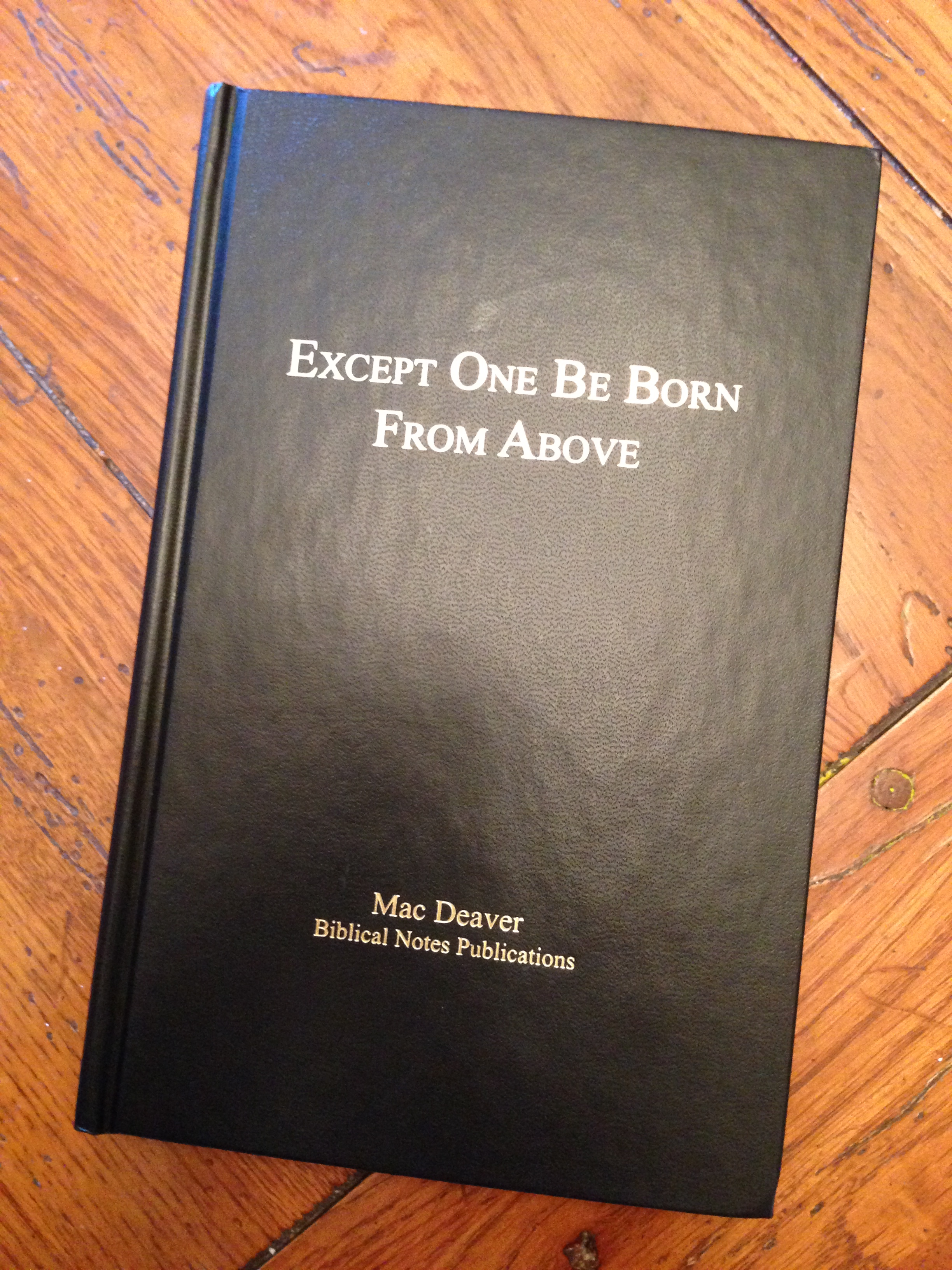
Upcoming Book by Mac Deaver

We’re very pleased to announce the forthcoming book by Mac Deaver, Except One Be Born From Above, published by Biblical Notes Publications in the summer of 2013. It will contain sixteen chapters and over three hundred pages of intriguing material on the new birth, centering around Jesus’ statements to Nicodemus in John 3. Realizing traditionally held views are not correct by virtue of having been long adopted, this book examines current belief and practice in light of what the inspired text actually does and does not say. Thoughtful readers may find themselves challenged with nearly every turn of the page. Thoughtful critics should find their hands full in trying to undermine or refute the book’s vigorous case. The interest here is not to win an argument, but to understand and defend the gospel, around which all Christians should be united. Stay tuned for more details. At the printer now, the book will, hopefully, be ready to ship to readers as early as July.

Posted in Christianity and Culture, LGBTQ

Sin Pride Month

By Weylan Deaver

In case you haven’t heard, we Americans are supposed to be celebrating sin this month. At least, that’s what our President tells us. From his whitehouse.gov website comes a proclamation which reads, in part:

“NOW, THEREFORE, I, BARACK OBAMA, President of the United States of America, by virtue of the authority vested in me by the Constitution and the laws of the United States, do hereby proclaim June 2013 as Lesbian, Gay, Bisexual, and Transgender Pride Month. I call upon the people of the United States to eliminate prejudice everywhere it exists, and to celebrate the great diversity of the American people.”

Sin has come a long way, hasn’t it? There was a time when it troubled people. Remember when Abraham’s nephew, Lot (a resident of Sodom), was “greatly distressed by the sensual conduct of the wicked” (2 Peter 2:7)? Of course, Lot was distressed by wickedness because he was “righteous” (ibid.). Which explains why our President is not distressed at all about homosexuality. President Obama proudly endorses evil, doing whatever he can to force its acceptance by the rest of us. We refuse to follow him on such a misguided errand. In fact, here is another quote, but, instead of coming from a presidential desk, it comes from the throne in heaven:

“Or do you not know that the unrighteous will not inherit the kingdom of God? Do not be deceived: neither the sexually immoral, nor idolaters, nor adulterers, nor men who practice homosexuality, nor thieves, nor the greedy, nor drunkards, nor revilers, nor swindlers will inherit the kingdom of God” (1 Cor. 6:9-10, ESV).

Now, if it is right to single out a particular sin as an object of celebration (a concept which ought to be too absurd to mention), then why not add some more special months to the calendar, such as…

  • National Pride in Sexual Immorality Month
  • National Pride in Idol Worship Month
  • National Adultery Pride Month
  • National Thief Pride Month
  • National Drunk Pride Month

Not long ago there were laws on the books against sodomy (i.e. homosexuality). Today, we are supposed to prop up homosexuality at every opportunity, applaud it by governmental proclamation, and reserve hatred only for those who refuse to endorse it. If the President is serious about the need to, in his words, “eliminate prejudice everywhere it exists,” then my question to him is this: Why does your Oval Office harbor such prejudice against the Bible and those who believe it? When is the President going to become intolerant with a culture that increasingly is willing to kick Christianity in the teeth? Obama’s hypocrisy is as odious as it is obvious and, for all his championing of “great diversity,” he clearly has no respect and little tolerance for views differing from his own, such as those held by Christians who still understand the distinction between good and evil.

No, Mr. President, we take no “pride” in homosexuality in any of its perverse manifestations. Neither in this month, nor in any other will we respect your directive to do so. Moreover, we hold your proclamation in contempt, realizing the utter foolishness of taking “pride” in anything which the Lord condemns. We bow to no king but Jesus, and he has already made a proclamation that excels and supercedes yours in every way. But, as long as we’re talking about “pride,” Mr. President, we submit this truth to your consideration: “Pride goes before destruction, and a haughty spirit before a fall” (Proverbs 16:18).

Posted in Christianity and Culture, Doctrine

“Whatever It Takes”

By Marlin Kilpatrick

In a recent church bulletin, the elders of the Heritage church of Christ (Fort Worth, Texas) made a Special Announcement under the title of Whatever It Takes. The Heritage elders announced that, beginning in the fall 2013, Heritage’s evening services will include instrumental music. The Sunday morning services will remain a cappella. The late brother J. D. Tant, gospel preacher, was known for his saying, “Brethren, we are drifting.” If he were still living he would say, “Brethren, we have drifted.” Fellow Christians, the Lord’s church is in deep spiritual trouble.

In the announcement it was claimed, “…all the elders were in agreement that “scripture does not prohibit the use of instruments in our worship.” On many issues it is good that all the elders be in agreement, but on this issue it matters not one whit that the elders are in agreement. While the elders may be “in agreement,” they are in disagreement with the Lord and his word. In the avenue of worshiping God in song, the scriptures are very specific: only singing is authorized. The use of instrumental music in Christian worship introduces another kind of music, which the scriptures do not authorize. In public debate with denominational preachers, faithful gospel preachers have met this issue time and again, and not once have denominational preachers been able to falsify this claim. Brethren, are we going to just throw away what we know the scriptures teach and become just another denominational church among many?

In their Special Announcement, the elders claimed “that the addition of instrumental worship service would be beneficial to our quest to reach the lost.” Here is where their “Whatever it Takes” enters the picture. Supposedly, if it takes instrumental music in worship to reach the lost, then the use of instrumental music is what we should do. But, the use of that which is sinful in worship will not save the lost. Where is the benefit in filling the auditorium with lost souls, even if they do enjoy the music? The only power to save the lost is the gospel of Christ (Rom. 1:16), but to pervert the gospel by using instrumental music in worship is in direct violation of Paul’s words (cf. Gal. 1:6-9), and renders the gospel powerless.

In the aforementioned rationale, where does such “reasoning” stop. If we use instruments of music in addition to our singing, in an effort not to offend the lost, when it comes to the question of music, then what will we do when the lost object (most already do) to baptism for the remission of sins? What will we do when someone objects to immersion in water, and insists on being sprinkled, instead? On what scriptural basis could we refuse to turn the Lord’s Supper into a common meal and remember the Lord’s death on Saturday night, if we use the rationale used by Heritage’s elders? Brethren, we are opening the flood gates, and when we do the Lord will hold us accountable. Such action as that taken by Heritage’s elders is a rejection of the need for scriptural authority for all that we do (cf. Col. 3:17). Correctly ascertaining scriptural authority on this issue will settle the matter.

In their Special Announcement, the Heritage elders said, “…we have spent a great deal of time studying the issue and praying for God to reveal his will as to what we should do.” The spending of “a great deal of time studying the issue” is commendable, but praying “for God to reveal his will as to what we should do,” is a waste of time. God has already revealed his will, and it is his will which we should obey. If we do, we will sing praises to him without instruments of music (Eph. 5:19; Col. 3:16). The New Testament is God’s final revelation to man. He will not reveal anything that is contradictory to his already revealed will. So waiting for God to reveal what we should do, when he has already revealed what he desires in worship, is useless.

Hopefully, the Heritage elders will see their mistake and repent. If this does not happen, it then becomes an issue of fellowship. We cannot fellowship error and please our Lord. Think about it.

Posted in Christianity and Culture, World Religions

Leftists and Islamists: Strange Bedfellows

By Weylan Deaver

The church of Christ and the gospel it seeks to uphold and defend are under attack from all directions. If we take seriously what the Bible teaches about Satan’s efforts, this should come as no surprise. If we realize that every Christian will be called on to suffer persecution of one brand or another (2 Tim. 3:12), we should be expecting it.

In point of fact, the “schemes of the devil” (Eph. 6:11) are so clever that we can even expect the unexpected. Have you ever been astonished at the palpable reluctance of the American media to criticize Islam? For example, on May 22 two Muslims plowed into a young British soldier in London in their car, then got out and attacked him with knives and a meat cleaver, nearly beheading the corpse. The murderous Muslims shouted “Allah Akbar” (Arabic for “God is great”) and recorded on camera a hateful speech before police arrived. In the recorded rant, one of the Muslims, hands covered in blood, said: “We swear by the almighty Allah we will never stop fighting you until you leave us alone…You people will never be safe. Remove your government, they don’t care about you…You think politicians are going to die? No, it’s going to be the average guy, like you, and your children.”

By now, American journalists and politicians should readily acknowledge the undeniable pattern emerging from a growing string of tragedies. In 2009 a Muslim soldier murdered thirteen and injured over thirty while shouting “Allahu Akhbar” at Ford Hood in Killeen, Texas. Yet, the Obama administration insists it was simply a case of workplace violence. On April 15, 2013 two bombs went off at the Boston Marathon, killing three and injuring 264, perpetrated by two foreign-born Muslim brothers. Yet, on May 23, 2013 President Obama boasted of his tenure, “There have been no large-scale attacks on the United States, and our homeland is more secure.” It seems we are doomed to the delusion that the religion of Islam is not an existential threat to American life.

Thus, to return to the late case of the murdered British soldier, consider how it was reported in America on the evening it happened (according to a newsbusters.org piece, “Networks’ Evening Shows Don’t Name Islam in London Terror Attack,” by Matthew Philbin). Brian Williams of NBC news said the killers vented “their message about religion and politics,” while NBC correspondent Michelle Kosinski remarked that one of the murderers “made a long political statement…”. Over at CBS, reporter Charlie D’Agata observed, “Witnesses said that the men shouted ‘god is great’ in Arabic during the attacks,” but there was no effort by CBS to emphasize or lay blame on Islam as a motive. At ABC news, Diane Sawyer said “officials in the United States and the United Kingdom are studying the meaning of this tape,” while ABC news reporter Lama Hasan said authorities were trying to learn “whether or not one of [the attackers] is of African origin with ties to terrorist groups.”

Even though one of the killers, moments after the murder, looked at a video camera and said, “We swear by the almighty Allah we will never stop fighting you until you leave us alone,” (which is what the Koran demands), our naivety knows no bounds. Leftist Americans scratch their heads and wonder what could have motivated such a grisly attack. Though a picture emerges, each new attack is met with an unwillingness to connect the dots.

Islam represents everything an increasingly godless American culture claims to hate. Islam puts to death adulterers and homosexuals, where godless liberals celebrate a sexual free-for-all where anything goes, and perversion is placed on the pedestal of respect. Islam calls for women to be covered, while the irreligious celebrate nakedness (in print, on film, in public). Islam opposes the consumption of alcohol, while America consumes it in volume. Islam opposes pornography while the Left supports it. Islam calls for everyone to submit to Allah, while godless liberalism refuses to submit to any lawgiving deity. Islam calls for a world ruled by Islam, whereas cultural leftists decry any organized religion. Islam says the Koran is ultimate law, but Leftists seem to recognize their own lusts as ultimate law, and the U.S. Constitution is respected by neither as the country’s highest authority. If truth be told, America’s constitutional republic and an Islamic society are definitionally incompatible. But there is none so blind as he who will not see.

Disparate as liberalism and Islam are, you would think liberal American journalists and Hollywood-types would be first in line to criticize Islam every chance they got. You might think the Left would see Islam as its greatest enemy. All things considered, Muslims should be coming under ever-increasing scrutiny and condemnation by the Left, since their respective worldviews are so diametrically opposed to each other. Or, are they?

It might be suggested that the Left is afraid to criticize Islam due to the latter’s obvious violent inclinations. While that is doubtless so in many countries, Islam in America has not reached a level of influence to scare us into submission. Muslims represent a small minority of our population. There must be another, more relevant answer. Why do American Muslims want to live in a country whose culture and governmental institutions stand in the way of the Koran’s influence? And why does our liberal American society seem so reluctant to offer criticism of Islam, when it stands for so many things liberals have a visceral reaction against?

Perhaps the answer lies in what they both have in common. The American Left hates the church of Christ. Islam hates the church of Christ. If there is one thing a godless worldview and an Islamic worldview have in common, it is this: they both fundamentally oppose the gospel of Christ. They both hate the Bible and the truth it contains. Think of it this way. By rejecting the truth of the gospel, liberalism embraces a worldview authored by the devil (who is the “father of lies,” John 8:44). By rejecting the truth of the gospel, Muslims also embrace a worldview from the same author. So, though they at first seem inherently different, liberalism and Islam both stem from worldviews issued from the devil. Both mindsets ultimately come from the same place! And the devil knows, whether it helps liberalism, or whether it helps Islam, it will make things harder on the Lord’s church. Since preventing men’s salvation seems his chief concern, Satan cares not from which direction the hindrance comes. In the case of American liberals, the devil has made for them a strange bedfellow, indeed.

Posted in Doctrine, Restoration History

Flawed from the Beginning

By Mac Deaver

For years I have been greatly interested in what is called The Restoration Movement of the 1800s. As a young student, I loved to read of the great men who called others back to a more serious consideration of the Scriptures and to see more clearly the then current religious scene that had been created through years and years of Bible neglect. And I still think that current members of the church owe a tremendous debt of gratitude to so many religious pioneers who have gone before and who were willing to break with never proved religious tradition and to break rank with those who proved to be non-Christians after all, but who claimed such status before God and man.

However, as we learn in the study of the period, not all those who came to be endorsers of and even participants in the “movement” understood clearly what a person had to do to become a Christian, and while some learned exactly what was essential , others who were involved did not. In fact, as we shall soon see, in this brief piece, the “movement” was flawed from the beginning. The movement was based on a cracked foundation that could not support the hoped for superstructure. And while it has had lasting effect to our good day in America, there were some concepts from the beginning that characterized some of its most prominent leaders that necessitated its limitation by division within because of its initial failure to divide from many without!

But before I continue, let me stress that the effort to “restore” New Testament Christianity was indeed a movement in the sense that there was an historical effort in time that was socially influential and that attempted to call men back to the Bible. It was an effort to call men back to original ground, at least allegedly so. To restore the “ancient order” of things was the goal because the then current religious division was deemed so intolerable by some, and that division seemed to make any religious progress most difficult if not impossible. And so a harmony or unity of all “Christians” (those who professed faith in Christ and obeyed him in such things as they understood) was sought and advocated upon a basis less divisive and less complex. A committed return to a more simple basis of spiritual fellowship was the desired item in the hearts of those longing for an end to the unending division within the “church” as the church was being viewed.

Now, the idea is only possible (much less essential) if original ground can be located. If the truth, the whole truth, and nothing but the obligatory truth regarding (1) how one enters the kingdom and (2) how one remains in the kingdom cannot be located, articulated, practiced, and successfully defended, then such an effort at “restoration” is wholly misguided because it is impossible to restore what cannot be found. But as we shall see, the working assumption that original ground could be located on the one hand (1) included some necessary concepts that on the other hand (2) were expressly excluded from the process of restoration. In fact, from the beginning there was an unrecognized conceptual self-contradiction offered as the right approach to the restoration of that original sacred ground. And so the “movement” was an attempt to restore what it was, in fact, impossible to restore given the way that it was going about the very business of restoration. If original ground were located, it would have to be found by going against some of the very foundational ideas upon which it was being launched.

Of course, it is very easy for me to criticize someone living in the 1800s who was for the first time beginning to see differences between what he found in his New Testament and religious doctrine that he had been brought up to believe in some denomination. And I certainly do not want to appear as an ungrateful recipient of great learning that took place during that time and within that movement.

But, I am more interested in (1) finding and in knowing that I have found what they were trying to restore themselves (the purity of original Christianity) than in (2) merely admiring a certain way of self-imposed looking, the effect of which would have to prevent one’s seeing clearly at all.

Let me begin the task of identifying the cracks in the foundation of the movement by first pointing out a few facts that must be faced by anyone who approaches the Scriptures in the effort to find the truth. Consider the following True-False statements:

T F 1. It is possible for a man to find all the truth necessary to his becoming a Christian and to find all the truth necessary to his remaining a faithful Christian.

T F 2. It is possible for a man to find only some of the truth necessary to his becoming a Christian and to find only some of the truth necessary to his remaining a faithful Christian.

T F 3. It is impossible for a man to find any truth necessary to his becoming a Christian and to find any truth necessary to his remaining a faithful Christian.

T F 4. It is possible for a man to find all the truth necessary to his becoming a Christian but only to find some of the truth necessary to his remaining a faithful Christian.

T F 5. It is possible for a man to find only some truth necessary to his becoming a Christian but to find all the truth necessary to his remaining a faithful Christian.

Now, these statements need a clear and careful answer. In the light of Scripture, #1 is the correct statement. Statements #2 through #5 are false (John 8:31, 32; 1 Tim. 2:4; Heb. 6:1; Eph. 5:3-14). And this truth would, at first, seem to have been grasped by the initial promoters of the restoration idea.

Now, let us consider several more relevant True-False statements that have to do with the very prospect of restoring the ancient order of things.

T F 1. Since Christians are the only components of the church, and since the first True-False statement above is correct, then we know that it is possible to locate in Scripture what is required of men today in order for them to be added to the Lord’s church (Gal. 1:6-10).

T F 2. Since we know that all men today must obey the same gospel in order to be added to the church, then we know that the church is composed only of those who have done the same thing in order to enter (Eph. 4:1-7).

T F 3. Since the church is composed of only those who have done the same thing (obeyed the same gospel) in order to enter, then spiritual fellowship is only rightly extended to those who have obeyed that gospel and thus who have entered (1 John 1:3; 2 Cor. 6:14-18).

T F 4. It is possible for a person to claim to be in God’s favor and a devoted follower of Christ while never having become a Christian at all (Rev. 2:9; Matt. 7:21-23).

T F 5. It is possible for a Christian to cease being a faithful Christian (Gal. 5:4; 1 John 2:19).

Now, while it is true that Christians are under obligation to love all men (Matt. 22:37-40), we have never been under obligation to treat even most men as Christians. For most men simply are not, and most men do not even claim to be. And, even more to the point, most men do not even desire to be. However, while doctrinally, the matter is fixed as to who is and who is not a Christian, a problem arises when –

  1. a non-Christian seeks to extend spiritual fellowship to another non-Christian when both parties claim to be Christians and yet neither one is.
  1. a Christian seeks to extend spiritual fellowship to a non-Christian in spite of the Christian’s knowing that the non-Christian is clearly a non-Christian.
  1. a Christian seeks to extend spiritual fellowship to a non-Christian because even though he knows on the one hand that the non-Christian is not a Christian, he knows that the non-Christian at least claims to be a Christian, and the Christian considers it more loving to endorse the non-Christian in his sin than to deny his claim. After all, the Christian isn’t God!
  1. a Christian seeks to extend spiritual fellowship to a non-Christian because the Christian himself no longer is sure of the essentiality of obedience to the gospel in order for a person to have a rightful claim to Christian status. He has now subscribed to a doctrine of “grace” that by redefinition allows him to fellowship those who make the claim to be Christians on the basis that, after all, who is he to say they are not. Again, truth has now become “unclear” truth when compared to a “clear” claim especially since the truth has no feelings to be hurt by rejection but the personal claimant surely does?

Note: At this point it may not bother him because it never dawns on him that if “grace” is actually extended to one who claims to be a Christian but who has not, in fact, obeyed the gospel, for all he knows then, that same “grace” may be extended to anyone who does not even claim to be a Christian. If a formerly viewed false claim has now become a possibly true claim because of a redefinition of grace, then why is a claim necessary (for the divine extension of grace) for the reception of grace at all? If one does not have to know and obey the truth in order to be saved, then no clear claim about anything is necessary to salvation at all! With his redefinition of “grace,” he is in no position to deny the salvation of all men since he knows that God desires that universal salvation (2 Pet. 3:9; 1 Tim. 2:4). Historically, truth has often been sacrificed on the altar of friendship and false claim. But if the non-Christian can’t prove the accuracy of his own claim to be a Christian, and if the Christian does not care about the absence of justification for the non-Christian’s claim to Christian status, then the truth does not matter to either the Christian or the non-Christian! Is such a spiritual fellowship worthy of a search and then support? What is the value of such a fellowship or of a “movement” that might embrace it?

Now, let us proceed by considering some things early on declared by two prominent men in the early days of the American Restoration Movement. And as I consider these quotations, I do so with a view toward establishing the point that there were at least three cracks in the original foundation of restoration effort or three flaws from the beginning. And for the purpose of this article, I mean by “beginning” 1809 when Thomas Campbell wrote the Declaration And Address. And the “cracks” that I will identify are (1) a faulty hermeneutic which was an attempt at the time to get rid of all human opinions as impediments to the rightful extension of spiritual fellowship to all Christians in the denominations, but which hermeneutic unwittingly created (2) a situation in which it was impossible to maintain the correct distinction between faith and opinion, and (3) a willingness to extend spiritual fellowship to people who were not complying with the nature and purpose of baptism as they came to understand it.

In the Declaration And Address, Thomas Campbell stated that he was not trying to create another human creed as a term of communion. What he was proposing was a route to “original ground” so that men in his day could “take up things just as the apostles left them” (Historical Documents Advocating Christian Union, edited by John Allen Hudson, p.107; hereafter this book will be referenced as HD). Thus, his goal in providing the thirteen propositions listed in the Address were based on the view that the apostles had left some things for us that needed to be recovered in thought and practiced in life. And these things needed to be distinguished from other things so that religious reform could indeed take place. All of the various additional doctrinal positions that had been taken over the centuries and which had accumulated as divisive creedal statements that kept equally sincere brethren in segregate communities simply had to be removed from human thinking if the unity required in Scripture was going to be achieved.

But how did Thomas Campbell come to the conclusion that there was an obligatory unity that Christians were obligated to practice? Whence came this understanding? How did he come to the conclusion that there was a kind of unity that Christians were under obligation to practice? How did he know that the obligation to uphold that unity lasted longer than the first century? And why did the Address seem to him to be important as an applied way of getting rid of the accumulated human decrees that stood in the way of the unity of Christ?

The Declaration And Address didn’t just fall from the sky. It was a document that originated in the mind of Thomas Campbell. Well, let us ask ourselves some questions as to the nature of that document as it first existed in thought in his mind. And let us be specific. Let us think about his goal of trying to get back to original ground, sacred ground not spoiled by wrong human thinking.

T F 1. The view that Thomas Campbell and all other men should only do what is authorized by Christ as revealed in the New Testament is itself a mistaken and unintended part of the accumulation of mere human opinions that stand in the way of the unity of Christ.

T F 2. The view that Thomas Campbell and all other men should only do what is authorized by Christ as revealed in the New Testament is a part of “original ground” discoverable by human reason but without the exertion of opinion.

Or let us word the two statements a little differently and make our point more simple:

T F 3. The view that Thomas Campbell and all other men should only do what is authorized by Christ as revealed in the New Testament is itself a mere human opinion.

T F 4. The view that Thomas Campbell and all other men should only do what is authorized by Christ as revealed in the New Testament is itself a matter of biblical faith.

Dear reader, now think about those four True-False statements very carefully. And with regard to the first and third statements, surely Campbell did not mean to be binding another mere human opinion on others in his attempt to get rid of the then current problem of binding human opinion on men as a basis of establishing and maintaining religious fellowship. He would certainly have no right to bind his own personal opinion that “original ground” should be recovered if such were merely an opinion, while at the same time deploring the use of human opinion as the means of establishing spiritual orthodoxy. So, we would take it that statement #1 is false and that statement #3 is false. Thomas Campbell’s view that “original ground” should be desired and that by it alone men could maintain the unity of Christ is a part of “original ground” or to express it another way, it is a part of biblical faith itself and certainly is not a matter of mere human opinion. So, statements #2 and #4 are true.

Paul’s words to the brethren at Colossae establish the correctness of the foregoing conclusion. “And whatsoever ye do, in word or in deed, do all in the name of the Lord Jesus, giving thanks to God the Father through him” (Col. 3:17). Truly, to do things in the name of Christ is to obey God rather than man (Acts 5:28, 29; cf. 4:12). And this is the very thing that was Campbell’s goal. It was a noble goal, but his process for accomplishing it was flawed. Now, just what do we mean?

Proposition #3 in the Declaration And Address is too restrictive in its statement of what constitutes the pattern of authority whereby Scriptural unity can be obtained and maintained. Campbell in trying to reach a position that would prohibit the constant dividing up into various religious camps said that “nothing ought to be inculcated upon Christians as articles of faith; nor required of them as terms of communion, but what is expressly taught and enjoined upon them in the word of God. Nor ought anything to be admitted, as of Divine obligation, in their Church institution and managements, but what is expressly enjoined by the authority of our Lord Jesus Christ and his apostles upon the New Testament Church; either in express terms or by approved precedent” (HD, 108). His words “expressly enjoined” are what we call “direct statement” and his “approved precedent” are what we call “approved example.” But Campbell left out the third category or way that the Bible authorizes. He left out what in our day came to be called “necessary inference,” but which later was more appropriately identified as “implication.” Campbell intentionally omitted that route to the record.

We can appreciate his reluctance since he was trying to avoid the mental route that had caused him so much pain. He well knew the agony of wrong inference when men drew conclusions not provable by Scripture and bound these conclusions on others. That is what had created the warring denominational camps. But rather than make the distinction between (1) inferring what is actually implied as can be established by logical argument, and (2) inferring what is not implied (thus merely drawing a conclusion not implied by the Bible which conclusion is then a mere human opinion), Campbell simply attempted to leave the whole process of “inference” out of ascertaining the pattern of authority. The pattern would consist of (1) direct statement and (2) approved example only.

In Proposition #5 we have the wonderful statement that “Nothing ought to be received into the faith or worship of the Church, or be made a term of communion among Christians, that is not as old as the New Testament” (HD, 110).

But when we come to Proposition #6, we see Thomas Campbell’s fear of inference as a category or route to Bible authority. Read it carefully in full:

“That although inferences and deductions from Scripture premises, when fairly inferred, may be truly called the doctrine of God’s holy word, yet are they not formally binding upon the consciences of Christians farther than they perceive the connection, and evidently see that they are so; for their faith must not stand in the wisdom of men, but in the power of God. Therefore, no such deductions can be made terms of communion, but do properly belong to the after and progressive edification of the Church. Hence, it is evident that no such deductions or inferential truths ought to have any place in the Church’s confession” (HD, 110).

Notice, please that while Campbell was honorably trying to prevent the continued application of human authority as binding on men as an appendix to or substitute for divine authority, in the very way that he was attacking “opinion binding,” he went too far by undermining the very procedure that he was, in fact, already employing. In looking at human reason the way that he was and in describing it the way that he did, he was creating unintentionally an impossible and self-contradictory task for himself and others. Consider carefully, please, that on the one hand (1) Campbell allows for the fact that when inferences and deductions are “fairly inferred,” the conclusions reached may be called “the doctrine of God’s holy word,” and yet on the other hand, (2) Campbell says that those conclusions, though a part of God’s holy word, are the product of human wisdom rather than divine power. Do you see a problem just here, dear reader?

If the principle that Campbell is upholding in his proposition #6 is the product of “fair inference” from Scripture premises, then although it may be a part of God’s holy word, it cannot be bound on anyone as divine authority since it is the product of Campbell’s own human reasoning and, therefore, is a part of human wisdom rather than the product of divine power. Therefore, Campbell’s own view which was reached by inferring what the Bible was implying (about substituting human authority for divine authority in his day) was a conclusion that (though correct and a part of God’s holy word) had no “place in the Church’s confession.”

Rather than stress the absolute necessity of correct reasoning (cf. 1 Thess. 5:21: Rom. 12:2), he attacked human reason, in the act of deduction, as leading to “the wisdom of men.” The truth of the matter is that it is only by the correct use of human reason that a person can come to comprehend that he is under the binding authority of the New Testament at all!

So, I ask, how in the world could the appeal in the Declaration And Address (to those viewed by Campbell as Christians) have any rightful place in their thinking? If his conclusion that there should be a rediscovery of “original ground” was rightly inferred from what the Bible implied, then (although correct and a part of God’s holy word according to Campbell himself), it still stood in the “wisdom of men” rather than in the “power and veracity of God.” According to Campbell, if these “Christians” couldn’t see the accuracy of the plea and thus the need of the plea for “restoration,” then the plea could not be “formally binding” on them, because he said that fairly inferred conclusions drawn from Scriptural premises cannot be “formally binding upon the consciences of Christians farther than they perceive the connection, and evidently see that they are so.” Therefore, unless the other “Christians” in the denominations were convinced that Campbell’s call for restoration was good and needful, and if they were convinced of the need to participate, they would be following the “wisdom of men” rather than the “power and veracity of God” in submitting to a principle that Campbell learned by proper deduction from Scripture premises.

Therefore, it is clear that the first “flaw” from the beginning was a hermeneutical (interpretational) flaw that appeared by way of Campbell’s unintentionally attacking “implication” as a way of learning what is binding upon men.

And since that error was advocated in the Address, that meant that there was no clear way for Campbell to make a clear distinction between (1) matters of faith and (2) matters of opinion although he was trying desperately to get rid of the notion of binding mere human opinion on anyone. If conclusions “fairly inferred” were still evaluated as standing in “the wisdom of men” rather than in “the power and veracity of God,” then there could be no precise distinction drawn between “God’s holy word,” learned by “fair inference” and mere human opinion both of which are products of a man’s mind.

In our day, when it comes to the matter of “ascertaining Bible authority” (that is also the name of one of my father’s well-received books), we have said that the Bible authorizes by (1) direct statement, (2) approved example, and by (3) implication. Of course, implication and approved example are both derived from direct statements, but the three categories are correct as identifications of literary function or the ways that we learn what we must do, what we may do, and what we must not do. And by the three routes to authority, we find our obligations, our options, and our prohibitions.

In Campbell’s words “fairly inferred” refer to a conclusion rightly deduced from Bible premises. “Fair inference” would be correct inference from Bible implication. That is, we fairly infer when we correctly infer what the Bible actually implies. These doctrines thus inferred can be, then, stated as conclusions of valid syllogisms. They become a part of a sound argument. And a sound argument is a valid argument with truthful premises. The argument is, therefore, dependable. The conclusion of a sound argument is true. If we infer what the Bible does not really imply at all, we draw a conclusion that is simply an opinion, and there is no sound argument whatever that can be constructed in its defense.

All doctrinal controversy can rationally only be settled by the appeal to a sound argument. And this is an obligation stated in Scripture. This is what the very notion of “proof” entails! According to Ruby’s Logic, An Introduction, the “law of rationality” is the principle that “We ought to justify our conclusions by adequate evidence” (Ruby, 131). Jesus always complied with that law or regulative principle of human reasoning. And Paul made our deference to that law a matter of biblical obligation in at least two passages of Scripture. He told the brethren at Thessalonica to “prove all things; hold fast that which is good,” (1 Thess. 5:21), and he told the saints in Rome, “And be not fashioned according to this world: but be ye transformed by the renewing of your mind, that ye may prove what is the good and acceptable and perfect will of God” (Rom. 12:2).

But as brother Thomas B. Warren taught us long ago, since none of us (and this applies to Thomas Campbell as well as to Thomas Warren and all men living today) can find his own name written in the Bible, he cannot learn that he is even under Bible authority without rightly inferring what the Bible implies! We cannot even recognize our connection to and the necessity of submitting to Bible authority without correctly inferring what the Bible implies! Although the Bible provides our obligations, options, and prohibitions, it reaches us or connects us to those ways of ascertaining Bible authority only or completely by way of implication. That is the one and only route that provides our connection to the binding authority of Holy Writ!

Since the Bible was originally addressed to others (none of us living today were even born when even one book of the Bible was written), we can only come to recognize that we, too, like the original audience are under Bible authority only by or exclusively by inferring what the Bible implies. And if this conclusion “fairly inferred” cannot be bound on anyone because it is simply a part of the wisdom of men rather than the product of the veracity and power of God as described by Thomas Campbell, then no man living today is under Bible obligation to do one single solitary thing! And this would also mean that no one living in Campbell’s day including Campbell himself was under Bible authority at all. That is how crucial the mistake made by Thomas Campbell was. Given the way that he was describing “fair inference” and “deduction,” he could not clearly distinguish between faith and opinion at all when it came to matters of binding obligation.

His idea of getting rid of binding human opinion in the religious arena was indeed correct! But the way he described the process whereby he thought that such could be achieved made it impossible for one to even be under divine authority to do such a thing.

And perhaps, because of the way that he confusedly and unintentionally blurred the distinction between human opinion and biblical faith, that at least partially explains why it is that he and later his son, Alexander, were so very willing to spiritually fellowship denominational people, including preachers, who did not share the “restoration” viewpoint. This is the third “flaw” that I want to mention.

When we read of the way that Thomas and Alexander Campbell related to other religious people in their day, we see that they were willing to spiritually fellowship them even though they were practitioners of denominationalism and not necessarily supporters of the idea of recovering original ground. The Campbells had come out of the Presbyterian church themselves. But their break with that group with all its historical internal division, did not mean that they would, however, refuse to recognize as faithful Christians those from whom they were now somewhat religiously estranged. And as their comprehension of certain Bible truths grew, even though they remained very ecumenical in their regard to the sects, yet their knowledge growth brought them into a closer affiliation with other religious people who had learned the same truth.

For example, following the Campbells’ learning that “baptism” was, in fact, in Scripture “immersion,” the little Brush Run church across the West Virginia line in southwestern Pennsylvania became organizationally connected to the Baptists. After writing out a statement which entailed a rejection of human creeds as a basis of fellowship, and declaring their willingness to become a part of the Redstone Association if they would be allowed to uphold what they were convinced the Bible taught, the Brush Run church then joined that Baptist association in 1813 (West, Search For The Ancient Order, Vol. I, p. 61). Alexander wrote to a relative in 1815,

“For my own part I must say that, after long study and investigation of books, and more especially the Sacred Scriptures, I have through clear convictions of truth and duty, renounced much of the traditions and errors of my early education. I am now an Independent in church government; of that faith and view of the gospel exhibited in John Walker’s Seven Letters to Alexander Knox, and a Baptist so far as regards baptism. What I am in religion I am from examination, reflection, and conviction, not from ‘ipse dixit’ tradition or human authority” (West, pp. 61, 62).

Later, while Alexander Campbell was working with the Wellsburg church, that congregation joined the Mahoning Baptist Association (West, pp. 66-68). So, while the Campbells were advancing in their understanding of Scripture, and while they were making headway in teaching the non-denominational nature of early Christianity and the necessity of unity among Christians, they still recognized Christians among the sectarians groups.

And later, in 1837, Campbell received a letter from a woman in Lunenburg, Virginia, in response to which Campbell again revealed his attitude toward the sects, and which attitude bothered some of his own brethren who thought that Campbell was surrendering ground gained in the reform effort. The woman from Lunenburg had been surprised by the fact that in Campbell’s periodical, Campbell had recognized “the Protestant parties as Christian” (Campbell, Millennial Harbinger, September, 1837, p. 411).

In response, Campbell first proposes the following:

“In reply to this conscientious sister, I observe, that if there be no Christians in the Protestant sects, there are certainly none among the Romanists, none among the Jews, Turks, Pagans; and therefore no Christians in the world except ourselves, or such of us as keep, or strive to keep, all the commandments of Jesus. Therefore, for many centuries there has been no church of Christ, no Christians in the world; and the promises concerning the everlasting kingdom of Messiah have failed, and the gates of hell have prevailed against his church! This cannot be; and therefore there are Christians among the sects” (Campbell, 411).

So, the basis on which Campbell rests his view that there must be Christians in the sects is that unless one is willing to grant that contention, then he must admit that in history the church at some point ceased to exist! But I ask the reader, is that true? Why would that admission necessarily have to follow? Isn’t it possible that Christians could have existed ever since Pentecost in the world without their getting involved with and amalgamated with some denomination. Even if history ignored the existence of non-denominational Christians in its record (given their small numbers), does anyone today have the right to claim that the church simply stopped existing in history unless one admits that it existed in combination with Catholicism and Protestant denominationalism or among Jews, Turks, and Pagans? Such simply does not at all follow. Campbell merely asserted what he could not prove.

It is the case that Christians, following the apostasy predicted by Paul, did not for a long time have the force of a massive societal movement, but their non-mention in the historical record of the continuing apostasy does not prove their non-existence. To be viewed as non-worthy of mention is not the equivalent of proof of their non-existence. Consider that outside the Bible there is very little mention of Jesus during the first few centuries from secular historians following his resurrection. And some today deny that he ever lived, but such is no proof of any currently alleged non-existence. The books of Matthew, Mark, Luke, and John are historical documents from antiquity. They establish the historicity of Jesus. I used to ask my students the following question: How long must you be dead before your “not having been” here becomes a real possibility? We are not here trying to beg any question. We are simply saying that real historical existence, while it can be denied, can never be disproved. Too, the non-existence of the church in one country would not argue conclusively for the non-existence of the church in every country. The fact that the Bible did not exist in many languages for a long time during the days of the apostasy did not mean that it was not here at all. And simply because the Bible had not existed in an English version before a certain date could not mean that it did not exist in some other language or languages before the first English version appeared. If the Bible presently exists in one language, then it has always existed in some language tracing back to the original.

Then, too, Campbell thinks that if we claim that there are no Christians in the sects, we have also to claim that there are no Christians among the Catholics (Romanists), the Jews, Turks, and Pagans. In other words, if there are no Christians among the sects, there have been no Christians in the world for many years! But it is certainly conceivable that one could argue for the existence of some Christians among the sects while denying that any Catholic or Jew or Turk or Pagan had ever become a Christian. And Campbell says that if we deny that all others have become Christians, that we are claiming, therefore, that there are “no Christians in the world except ourselves, or such of us as keep, or strive to keep, all the commandments of Jesus.” Well, is that a false claim? If “ourselves” refers exclusively to those in America, it would be a false claim. If it refers to those known only to Campbell, it would be a false claim. But if it refers to all those who “keep” (not just strive to keep) the commands of Jesus any and everywhere, the claim is correct. And it is beyond successful contradiction.

On the one hand Campbell (1) strove for recovering original ground, (2) did not intend to start a new religious group or church, (3) attempted to get Christians among the sects to unify on that recovered ground. He plainly stated that he was not striving for the unification of the sectarian groups as such. He was appealing to those among them who were Christians to come out and unify on the restored basis of divine doctrine, but he (4) spiritually fellowshipped the denominationalists who did not agree with him doctrinally. This made the very idea of “restoration” seem suspect. If on the one hand he was distinguishing between “Christians among the sects” (thus calling them out from among those in the sects who were not really Christians) that might have a certain Scriptural appeal to it. It would seem fair to assume the possibility that some people had, in fact, become Christians but who had subsequently joined some denomination. However, since Campbell himself spiritually fellowshipped others who were not willing or who had not as yet “come out” to unify on original ground, that made the Campbells concept of “restoration” suspect and inconsistent.

But then notice what Campbell says in response to the letter from Lunenburg:

“But who is a Christian? I answer, Every one that believes in his heart that Jesus of Nazareth is the Messiah, the Son of God; repents of his sins, and obeys him in all things according to his measure of knowledge of his will. A perfect man in Christ, or a perfect Christian, is one thing; and ‘a babe in Christ,’ a stripling in the faith, or an imperfect Christian, is another” (Campbell, p. 411).

He goes on to say that both groups are recognized in Scripture and the imperfect Christians are told to be perfect, and he cites 2 Corinthians 3:11. But Campbell’s significant problem is that he is assuming that a person can become a Christian without clearly understanding anything beyond repentance. According to his own words, a Christian is a man who believes that Jesus is the Christ, repents of his sins, and “obeys him in all things according to his measure of knowledge of his will.” So, given the way that Campbell describes who a Christian is, the following individuals would be Christians:

  1. a man who has faith and repents but does not know anything about baptism;
  2. a man who has faith and repents and knows that he should be “baptized” for some unknown (to him) reason;
  3. a man who has faith and repents and who is “ baptized” for some wrong reason;
  4. a man who has faith and repents and who is “baptized” in the wrong way (by sprinkling or pouring but not by immersion) would be a Christian.

In response to the implications of Campbell’s remarks to the woman from Lunenburg, I would say this: “repentance unto life” per Acts 11:18 does not entail any of the four categories just listed! The cases of kingdom entry in the book of Acts do not allow for such variation as Campbell’s view did. Read the following from the “Lunenburg Letter” carefully, and you can see how that other brethren began to see that they were not looking at “restoration” in the same way that Campbell evidently was:

“Should I find a Pedobaptist more intelligent in the Christian Scriptures, more spiritually-minded and more devoted to the Lord than a Baptist, or one immersed on a profession of the ancient faith, I could not hesitate a moment in giving the preference of my heart to him that loveth most. Did I act otherwise, I would be a pure sectarian, a Pharisee among Christians. Still I will be asked, How I know that any one loves my Master but by his obedience to his commandments? I answer, In no other way. But mark, I do not substitute obedience to one commandment, for universal or even for general obedience. And should I see a sectarian Baptist or a Pedobaptist more spiritually minded, more generally conformed to the requisitions of the Messiah, than one who precisely acquiesces with me in the theory or practice of immersion as I teach, doubtless the former rather than the latter, would have my cordial approbation and love as a Christian. So I judge, and so I feel. It is the image of Christ the Christian looks for and loves; and this does not consist in being exact in a few items, but in general devotion to the whole truth as far as known” (Campbell, p. 412).

Dear reader, did you understand what Campbell just affirmed? He said that if they were “more spiritually minded, more generally conformed to the requisitions of the Messiah” both a sectarian Baptist and a Pedobaptist (one who believes in infant baptism) would have his “cordial approbation and love as a Christian” more so than that given to someone less spiritually minded but who “precisely acquiesces with me in the theory or practice of immersion as I teach.” WOW!

In the November issue of the Millennial Harbinger under the heading, “Christians Among The Sects,” Campbell briefly responded to some objections received in the light of his response to that letter from Lunenburg (pp. 506-508). One can easily see how that some concluded that Campbell was surrendering ground for which he and others had fought. Campbell, however, didn’t think he was surrendering anything, and if he wasn’t, we see that many who had been striving for “restoration” for years had failed completely to grasp the weakness in the foundation of Campbell’s thought regarding who was and who was not a Christian. When Campbell’s precise teaching on the nature and purpose of baptism was grasped and practiced by others, they took it as a point that was necessary to be understood in order to become a Christian. Campbell evidently thought that was going too far.

So, we see that early on there were flaws in the thinking of some who were most engaged in the effort at “restoration.” There was a (1) hermeneutical flaw regarding the place of deduction in discerning the pattern of authority, (2) an epistemological flaw, therefore, that did not allow for clear distinction between matters of faith and matters of opinion, and (3) there was the willingness of some involved in the formative period of “restoration” thought to spiritually fellowship other religious people who had never obeyed the gospel, which rendered the whole effort at restoration suspicious. It is a wonder that unity was maintained as long as it was.