Posted in Christianity and Culture, Church and State

Whatever happens in the election…

By Weylan Deaver

Whatever happens in the election, God will still be on his throne, for “the Most High rules the kingdom of men and gives it to whom he will” (Dan. 4:25, ESV). Whatever happens in the election, the Bible will still be true in all it says, since “it is impossible for God to lie” (Heb. 6:18). Whatever happens in the election, Jesus will still be the only way to heaven, for he is “the way, and the truth, and the life” (John 14:6). Whatever happens in the election, good and evil will still be defined by the Lord, and government will still have the duty to function as a “servant, of God, an avenger who carries out God’s wrath on the wrongdoer” (Rom. 13:4). Whatever happens in the election, for protection our military will never be as powerful as morality, since “Righteousness exalts a nation, but sin is a reproach to any people” (Prov. 14:34). Whatever happens in the election, citizens will still be obligated to work in such a way they are “dependent on no one” (1 Thess. 4:12), which means government ought not foster a culture of dependency. Whatever happens in the election, America will still not be as important as the church of Christ, for it was “obtained with his own blood” (Acts 20:28). Whatever happens in the election, every American is still supposed to “love the Lord your God with all your heart and with all your soul and with all your mind” (Matt. 22:37), remembering “we must all appear before the judgment seat of Christ, so that each one may receive what is due for what he has done in the body, whether good or evil” (2 Cor. 5:10). In the church of Christ in the United States, we are thankful to be Americans, but even more grateful “our citizenship is in heaven, and from it we await a Savior, the Lord Jesus Christ” (Phil. 3:20).

Posted in Doctrine

A Most Significant Scripture

By Marlin Kilpatrick

The Bible is God’s inspired word (2 Tim. 3:16-17). In one sense there are no insignificant scriptures. Still, there are some scriptures which are more relevant than others in helping us understand the great biblical themes which are woven throughout the Bible. Our Lord’s promise to send his Holy Spirit to his faithful brethren is a Bible theme which has occasioned the asking of many questions. One question concerning the giving of the Holy Spirit is whether the Spirit is given by measure.

Most all of my life I have heard of different measures of the Spirit being given. It was claimed that (1) Christ had the Spirit without measure, (2) the apostles received the “baptismal” measure, and (3) some upon whom the apostles laid their hands received the “laying on of hands” measure. All other Christians received what is called the “common” or “ordinary” measure of the Spirit. But were there different measures of the Spirit given?

A most significant scripture is John 3:34 which, due to the KJV translation, has caused many to believe and teach there are different measures of the Spirit given. The KJV reads, “For he whom God hath sent speaketh the words of God, for God giveth not the Spirit by measure unto him.” The problem with which we are faced involves the words “unto him” which were supplied by the KJV translators. However, they are not in the old manuscripts. The ASV (1901) correctly translates the verse by omitting the words “unto him.” Likewise, most newer translations have followed suit. This is a most significant rendering of the scripture and it helps immensely our understanding of the reception of the Spirit by all who obey the gospel. There are no measures of the Spirit.

If there are no measures of the Spirit, then all who received the Spirit, beginning at Acts 2 and throughout the book of Acts, received the same thing. Since Jesus promised his apostles they would be baptized in the Holy Spirit (Acts 1:4-5) and there are no measures of the Spirit, then all who received the Spirit on Pentecost (Acts 2) were baptized in the Holy Spirit. And this harmonizes with John the Baptist’s words, “…he shall baptize you with the Holy Spirit and with fire” (Matt. 3:11; Luke 3:16).

I anticipate that someone may say, “But not all Christians could do what the apostles could do.” Yes, this is true. But now we are speaking of the power supplied by the Spirit. We must make a distinction between the baptism in the Spirit and the power supplied by the Spirit. It is certainly the case that the apostles had supernatural (miraculous) power. The apostles laid their hands on certain individuals and they received limited supernatural power. And all other Christians had non-miraculous power. Today, the Spirit’s power in Christians is limited to the non-miraculous.

If only the translators of the KJV had translated John 3:34 correctly, much of the confusion over the so-called measures of the Spirit would have never occurred. Today there are no measures of the Spirit; one either has the Spirit or he does not have the Spirit. He who does not have the Spirit, does not belong to Christ (Rom. 8:9-11). Think about it.

Posted in Apologetics, Books, Reviews

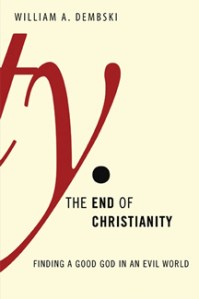
The End of Christianity (Book Review)

By Weylan Deaver

The End of Christianity, by William A. Dembski, was published in 2009 by B&H Publishing Group. Dembski is Research Professor in Culture and Science at Southern Evangelical Seminary and a Senior Fellow at the Discovery Institute’s Center for Science and Culture. As both a philosopher and mathematician, he is on the front lines of the Intelligent Design (ID) movement among scientists. His list of credentials and accomplishments impresses. With postdoctoral work at MIT, University of Chicago, and Princeton, Dembski has written over a dozen books, appeared on ABC News Nightline, BBC, CNN, PBS, NPR, and Fox News, and been cited by The New York Times and Time Magazine. He was interviewed for the Ben Stein documentary, Expelled: No Intelligence Allowed.

The book’s subtitle is “Finding a Good God in an Evil World,” and it is a theodicy, attempting to demonstrate that God’s goodness is compatible with the existence of evil on earth, or, in other words, “to resolve how a good God and an evil world can coexist” (p. 4). Divided into five sections, it contains twenty-four chapters and 238 pages, including introduction and various indices.

More than mere theodicy, Dembski’s goal is to outline a specifically Christian theodicy that defends three particular claims: “God by wisdom created the world out of nothing…God exercises particular providence in the world…All evil in the world ultimately traces back to human sin” (p. 8).

The eye-catching title has nothing to do with Christianity’s demise, but, rather, its effect. “The end of Christianity, as envisioned in this book, is the radical realignment of our thinking so that we see God’s goodness in creation despite the distorting effects of sin in our hearts and evil in the world” (p. 11).

One might suspect an author trained in mathematics and philosophy should not be the most interesting to read, but Dembski is no dull writer. He excels at casting deep theological and philosophical truths in easy-to-understand, creative, and thought-provoking ways, perhaps even reminiscent of C. S. Lewis.

The initial four chapters treat the topic of evil, and Dembski offers many keen insights. In the face of critics who say Jesus could not fully identify with human suffering, Dembski defends the Cross as far more than the Lord taking a few hours of pain. “In particular, Christ on the Cross identifies with the whole of human suffering, and this includes the ignorance and uncertainty that intensify human suffering” (p. 20). “The extent to which we can love God depends on the extent to which God has demonstrated his love for us, and that depends on the extent of evil that God has had to absorb, suffer, and overcome on our behalf” (p. 23).

Humans are to blame for both the presence of personal sin (i.e. disobedience to God), and the existence of natural evil (e.g. floods, disease, animal suffering, etc.). Says Dembski, “We started a fire in consenting to evil. God permits this fire to rage. He grants this permission not so that he can be a big hero when he rescues us but so that we can rightly understand the human condition and thus come to our senses” (p. 26). Sin forced souls into a state of disorder, which, in turn, came to be reflected in nature (p. 28). The evil and disorder apparent in nature are designed to impress people with the magnitude of the Fall in the Garden of Eden. Thus, “humanity must experience the full brunt of the evil that we have set in motion, and this requires that the creation itself fully manifest the consequences of humanity’s rebellion against God” (p. 44). It is not that we serve a petty God who holds grudges, but, rather, that we must come to terms with the seriousness and consequences of human sin. “The problem isn’t that God can’t take it but that we can’t take it—in offending God, we ruin the image of God in ourselves and so lose our true self” (p. 45).

Chapters 5-9 deal with creationism from a young-earth and an old-earth perspective. “God gave humanity two primary sources of revelation about himself: the world that he created and the Scripture that he inspired. These are also known as general and special revelation, or sometimes as the Book of Nature and the Book of Scripture…We study science to understand the first of these books, theology to understand the second” (p. 71). Further, “God is a God of truth. As the author of both books, he does not contradict himself” (p. 72).

Admitting that “Young-earth creationism was the dominant position of Christians from the Church Fathers through the Reformers” (p. 52), Dembski says he “would adopt it in a heartbeat except that nature seems to present such strong evidence against it” (p. 55). He sees a problem in that today astrophysics and geology posit an age of 13 billion years for the universe, 4.5 billion years for the earth. This model results in a world where animals predated humans by eons, and in which this animal planet was suffering the effects of natural evil. In other words, according to the current climate of accepted science, long before man arrived there were animals eating each other, dying slow deaths, suffering from parasites, drowning, falling in tar pits, etc. If humans are responsible for the existence of all evil on earth, then how could such evil exist before there were humans? The answer to that question is the gist of the book. More on that in a minute.

Young-earth creationists have no dilemma in which the need arises to account for evil before man, since everything was created in the span of six 24-hour days. But Dembski thinks this cannot—at least in the current scientific atmosphere—be made to harmonize with accepted facts of geology and astrophysics. “Christians, it seems, must therefore choose their poison. They can go with a young earth, thereby maintaining theological orthodoxy but committing scientific heresy; or they can go with an old earth, thereby committing theological heresy but maintaining scientific orthodoxy” (p. 77).

Taking young-earth creationists to task, Dembski accuses them of adopting a double standard, appealing to nature’s constancy when it helps their case, and denying nature’s constancy when it appears to hurt (p. 63). According to him, “Young-earth creationists, it would seem, hold to a recent creation not because of but in spite of the scientific evidence” (p. 70).

Chapters 10-15 are about divine creation and action. Writing on the creation week, he notes, “At the end of the six days of creation, God is exhausted—not fatigued, as we might be, but exhausted in the sense of having drawn out of himself everything needed for the creature to be what it was intended to be” (p. 99). However, Dembski does not take the days of Genesis 1 to be 24-hour days, which brings us to his unique solution.

Chapters 16-20 cover what he calls retroactive effects of the Fall. If, as Christians believe, the efficacy of Christ’s blood at the Cross could flow backward in time, as well as forward, then why not also the detrimental effects of original sin? Because God is not bound by chronological time, he could engineer the world to account for sin’s consequences, and allow those consequences to begin to play out long before Adam and Eve (who were the reason for sin’s consequences) appeared in the Garden of Eden. This intriguing suggestion would allow for an old earth, in which animals and natural evil existed long before humans. Evolution’s timetable could fit nicely, and even evolution itself since, as Dembski suggests, it is possible that part of sin’s result is that God had man evolve from lower forms, not because it was the original plan, but because evolution would itself be a form of evil brought on by man’s sin in the Garden, with God initiating evolution long before the Garden as a response to Adam’s sin (which was yet to be committed, chronologically speaking).

As he puts it, “in the theodicy I am proposing, our evolutionary past would itself be a consequence of sin (i.e., evolution would be a retroactive effect of the Fall)” (p. 162). Remember, Dembski is not saying we got here by evolution, but he is saying that, with his proposal, theistic evolution is welcome at the table, along with old-earth creationism (with young-earth creationism seemingly the odd-man-out).

It’s a bit of a mind-twister to think about this idea, somewhat akin to figuring out a time-travel plot in a science fiction movie. Writes Dembski, “God is under no compulsion merely to rewrite the future of the world from the moment of the Fall (as assumed by young-earth creationism). Rather, God can rewrite our story while it is being performed and even change the entire backdrop against which it is performed—that includes past, present, and future…In other words, the effects of the Fall can be retroactive” (p. 110). So, in a nutshell, natural evil is chronologically prior to man, but man is logically prior to natural evil.

This proposed solution harmonizes modern scientific belief about the age of the earth with the biblical account of the Fall, thus preserving the doctrine that all evil on earth traces back to man’s sin, which is the third plank in Dembski’s theodicy. And this, even though the beginning of evil on earth predates the arrival of man. “Young-earth creationism attempts to make natural history match up with the order of creation point for point. By contrast, divine anticipation—the ability of God to act upon events before they happen—suggests that natural history need not match up so precisely with the order of creation…” (p. 137).

But, if he is right, what about the creation account of Genesis 1? Dembski does not want to deny a literal interpretation of Genesis, nor does he want to suggest the day-age theory. He says, “Accordingly, the days of creation are neither exact 24-hour days nor epochs in natural history nor even a literary device. Rather, they are actual (literal!) episodes in the divine creative activity” (p. 142). But if the days are not days as we normally think of days, what are they? “They represent key divisions in the divine order of creation, with one episode building logically on its predecessor. As a consequence, their description as chronological days falls under the common scriptural practice of employing physical realities to illuminate spiritual truths (cf. John 3:12)” (ibid.).

The days of Genesis 1 are, thus, to be taken literally, but not as composed of either hours or eons of time. Rather, they describe chapters of activity by a God unconstrained by chronologic time. Chapter 16 is titled “Chronos and Kairos,” taken from two New Testament Greek words, and Dembski uses them to distinguish between two concepts of time. “The visible realm thus operates according to chronos, the simple passage of time. But the invisible realm, in which God resides, operates according to kairos, the ordering of reality according to divine purposes” (p. 126). Again, “Chronos is the time of physics, and physics has only been around as long as the cosmos. But kairos is God’s time, and God has been around forever” (ibid.). “Thus God responds to the Fall by acting not simply after it, as held by young-earth creationism, but also by acting before it” (ibid.).

So, the world we inhabit—affected as it is by sin—is greatly marred, for “God himself wills the disordering of creation, making it defective on purpose” (p. 145, emph. his). But why should the earth and animals suffer the effects of human sin? “The broad principle that justifies linking human sin and natural evil is humanity’s covenant headship in creation” (p. 147). Since man is creation’s apex, God holds man responsible for the results of his sin on himself, as well as the world. “God’s dealings with creation therefore parallel his dealings with humanity” (ibid.).

Refusing to question God’s justice in allowing nature to suffer for human sin, Dembski turns it around to suggest it would be unjust if God were to allow man to sin without its consequences coming down on nature. “Sin has ignited a raging fire in our hearts. God uses natural evil to fight fire with fire, setting a comparatively smaller fire (natural evil) to control a much larger fire (personal evil)” (p. 148).

The last part of the book, chapters 21-24, attempt to tie up “Loose Ends.” Dembski freely admits that “the present theodicy attempts to make peace between our understanding of Genesis and the current mental environment” (p. 170). The “mental environment” to which he refers is the current conception of a universe that began billions of years ago with a Big Bang.

It is important to note that Dembski himself is not an evolutionist. And, as stated, he is a leader in the field among those in academia subscribing to Intelligent Design. Nor does he deny the verbal inspiration of Scripture. We appreciate his effort to defend God, Christ, the Cross, and the Genesis account of the Fall, as well as the existence and nature of evil. And, to his credit, Dembski rejects process theology, which reduces God’s infinity in order to account for the existence of evil (making God himself an evolving, and in some ways helpless, being). Dembski believes in and defends the God of Scripture.

Thus, it is disappointing to see young-earth creationism endure a broadside (albeit a sympathetic broadside) from this proponent of Intelligent Design. Disappointment continues when Dembski writes, “Noah’s flood, though presented as a global event, is probably best understood as historically rooted in a local event (e.g., a catastrophic flood in the Middle East)” (p. 170).

Though this review, in the main, describes a thesis of Dembski’s with which we disagree, he does offer helpful insights and thought-provoking analyses, especially in Part I (“Dealing With Evil”) and Part III (“Divine Creation and Action”). Among many of note who praise the book, Douglas Groothuis, philosophy professor at Denver Seminary, writes, “Dembski’s ingenious approach to explaining natural evil (particularly animal pain and death before the fall) will not convince everyone, but all who read it will benefit from a mind crackling with intelligence, insight, and expertise.”

In the final analysis, we think Dembski goes too far in an effort to accommodate what parades under the rubric of modern science. His “kairological” interpretation of the Genesis creation account loads the text with more meaning than the language can bear (e.g. “the evening and the morning were the first day…the second day…the third day,” etc.), giving rise to this question: If God had wanted to convey the idea of his having created the earth in six 24-hour days, how might God have written that?

Further, Dembski’s proposed retroactive effects of the Fall (and even making room for the evolutionary timetable) does violence to the understanding of Bible believers across the centuries. Are we to think that truths as fundamental as the origin of man and earth were necessarily misunderstood by Christians until the advent of modern geology and astrophysics?

We’ll continue to occupy and defend our acre where evolutionary theory is untenable, unwelcome, and unable to be harmonized with Genesis. If it comes to a duel between science (or, what passes for science) and Scripture, we defer to the apostle Paul’s timeless principle, “let God be true, but every man a liar” (Rom. 3:4). God is the God of true science, and of all knowledge. All truth (i.e. whatever accords with reality) harmonizes with all Scripture (since all Scripture is, itself, true).

But science does not know everything it says it knows. And it is difficult to read some of Paul’s statements without the hubris of modern science springing to mind: “For it is written, I will destroy the wisdom of the wise, and will bring to nothing the understanding of the prudent. Where is the wise? where is the scribe? where is the disputer of this world? hath not God made foolish the wisdom of this world?” (1 Cor. 1:19-20). “O Timothy, keep that which is committed to thy trust, avoiding profane and vain babblings, and oppositions of science falsely so called” (1 Tim. 6:20).

 

Posted in Expository, New Testament

Three Definitive Descriptions

By Mac Deaver

In Peter’s sermon on Pentecost of Acts 2, we find three descriptions that are worthy of much thought. In his great sermon Peter describes for us Jesus and then David. Next, he gives us David’s own description of Jesus. It would be good for us all to ponder well the facts presented.

How Peter described Jesus. Regarding Jesus, Peter says that he was “of Nazareth” (v. 22). In harmony with what the prophets had long ago predicted, “he should be called a Nazarene” (Matt. 2:23). The reputation of one from that town evidently was not so good (John 1:46). Thus, Jesus was born in a manger, lived in humble economic situation, and grew up in a town with a bad reputation. From a merely human point of view, his start on earth did not look all that promising. Peter says that Jesus was “a man approved of God” (v. 22). God approved him by empowering him with miracle working ability. Peter calls on his audience to reflect on the fact that “mighty works and wonders and signs” were done in their midst, and they knew it was so. Then, Peter declares that Jesus was “delivered up by the determinate counsel and foreknowledge of God” and that the Jews “by the hand of lawless men did crucify and slay” (v. 23). Christ’s death was according to God’s grand divine plan. His marvelous will was worked out at the cross. The evil Jews were being utilized by God to bring about a result that they did not comprehend. God’s will was predetermined and his knowledge of what would happen was set. He used the free will of man to accomplish the deed at the cross. And the men who crucified Jesus were lawless. But then, Peter announces the wonderful truth that God raised Jesus from the dead (v. 24). In fact, he affirms that it was impossible for Christ to remain dead. He then provides a quotation from a prophecy long ago made by David regarding the resurrection of Jesus (vv. 25-28). Later he points out that Jesus has now been exalted by God’s right hand, and that he had received from the Father the promise of the Holy Spirit, which he had now poured forth on the apostles, the evidence of which was discernable by the audience (v. 33). He claims that Jesus is now sitting on David’s throne (vv. 30, 33) and that God has now made him “both Lord and Christ,” the very man that the Jews had earlier crucified (v. 36).

How Peter described David. Having provided the prophecy that David had earlier made from Psalm 16, he then states that David was a patriarch (father-ruler) and a prophet (vv. 29, 30). Regarding his death, Peter said that David died, was buried, and his tomb still existed (v. 29). God had sworn to David that he would raise one of David’s descendants to sit on David’s throne (v. 30). Jesus was “of the fruit of his loins.” Of course, this involved the profundity of the incarnation (John 1:14). Jesus’ mother was a descendant of David (Luke 3:31). Jesus’ legal earthly father also was a descendant of David (Matt. 1:6, 20). And, thus, long ago David predicted that God would not leave Jesus’ soul in Hades nor allow his flesh to see corruption. Though long dead, David had not yet ascended into heaven (v. 34). His soul remained in Hades, and his flesh had already seen corruption.

How David described Jesus. Peter quotes David who refers to Jesus as “thy Holy One” (v. 27). That is, Jesus was the Father’s Holy One. According to the flesh, Jesus was a descendant of David or “of the fruit of his loins” (v. 30). David predicted that God would in time set one of David’s descendants upon David’s throne (v. 30; cf. 2 Sam. 7:12-16), and this placement on David’s throne would follow the Lord’s being raised from the dead (vv. 30-31). Interestingly, all the other kings in Israel served as kings prior to their deaths, of course. But, Jesus’ kingship would take place after his death via the resurrection! This strange fact also indicates the change in the nature of the kingdom over which he would rule. The throne upon which he sat was still “David’s,” but it was now to be viewed as a purely spiritual throne at the right hand of God (vv. 30, 33). When God had Nathan inform David that his throne would be established forever, God was referring to a spiritual kingdom and to a spiritual throne (2 Sam. 7). The one now sitting on David’s throne is David’s Lord. “The Lord said unto my Lord, Sit thou on my right hand, Till I make thine enemies the footstool of thy feet” (vv. 34-35). That is, the Father said these words to the Son (Jesus Christ). David’s son was David’s Lord. Jesus was David’s son and Lord. The divinity of Christ was mixed with the humanity of David’s lineage, and made it possible for Jesus to be both the son of man and the son of God. During his ministry, Jesus had once posed a question to some Pharisees as to the sonship of Christ, and he quoted David’s statement that Peter later quoted on Pentecost (Matt. 22:41-44; Acts 2:34). Indeed, Christ was both David’s son and David’s Lord!

Posted in Apologetics, Existence of God

The Uncaused First Cause

By Weylan Deaver

Atheists have long grasped at philosophic straws in desperate effort to avoid facing the ultimate fact of reality: God. French existentialist philosopher, Jean-Paul Sartre (1905-1980), argued against God, noting that, if everything requires a cause, and if God created everything, then God would have to have caused himself. The Creator would have to be his own creation, which, of course, is impossible. But, Sartre missed the point. Only contingent (that is, dependent) things require a cause. Every effect requires an adequate cause, but God is not an effect. God simply is. God is the self-existing, uncaused first cause of all creation. As the writer put it long ago, “every house is built by someone, but the builder of all things is God” (Heb. 3:4, ESV). God is unique in that he is the only one whose very nature is to be. Thus, God instructs Moses to tell Israel, “I AM has sent me to you” (Exod. 3:14). Everything outside God is contingent, requiring a sufficient cause for its existence. “By faith we understand that the universe was created by the word of God, so that what is seen was not made out of things that are visible” (Heb. 11:3). The principle of causation leads inexorably to an infinite, uncaused, Creator. The atheist must be false to his own nature (which was made to seek God, Acts 17:27), false to the overwhelming evidence (the heavens declare God’s glory, Ps. 19:1), and false to right reason (since disbelief is inexcusable, Rom. 1:20). His is a fool’s errand.

Posted in General

I Was Just Thinking…

By Marlin Kilpatrick

One of man’s attributes is the ability to think. God created man as a rational being. The ability to reason through complex problems separates man from the beast of the field. The beast operates by instinct, but we operate as rational beings. The ability to think does not guarantee we will always be rational. Sometimes we fail to think rationally. When this happens, we get into all kinds of trouble.

The Bible obligates each of us to think correctly. The apostle Paul said, “Prove all things, hold fast that which is good” (1 Thess. 5:21). He also said we are to “…be transformed by the renewing of your mind, that ye may prove what is that good, and acceptable, and perfect, will of God” (Rom. 12:2). In the preceeding quotations the word “prove” means “…to test, to prove with expectation of accepting” (Vine’s, p. 146). The same word is translated try as in “…try the spirits whether they are of God, for many false prophets are gone out into the world” (1 John 4:1). We are to try or test every doctrine to determine if it is from God or man, and the standard by which such trying is done is the word of God.

The obligation to think correctly implies we, among many other things, should study our Bibles daily. After developing a knowledge of what the scriptures say, we must reason correctly about those scriptures. The apostle Peter wrote, “…and be ready to give an answer to every man that asketh you a reason of the hope that is in you with meekness and fear” (1 Pet. 3:15). The word answer is translated from a word which means to make a defense of our hope, but how are we going to be able to make a defense, if we do not know how to reason correctly about the scriptures? Here is where the study of the elementary rules of logic becomes useful.

I was just thinking, how wonderful it would be if all people thought correctly about the scriptures. If everyone thought correctly about the scriptures, all the religious confusion in today’s world would be eliminated. A failure to think correctly about the scriptures will cost many sincere people their home in heaven.

No one will enter heaven just because he was lucky. No one will make it to heaven just because he happened to guess right. Only those who know and obey the truth and who can think correctly about the scriptures, have the hope of being with the Lord in eternity. Think about it.

Posted in Doctrine

The Difference in Kingdom Entry (Then and Now)

By Marlin Kilpatrick

Most serious Bible students know the kingdom of God (his church) was established by Christ on the day of Pentecost (Acts 2:1-4). The establishment of the kingdom of God was the fulfillment of several Old Testament prophecies (cf. Isa. 2:1-4; Dan. 2:44; Joel 2:28-32).

There is a problem that exists in the minds of many sincere brethren about the difference between how entry was first made into the kingdom and how we enter the kingdom today. There is definitely a difference between kingdom entry of the converts of John the Baptist, including the apostles, along with the Samaritans (Acts 8), Cornelius and his household and near friends (Acts 10), and the twelve disciples at Ephesus (Acts 19) and our entry today. Why does this difference exist?

Since Jesus spoke to Nicodemus, there has only been one way into the kingdom. Jesus said, “Except a man be born of water and of the Spirit, he cannot enter into the kingdom of God” (John 3:5). On Pentecost day the Holy Spirit came upon the 120 disciples of John, which included the apostles (Acts 2:1-4). But these had been “born of water” when they were baptized by John (John 3:23). Their baptism was “for the remission of sins” (Mark 1:4). Though “born of water” and “for the remission of sins,” they were not yet in the kingdom. What allowed them to enter the kingdom? It was their baptism in the Spirit (Acts 2:1-4). And their baptism in Spirit was accompanied by the miraculous — their speaking in languages they had never learned. The miracle of “tongue speaking” was the empirical evidence of God’s acceptance of them into his kingdom. Clearly, there was a time-lapse between their baptism by John and their being baptized in the Spirit. So, when the first ethnic group (Jews) entered the kingdom, a time-lapse existed, but no such time-lapse exists today.

The second group to enter the kingdom on Pentecost (Acts 2) were the 3,000 (Acts 2:41). In their case, there was no time-lapse between their baptism in water and in Spirit. Why? Since Jews (converts of John, including the apostles) had already entered the kingdom, there was no need for a time-lapse; their baptism consisted of two elements: water and Spirit (John 3:5). The time-lapse between the baptism in water and Spirit occurred only when a new ethnic group entered the kingdom, and in each case there were miracles associated with their entry into the kingdom.

When the second ethnic group (the Samaritans) entered the kingdom, there was also a time-lapse. Philip the evangelist had gone down to Samaria and preached Christ to them, but they were baptized only in the name of Jesus (Acts 8:16). But under the Great Commission, baptism was to be administered in the name of the Father, and of the Son, and of the Holy Spirit (Matt. 28:19). When the apostles in Jerusalem learned the Samaritans had received the word of God, they sent Peter and John to the Samaritans, who laid their hands on them and they received the Holy Spirit (Acts 8:17). So, again, we have a time-lapse between the Samaritans’ baptism in water and their baptism in the Holy Spirit.

In the case of Cornelius, his household and near friends, there was also a time-lapse between their receiving the Spirit and their baptism in water (Acts 10:44-48). After having received Holy Spirit baptism, these Gentiles began to speak in tongues (Acts 10:46). Why did the Spirit fall upon these Gentiles before they were baptized in water? He did so because Cornelius, his household and near friends were righteous Gentiles. God’s Spirit cannot dwell in the hearts of those who are practicing sinners, and it is explicitly said of Cornelius that he was a righteous man (Acts 10:22, NASB).

The case of the twelve disciples at Ephesus who had received John’s baptism also involved a time-lapse. These disciples had not heard of the Holy Spirit (Acts 19:2). When Paul explained that John’s converts were to believe on Christ, they were baptized in the name of the Lord Jesus (Acts 19:4-5). Then Paul laid his hands on them, they received the Holy Spirit, and they spoke in tongues and prophesied (Acts 19:6). With this event at Ephesus, the necessity for a time-lapse between water and Spirit baptism ceased because all ethnic groups (Jews, Samaritans, and full Gentiles) had entered the kingdom.

So far we have discussed what happened back then when various ethnic groups were entering the kingdom. What is the case now with men and women who obey the gospel? There is no time-lapse. When a penitent, having confessed, alien sinner is baptized for the remission of his sins, while in the water, his spirit is immersed in Holy Spirit (Tit. 3:5-6). There is now only one baptism (Eph. 4:5), but it consist of two elements: water and Spirit (John 3:3). Think about it.

Posted in Christianity and Culture, Church and State

Booing God

By Weylan Deaver

In recent years, the Democratic party in America has abandoned all respect for the Bible’s teaching on marriage, life’s sanctity, and sin in general. In their official party platform for 2008, they were hanging onto God by a thread when they mentioned him once in stating, “We need a government that stands up for the hopes, values, and interests of working people, and gives everyone willing to work hard the chance to make the most of their God-given potential.” Notice, that was no call for anyone to worship God. It was no call for anyone to thank God or even respect him. Rather, it was a statement about needing big government to take care of little people, with a passing reference to God.

In the initial 2012 Democratic party platform, God rated no mention at all, with the statement reading, “We gather to reclaim the basic bargain that built the largest middle class and the most prosperous nation on Earth — the simple principle that in America, hard work should pay off, responsibility should be rewarded, and each one of us should be able to go as far as our talent and drive take us.” Rather than credit God with blessing America into the most prosperous country, Democrats think it resulted from something they term a “basic bargain.”

On September 5, the chair of the platform drafting committee suggested “God” be put back into the platform’s language, as well as an acknowledgment that Jerusalem is “the capital of Israel.” The head of the Democratic National Convention then put the matter to a voice vote and, after a third try, declared the motions passed (even though two-thirds were clearly not in favor). What followed was some loud and angry booing, which speaks with much volume about the heart of that political party.

Why would anyone boo the mention of God? Perhaps some objectors were Muslims who reject the God of the Bible, but some who booed simply want nothing to do with God, period. A godless people feel free to pursue their selfish lusts without needing to worry about being judged by a righteous Creator who hates sin. The sad truth is, plenty of people want to live like a troop of baboons, not worrying about right vs. wrong, not wrestling with a conscience, not thinking about heaven and hell, never thanking or listening to their Maker.

Though the mention of God engenders debate, there are uncontested issues dear to the Democratic heart: a woman’s ability to legally kill her unborn child, and a man’s right to fornicate with another man while calling it “marriage.” The innocent are annihilated, the perverse are applauded, and a morally bankrupt party loves to have it so.

It is precisely as Paul described the wicked: “And since they did not see fit to acknowledge God, God gave them up to a debased mind to do what ought not to be done” (Rom. 1:28, ESV). In verses 26-31 Paul condemns homosexuality as godless, dishonorable, unnatural, shameless, and erroneous, mentioning also several sins related to abortion, including murder, malice, arrogance, heartlessness, ruthlessness, and being disobedient to parents.

Those who “boo” God are no better than those who wagged their heads at Jesus on the cross (Matt. 27:39). No culture has the right to endorse what God condemns, and does so at its own peril. In defining family and morality in a civil society, the New Testament and the Democratic party could not be at greater odds. If those in the political sphere wish not to be rebuked by Christians, then they should stick to politics. Calling an issue “political” or “social” does not make it non-moral. And politicians who venture where the Bible speaks ought not be surprised when Bible-believers have something to say about it.